Medical Billing vs Medical Coding: Key Differences for Medical Practices
Medical billing vs medical coding: what is the difference, and why does it matter for your practice’s revenue? This guide explains what each function does, compares them side by side, walks through how coding and billing work together from patient visit to payment, and helps you decide whether to handle them in-house or outsource.
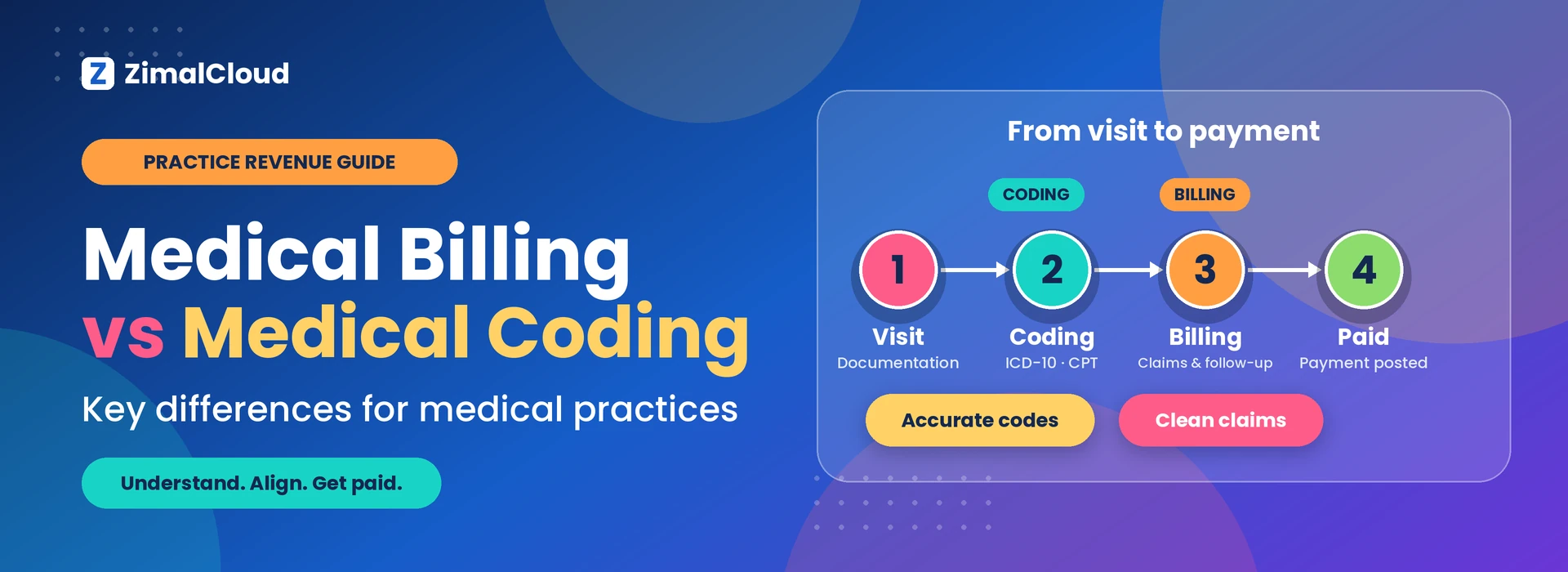
Table of contents
- Medical Billing vs Medical Coding: The Quick Answer
- What Is Medical Coding?
- What Is Medical Billing?
- Medical Billing vs Medical Coding: Side-by-Side Comparison
- How Medical Coding and Billing Work Together
- What Happens When Coding or Billing Goes Wrong?
- Who Should Handle Billing and Coding in Your Practice?
- How Software Connects Documentation, Coding and Billing
Ask three practice managers what separates medical billing from medical coding and you may get three different answers. Both functions sit inside the revenue cycle, both involve codes and claims, and in many small practices one person does a bit of each. But they are not the same job, and treating them as interchangeable is one of the quieter ways practices lose money.
This guide explains medical billing vs medical coding in plain language: what each one does, how they differ, how they work together from the patient visit to final payment, and what to consider when deciding who handles them in your practice.
Medical Billing vs Medical Coding: The Quick Answer
Medical coding translates what happened during a patient encounter into standardized codes. Medical billing uses those codes to create and submit claims, then follows up until the practice is paid.
- Coding answers: What was done, and why?
- Billing answers: Who owes what, and have we been paid?
Coding is mostly clinical and documentation-driven. Billing is mostly financial and payer-driven. Each depends on the other: accurate billing is impossible on top of inaccurate codes, and accurate codes still produce no revenue if claims are never submitted or followed up.
What Is Medical Coding?
Medical coding is the process of converting documented patient care into standardized alphanumeric codes. After a visit or procedure, a coder reviews the clinical documentation, including the provider’s notes, orders, test results and procedure reports, and assigns codes from established code sets:
- ICD-10-CM codes describe diagnoses and conditions.
- CPT codes describe procedures and services performed.
- HCPCS Level II codes cover certain supplies, drugs and services that CPT does not capture.
Together, these codes tell the payer what the patient’s condition was and what the practice did about it. Coders also apply modifiers where needed and confirm that the codes are supported by the documentation.
Because coding depends on what is written in the chart, it is closely tied to clinical documentation. If a note lacks detail, such as the laterality of a condition, the extent of a procedure or the reason for a service, the coder cannot assign the most accurate code. That is why good coding often starts with providers documenting clearly at the point of care.
Strong coders combine knowledge of anatomy and medical terminology, familiarity with coding guidelines and payer policies, and close attention to detail. In many practices, coding is done by certified coders, trained billers or the providers themselves.
What Is Medical Billing?
Medical billing is the administrative and financial process of turning coded services into payment. Once the encounter is coded, the biller prepares and submits the claim to the patient’s insurance payer, usually through a clearinghouse, and manages everything that happens afterward.
Common billing tasks include:
- Verifying patient insurance eligibility and collecting demographic and coverage details
- Entering charges and attaching the correct codes to the claim
- Checking claims for errors before submission
- Submitting claims electronically and tracking their status
- Posting payments and adjustments from payers and patients
- Working denials and appeals, and resubmitting corrected claims
- Sending patient statements and managing balances
Billing is deadline-driven and payer-driven. Each payer has its own rules, filing limits and requirements, and billers need to know them. Good billers combine organization, persistence, knowledge of payer processes and clear communication, since they often talk with both insurers and patients.
In short, coding decides what goes on the claim. Billing decides how it gets there and what happens next.
Medical Billing vs Medical Coding: Side-by-Side Comparison
The table below summarizes the main differences between the two functions.
| Medical Coding | Medical Billing | |
|---|---|---|
| Main focus | Translating care into standardized codes | Submitting claims and collecting payment |
| Starts with | Clinical documentation | Coded encounter and patient insurance details |
| Key output | Accurate diagnosis and procedure codes | Clean claims, posted payments and resolved denials |
| Nature of work | Clinical and documentation-driven | Financial and payer-driven |
| Works most with | Providers and clinical staff | Payers, clearinghouses and patients |
| Core knowledge | ICD-10-CM, CPT, HCPCS, coding guidelines | Payer rules, claim forms, eligibility, denial management |
| Typical risk | Undercoding, overcoding, unsupported codes | Rejected claims, missed deadlines, unworked denials |
Both functions aim for the same result, accurate and timely reimbursement, but they approach it from different ends of the process.
How Medical Coding and Billing Work Together
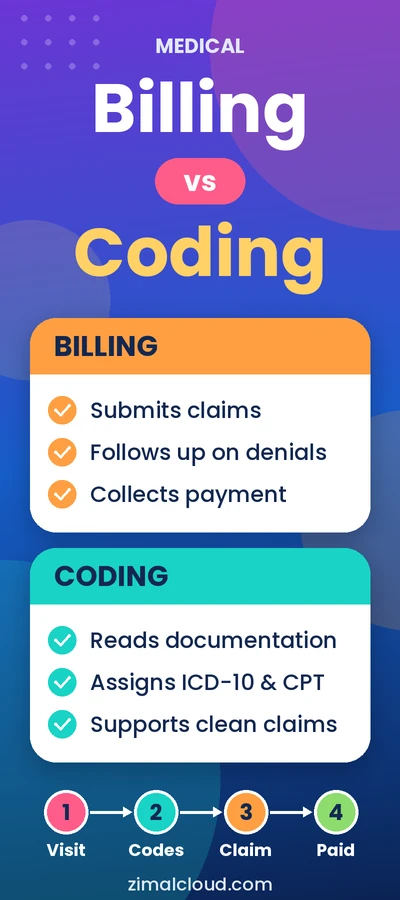
Coding and billing are links in the same chain, usually called the revenue cycle. Here is how a typical outpatient encounter moves through it:
- Scheduling and registration. Front-desk staff collect patient and insurance details and verify eligibility.
- The patient visit. The provider examines the patient and documents the diagnosis, services and any procedures.
- Coding. A coder reviews the documentation and assigns diagnosis and procedure codes.
- Charge capture. The coded services become charges tied to the patient, provider and date of service.
- Claim creation and submission. The biller builds the claim, checks it for errors and sends it to the payer, often through a clearinghouse.
- Payer review. The payer approves, reduces or denies the claim, or asks for more information.
- Payment posting and follow-up. The biller posts payments, bills the patient for their share and works any denials.
Imagine a patient who comes in for a follow-up on a chronic condition and has a lab test done in the office. The provider documents the condition, the exam and the test. The coder assigns codes for the diagnoses and services. The biller attaches those codes to a claim for the patient’s insurance. If the payer denies the lab charge because it does not match a diagnosis, the biller flags the denial and the coder checks whether the documentation and codes support a correction. The two roles pass the claim back and forth until it is resolved.
What Happens When Coding or Billing Goes Wrong?
Errors in either function show up as delayed or lost revenue, but the causes differ.
Coding problems include missing specificity, codes that the documentation does not support, mismatches between diagnoses and procedures, and incorrect modifiers. These can lead to denials, underpayment or, in more serious cases, audit and compliance risk.
Billing problems include incorrect patient or insurance information, claims filed late, claims sent without a final check, and denials that nobody works. These lead to delayed payments and write-offs.
Many issues start earlier than either team: incomplete documentation, outdated insurance details or poor communication between clinical and administrative staff. The costs are real, including staff time spent on rework, longer payment cycles and unnecessary friction for patients. Tracking denial reasons by category helps you see whether the root cause is documentation, coding or billing. Reducing them takes clear documentation standards, regular denial reviews and a process where coders and billers share feedback.
Who Should Handle Billing and Coding in Your Practice?
There is no single right model. Most practices use one of three setups:
- In-house for both. You keep full control and direct communication with providers, but you carry the cost of hiring, training, coverage and keeping up with code and payer changes.
- In-house coding, outsourced billing (or the reverse). This can balance control and capacity, but it requires clear handoffs between teams.
- Fully outsourced revenue cycle management. This reduces your administrative load, but you need transparency into reporting, turnaround times and denial rates.
Consider your claim volume, the complexity of your specialty, your team’s capacity, your compliance needs and how much visibility you want into the numbers. Procedure-heavy specialties often have more complex coding rules, so documentation quality and coder expertise matter even more.
Whichever model you choose, make sure someone owns the connection between the two functions. Many revenue problems happen at the handoff, not inside either role.
How Software Connects Documentation, Coding and Billing
The smoother the handoff between documentation, coding and billing, the fewer errors slip through. When your EHR and billing system are separate, staff retype information, charges get missed and problems surface only after a claim is denied.
A connected platform can reduce that friction. EHR software with built-in documentation captures what happened during the visit, and practice management software can carry charges, insurance details and claim status through to payment, with checks along the way. For a deeper look at how these pieces fit together, read our guide to EHR, practice management and billing integration.
Software does not replace coding expertise or good documentation. It makes those efforts easier to apply consistently.
Let’s have a demo and see what you’re missing
Live RPM workflows built around your devices, alerts, and review documentation.
- Devices → Readings → Minutes → Review & Sign → Billing.
- RPM worklist shows who needs review now.
- Order, assign, and manage devices in one path.
- Treatment minutes toward 99453, 99454, 99457, 99458.
- Admin setup for CPT rules and device catalogs, no custom builds.
- One patient hub with CCM, PCM, and Practice Management.
See features and workflows on Remote Patient Monitoring EHR Software.
This launch offer has ended.
FAQ
Frequently asked questions
Is medical billing the same as medical coding?
No. Coding converts documented care into standardized codes, while billing uses those codes to submit claims and collect payment. They are closely connected and sometimes performed by the same person, but they are different functions.
What comes first, medical coding or medical billing?
Coding comes first. A claim cannot be built until the encounter has been coded, so coding feeds the billing process. Billing-related tasks such as eligibility checks, however, begin earlier at scheduling and registration.
Can one person handle both billing and coding?
Yes, especially in small practices, but it requires training in both areas and clear controls. As volume or complexity grows, separating the roles or adding review steps can improve accuracy and reduce risk.
How do coding errors cause claim denials?
Payers compare the codes on a claim against their policies and against each other. If a code is not supported by the documentation, lacks detail, or does not match the diagnosis or service, the payer may deny or reduce the claim.
Should a small practice outsource billing and coding?
It depends on your volume, budget and capacity. Outsourcing can free up staff time, but confirm reporting, turnaround times, compliance practices and who is accountable for denials before deciding.
What software helps with billing and coding workflows?
Look for an EHR and practice management system that work together, with charge capture, claim checks, clearinghouse connectivity, denial tracking and reporting. Integration matters more than any single feature.