What Is Medical Billing? A Complete Guide for Healthcare Providers
Medical billing is the process of turning healthcare services into claims and managing them through payment. This guide explains medical billing, coding, claims, denials, payment posting, accounts receivable, and automation. Learn how healthcare providers can use connected technology to reduce administrative work, improve billing accuracy, track claims, and build a more efficient revenue cycle.
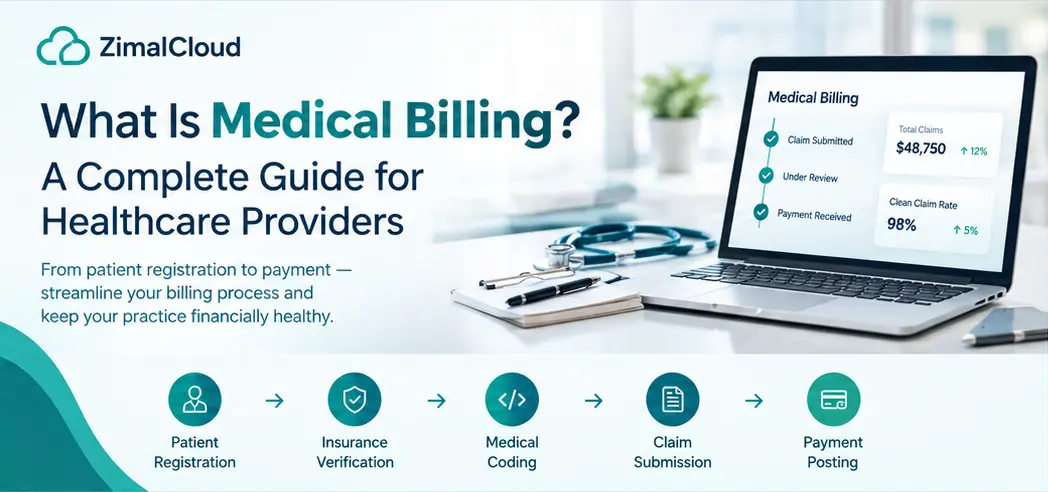
Table of contents
- What Is Medical Billing? A Complete Guide for Healthcare Providers
- What Is Medical Billing?
- Why Is Medical Billing Important for Healthcare Providers?
- How Does the Medical Billing Process Work?
- 1. Patient Registration
- 2. Insurance Verification
- 3. Documentation of Services
- 4. Medical Coding
- 5. Charge Capture
- 6. Claim Creation
- 7. Claim Submission
- 8. Payer Adjudication
- 9. Payment Posting
- 10. Denial Management
- 11. Patient Billing
- Medical Billing vs. Medical Coding
- Medical Coding
- Medical Billing
- What Is Revenue Cycle Management?
- Common Medical Billing Challenges
- 1. Claim Denials
- 2. Incorrect Patient Information
- 3. Insurance Eligibility Problems
- 4. Coding Errors
- 5. Missing Documentation
- 6. Delayed Claim Submission
- 7. Manual Data Entry
- 8. Poor A/R Visibility
- How Technology Can Improve Medical Billing
- Automated Data Capture
- Coding Assistance
- Claim Validation
- Claim Tracking
- Denial Worklists
- Payment Posting
- Reporting and Analytics
- What Is Automated Medical Billing?
- Benefits of Automated Medical Billing
- Faster Workflow
- Fewer Manual Errors
- Better Claim Visibility
- Improved Revenue Monitoring
- Reduced Administrative Burden
- Better Scalability
- Medical Billing for Independent Practices
- How to Improve Your Medical Billing Workflow
- 1. Keep Patient Information Accurate
- 2. Verify Eligibility
- 3. Strengthen Documentation
- 4. Review Coding
- 5. Submit Claims Promptly
- 6. Monitor Denials
- 7. Manage A/R Regularly
- 8. Reduce Duplicate Data Entry
- 9. Use Reporting
- Key Medical Billing Metrics to Monitor
- The Future of Medical Billing
- Conclusion
What Is Medical Billing? A Complete Guide for Healthcare Providers
Medical billing is the process of converting healthcare services into claims, submitting those claims to insurance companies or government payers, tracking claim status, and collecting payment for services provided. For healthcare providers, an efficient medical billing process is essential for maintaining cash flow, reducing claim denials, and getting paid accurately and on time.
This complete guide explains what medical billing is, how the process works, common challenges, and how technology can help healthcare practices improve their billing workflow.
What Is Medical Billing?
Medical billing is the administrative process used by healthcare providers to obtain payment for medical services.
When a doctor, clinic, hospital, or other healthcare provider treats a patient, the services performed must be documented and translated into standardized medical codes. These codes are then used to create an insurance claim.
The claim is submitted to the appropriate payer, which reviews the information and determines how much it will pay according to the patient's coverage and applicable rules.
The medical billing process generally includes:
- Patient registration
- Insurance verification
- Charge capture
- Medical coding
- Claim creation
- Claim submission
- Claim tracking
- Payment posting
- Denial management
- Patient billing
- Accounts receivable follow-up
In simple terms:
Patient Visit → Documentation → Coding → Claim → Payer Review → Payment → Payment Posting
Why Is Medical Billing Important for Healthcare Providers?
Medical billing directly affects a healthcare organization's financial performance.
Even when a practice provides excellent patient care, billing problems can result in delayed payments, rejected claims, and lost revenue.
An effective billing workflow helps providers:
- Receive payments faster
- Reduce claim errors
- Minimize rejected and denied claims
- Improve revenue cycle management
- Track outstanding balances
- Reduce administrative workload
- Improve financial visibility
- Maintain accurate billing records
For independent practices, efficient billing can be especially important because administrative resources are often limited.
How Does the Medical Billing Process Work?
Medical billing involves multiple steps. Each step contributes to the successful reimbursement of a healthcare service.

1. Patient Registration
The process usually begins when a patient schedules an appointment or arrives at a healthcare facility.
The practice collects information such as:
- Patient name
- Date of birth
- Contact information
- Insurance information
- Subscriber information
- Relevant demographic details
Accurate registration helps prevent billing problems later.
2. Insurance Verification
Before or around the time of the appointment, the practice may verify the patient's insurance coverage.
Verification can help determine:
- Whether the insurance is active
- Patient eligibility
- Copay requirements
- Deductible information
- Coinsurance
- Coverage limitations
- Referral or authorization requirements
Incorrect insurance information is a common source of claim problems.
3. Documentation of Services
During the encounter, the healthcare provider documents the services provided.
Clinical documentation may include:
- Patient history
- Examination findings
- Diagnosis
- Treatment
- Procedures
- Medical decision-making
- Follow-up instructions
Accurate documentation is important because billing and coding should reflect the services actually provided.
4. Medical Coding
Medical coders translate clinical documentation into standardized codes.
Depending on the service, coding may involve systems such as:
- ICD-10-CM for diagnoses
- CPT for many professional medical services and procedures
- HCPCS for certain healthcare services, procedures, products, and supplies
For example, a provider's documentation may support a particular diagnosis and procedure code. Those codes become important components of the claim.
Coding should be based on appropriate documentation and applicable coding rules.
5. Charge Capture
Charge capture ensures that billable services performed during a patient encounter are identified and included in the billing workflow.
Missing charges can result in lost revenue.
An automated system can help connect clinical documentation and billing information so that fewer billable services are overlooked.
6. Claim Creation
The billing system uses patient, provider, insurance, diagnosis, procedure, and charge information to create a claim.
Claims must contain accurate information and follow applicable payer and electronic submission requirements.
A claim may contain information such as:
- Patient details
- Provider information
- Diagnosis codes
- Procedure codes
- Modifiers
- Dates of service
- Charges
- Insurance information
7. Claim Submission
Once the claim is prepared, it is submitted to the appropriate payer, often electronically through a clearinghouse or another approved electronic transaction pathway.
Electronic claim submission can make the process faster and easier to track than paper-based workflows.
8. Payer Adjudication
After receiving a claim, the payer reviews it according to the patient's coverage and applicable payment rules.
The payer may:
- Approve the claim
- Pay the claim
- Partially pay the claim
- Reject the claim
- Deny the claim
- Request additional information
The result affects how much the provider ultimately receives.
9. Payment Posting
When payment is received, the practice records the payment against the appropriate patient account and claim.
Payment posting may involve:
- Insurance payments
- Patient payments
- Adjustments
- Contractual amounts
- Remaining balances
Accurate payment posting gives the practice a clearer view of its accounts receivable.
10. Denial Management
Not every claim is paid successfully on the first submission.
A claim may be denied because of:
- Incorrect patient information
- Insurance eligibility problems
- Coding errors
- Missing documentation
- Authorization issues
- Duplicate claims
- Incorrect modifiers
- Timely filing problems
- Coverage limitations
Effective denial management involves identifying the reason for the denial, correcting the underlying issue when appropriate, and resubmitting or appealing the claim according to applicable payer requirements.
11. Patient Billing
After insurance processing, a remaining balance may be assigned to the patient when applicable.
The practice may send a statement explaining:
- Amount billed
- Insurance payment
- Adjustments
- Remaining patient responsibility
- Payment options
Clear patient statements can make the billing process easier for patients to understand.
Medical Billing vs. Medical Coding
Medical billing and medical coding are closely connected, but they are not the same thing.
Medical Coding
Medical coding focuses on translating clinical documentation into standardized codes.
Main focus:
Clinical information → Medical codes
Medical Billing
Medical billing focuses on using billing and coding information to submit claims, process payments, manage denials, and collect outstanding balances.
Main focus:
Medical services → Claim → Payment
In many healthcare organizations, coding and billing work together as part of the broader revenue cycle management (RCM) process.
What Is Revenue Cycle Management?
Revenue cycle management is the broader financial process that manages the movement from patient registration and service delivery through claim submission and final payment.
A simplified revenue cycle looks like:
Scheduling → Registration → Eligibility → Visit → Documentation → Coding → Billing → Claim → Payment → A/R Follow-Up
Medical billing is therefore an important part of revenue cycle management, but RCM can include a much wider range of financial and administrative activities.
Common Medical Billing Challenges
Healthcare providers can encounter several billing problems.
1. Claim Denials
Denied claims require additional staff time and can delay reimbursement.
2. Incorrect Patient Information
Small registration errors can prevent a claim from processing correctly.
3. Insurance Eligibility Problems
A patient's coverage may have changed or may not cover a particular service.
4. Coding Errors
Incorrect diagnosis or procedure coding can lead to claim rejections, denials, or payment problems.
5. Missing Documentation
Insufficient documentation may make it difficult to support a billed service.
6. Delayed Claim Submission
Claims submitted too late may create reimbursement problems depending on payer requirements.
7. Manual Data Entry
Repeatedly entering information across multiple systems increases administrative work and the possibility of errors.
8. Poor A/R Visibility
If staff cannot easily identify unpaid or aging claims, outstanding balances can continue to grow.
How Technology Can Improve Medical Billing
Modern healthcare technology can reduce repetitive administrative work and improve visibility across the billing workflow.
A connected healthcare platform can help practices manage information from scheduling and documentation through billing and payment workflows.
Useful capabilities may include:
Automated Data Capture
Patient and encounter information can flow into downstream workflows, reducing unnecessary manual entry.
Coding Assistance
Technology can help identify potential diagnosis and procedure codes based on documented information. Providers and qualified coding professionals should remain responsible for appropriate review and final coding decisions.
Claim Validation
Automated checks can identify certain missing or inconsistent information before a claim is submitted.
Claim Tracking
A centralized system can help staff monitor submitted, rejected, denied, and paid claims.
Denial Worklists
Billing teams can prioritize claims that require attention instead of manually searching through multiple systems.
Payment Posting
Electronic payment information can reduce repetitive manual posting work when properly integrated.
Reporting and Analytics
Dashboards can help practices monitor:
- Claims
- Payments
- Denials
- Aging accounts receivable
- Outstanding balances
- Revenue trends
- Billing performance
What Is Automated Medical Billing?
Automated medical billing uses software to reduce manual work throughout the billing process.
Depending on the platform, automation may support activities such as:
Documentation → Coding Support → Claim Preparation → Claim Validation → Submission → Status Tracking → Payment Posting → Reporting
Automation does not necessarily mean removing people from the process. Instead, it can help healthcare teams spend less time on repetitive administrative tasks and more time handling exceptions and higher-value work.
Benefits of Automated Medical Billing
For healthcare practices, a well-designed automated billing workflow can provide several benefits.
Faster Workflow
Automation can reduce repetitive data entry and administrative steps.
Fewer Manual Errors
Reducing duplicate data entry can help lower the risk of certain avoidable mistakes.
Better Claim Visibility
Staff can more easily see where claims are in the billing cycle.
Improved Revenue Monitoring
Financial dashboards can provide better visibility into payments, denials, and outstanding balances.
Reduced Administrative Burden
Staff can spend less time performing repetitive tasks.
Better Scalability
A technology-supported workflow can make it easier for growing practices to manage increasing patient volumes.
Medical Billing for Independent Practices
Independent medical practices often face unique operational challenges.
A practice may have to manage:
- Patient scheduling
- Registration
- Documentation
- Insurance verification
- Coding
- Billing
- Claims
- Denials
- Payments
- Accounts receivable
- Patient communication
When these activities are spread across disconnected systems, staff may have to repeatedly enter or transfer information.
A connected platform can help create a more unified workflow where relevant patient and encounter information moves between clinical and administrative processes.
How to Improve Your Medical Billing Workflow
Healthcare providers can take several practical steps to improve billing performance.
1. Keep Patient Information Accurate
Verify demographic and insurance information regularly.
2. Verify Eligibility
Check coverage before services whenever appropriate.
3. Strengthen Documentation
Make sure documentation accurately supports the services provided.
4. Review Coding
Use qualified professionals and appropriate coding processes to support accurate claims.
5. Submit Claims Promptly
Avoid unnecessary delays between service delivery and claim submission.
6. Monitor Denials
Track denial reasons to identify recurring problems.
7. Manage A/R Regularly
Review aging accounts receivable and prioritize appropriate follow-up.
8. Reduce Duplicate Data Entry
Look for opportunities to connect systems and automate repetitive workflows.
9. Use Reporting
Monitor billing metrics to understand where revenue may be delayed or lost.
Key Medical Billing Metrics to Monitor
Healthcare practices can monitor several metrics to evaluate their billing performance.
Common examples include:
- Clean Claim Rate: Percentage of claims submitted without errors that require correction.
- Denial Rate: Percentage of claims denied by payers.
- Days in A/R: Average number of days revenue remains outstanding.
- Collection Rate: Amount collected compared with the amount expected or billed, depending on the metric definition.
- A/R Aging: Distribution of outstanding balances by age.
- Claim Submission Time: Time between the date of service and claim submission.
The exact calculation and benchmark for each metric can vary by organization, payer mix, specialty, and reporting methodology.
The Future of Medical Billing
Medical billing is increasingly moving toward connected, automated, and data-driven workflows.
Artificial intelligence, workflow automation, electronic transactions, analytics, and integrated healthcare platforms can help reduce repetitive administrative work and improve visibility.
The goal is not simply to automate billing. The larger opportunity is to connect the entire practice workflow.
For example:
Patient → Appointment → Encounter → Documentation → Coding → Claim → Payment → Analytics
When these processes operate within a connected environment, healthcare organizations can reduce unnecessary handoffs and gain a clearer view of their operational and financial performance.
Conclusion
Medical billing is a critical part of healthcare practice operations. From patient registration and insurance verification to coding, claim submission, payment posting, and denial management, every stage can affect how quickly and accurately a practice gets paid.
For healthcare providers, the goal should not be simply to submit more claims. It should be to build an accurate, connected, transparent, and efficient billing workflow.
Technology can play an important role by reducing repetitive administrative work, connecting clinical and financial information, identifying potential errors earlier, and giving practice teams better visibility into claims and revenue.
For modern healthcare practices, better medical billing starts with a better-connected workflow.
FAQ
Frequently asked questions
What is medical billing?
Medical billing is the process of submitting healthcare service information to insurance companies or other payers and managing claims, payments, denials, and patient balances.
What is the difference between medical billing and medical coding?
Medical coding converts clinical documentation into standardized medical codes, while medical billing uses coding and patient information to prepare and submit claims, track payments, manage denials, and handle outstanding balances.
How does the medical billing process work?
The medical billing process typically includes patient registration, insurance verification, documentation, medical coding, charge capture, claim creation, claim submission, payer review, payment posting, denial management, and patient billing.
Why are medical claims denied?
Medical claims may be denied because of incorrect patient information, insurance eligibility issues, coding errors, missing documentation, authorization requirements, duplicate claims, timely filing problems, or payer-specific requirements.
Can medical billing be automated?
Yes. Many parts of medical billing can be supported by automation, including data transfer, claim validation, claim tracking, worklists, payment workflows, and reporting. Human review remains important for exceptions, coding decisions, compliance, and professional judgment.
What is medical billing software?
Medical billing software helps healthcare organizations manage billing workflows, claims, payments, accounts receivable, denials, and financial reporting.
How does medical billing affect practice revenue?
Accurate and timely medical billing can help reduce payment delays, prevent avoidable claim problems, improve accounts receivable management, and support more consistent revenue collection.
What is revenue cycle management in healthcare?
Revenue cycle management is the broader financial process that manages healthcare revenue from patient registration and service delivery through coding, claim submission, payment processing, and accounts receivable follow-up.
What medical billing metrics should healthcare providers monitor?
Healthcare providers commonly monitor metrics such as clean claim rate, denial rate, days in accounts receivable, collection rate, accounts receivable aging, and the time between service delivery and claim submission.
How can healthcare providers improve their medical billing workflow?
Healthcare providers can improve medical billing by keeping patient information accurate, verifying insurance eligibility, maintaining strong documentation, reviewing coding, submitting claims promptly, monitoring denials, managing accounts receivable, reducing duplicate data entry, and using billing analytics.