How GI Practices Can Improve Revenue Cycle Management
GI practices can improve revenue cycle management by strengthening eligibility verification, prior authorization, charge capture, coding, claims tracking, and denial management. A connected RCM workflow can improve visibility, reduce avoidable administrative issues, support faster follow-up, and help practice teams manage billing operations more consistently.
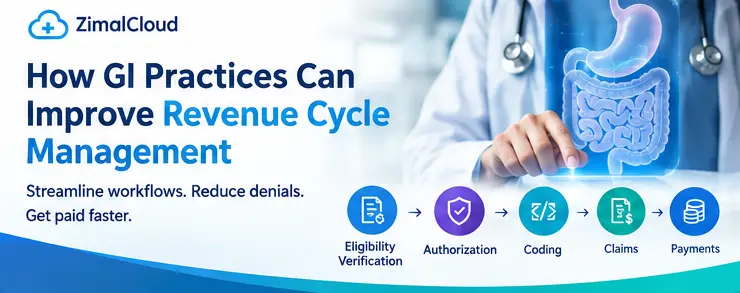
Table of contents
- Introduction
- What Is Revenue Cycle Management for GI Practices?
- Common RCM Challenges for GI Practices
- 1. Insurance Eligibility Problems
- 2. Prior Authorization Delays
- 3. Coding and Documentation Issues
- 4. Claim Denials
- 5. Delayed Accounts Receivable Follow-Up
- 7 Ways GI Practices Can Improve Revenue Cycle Management
- 1. Verify Eligibility Before the Visit
- 2. Create a Structured Prior Authorization Workflow
- 3. Improve Charge Capture
- 4. Strengthen Coding and Documentation Workflows
- 5. Monitor Claims After Submission
- 6. Build a Denial Management Process
- 7. Use Technology to Improve RCM Visibility
- Key RCM Metrics GI Practices Should Monitor
- Clean Claim Rate
- Claim Denial Rate
- Days in Accounts Receivable
- A/R Aging
- Payment Collection Rate
- Authorization Completion Rate
- Charge Lag
- How Automation Can Support GI Revenue Cycle Management
- Connect Clinical and Financial Workflows
- Benefits of a More Efficient GI RCM Workflow
- Final Thoughts
Introduction
Revenue cycle management (RCM) is an essential part of running a successful gastroenterology practice. From patient registration and insurance verification to coding, claims submission, payment posting, and denial management, every step can affect how quickly and accurately a practice gets paid.
GI practices often manage complex procedures, multiple CPT codes, payer requirements, prior authorizations, and detailed documentation. Without an efficient RCM workflow, administrative issues can lead to delayed payments, claim denials, and unnecessary staff workload.
The good news is that GI practices can improve their financial operations by identifying workflow gaps, strengthening billing processes, and using technology to improve visibility across the revenue cycle.
What Is Revenue Cycle Management for GI Practices?
Revenue cycle management is the process of managing the financial journey of a healthcare service—from the time a patient schedules an appointment through final payment collection.
For a GI practice, the revenue cycle may include:
- Patient registration
- Insurance eligibility verification
- Benefits verification
- Prior authorization
- Procedure scheduling
- Documentation and charge capture
- Medical coding
- Claim submission
- Claim tracking
- Payment posting
- Denial management
- Patient billing
- Accounts receivable follow-up
A connected workflow helps practices identify problems earlier instead of discovering them after a claim has already been denied or payment has been delayed.
Common RCM Challenges for GI Practices
Gastroenterology practices can face several revenue cycle challenges because of the complexity of GI services and procedures.
1. Insurance Eligibility Problems
Incorrect or outdated insurance information can result in rejected or denied claims.
Verifying eligibility and benefits before services are provided can help staff identify coverage issues earlier and reduce avoidable billing problems.
2. Prior Authorization Delays
Some GI procedures may require authorization depending on the patient's insurance plan and the service being provided.
Missing or incomplete authorization information can create delays and may contribute to claim issues.
A standardized authorization workflow can help staff track requirements before the procedure takes place.
3. Coding and Documentation Issues
GI procedures can involve detailed coding requirements. Incorrect CPT or diagnosis coding, incomplete documentation, or mismatched information can affect claim processing.
Practices should establish processes that help coding and clinical documentation remain aligned.
4. Claim Denials
Denied claims can consume significant staff time.
Common issues may include:
- Incorrect patient information
- Eligibility problems
- Missing authorization
- Coding errors
- Documentation issues
- Incorrect modifiers
- Payer-specific requirements
- Duplicate claims
Tracking denial reasons can help practices identify recurring problems instead of treating every denial as an isolated event.
5. Delayed Accounts Receivable Follow-Up
Claims that remain unpaid for extended periods can increase accounts receivable.
Without clear ownership and follow-up procedures, outstanding claims may receive attention only after they become significantly overdue.
7 Ways GI Practices Can Improve Revenue Cycle Management
1. Verify Eligibility Before the Visit
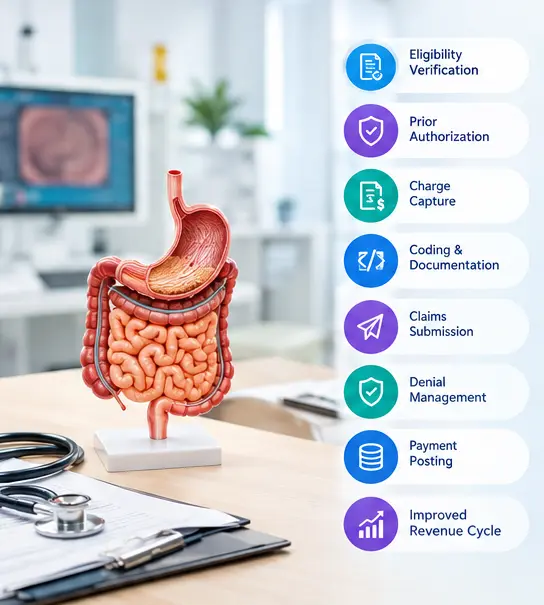
Insurance verification should happen as early as practical in the patient workflow.
Staff can verify:
- Active coverage
- Patient responsibility
- Deductible information
- Copayment or coinsurance requirements
- Procedure-related benefits
- Authorization requirements
Early verification gives the practice an opportunity to address coverage issues before the service is delivered.
2. Create a Structured Prior Authorization Workflow
Prior authorization should not depend entirely on manual reminders or individual staff members.
A structured workflow can help teams track:
Patient → Procedure → Payer → Authorization Requirement → Submission → Approval → Procedure
Practices can use task assignments, status tracking, and automated reminders to make authorization management more consistent.
3. Improve Charge Capture
Accurate charge capture is an important part of the GI revenue cycle.
Practices should establish processes that connect clinical documentation with the services performed. Missing charges can result in lost revenue, while inaccurate charges can create downstream billing issues.
A charge-capture review can help identify:
- Missing procedures
- Incorrect service information
- Documentation discrepancies
- Delayed charge entry
- Unbilled services
4. Strengthen Coding and Documentation Workflows
Coding accuracy depends on appropriate documentation and consistent communication between clinical and billing teams.
GI practices can improve this process by establishing clear procedures for reviewing:
- Procedure documentation
- Diagnosis information
- CPT codes
- Modifiers
- Supporting documentation
- Payer-specific requirements
Technology can also help connect documentation, coding, and billing information so teams have better visibility into the status of each claim.
5. Monitor Claims After Submission
Submitting a claim is not the end of the revenue cycle.
Practices should monitor claims to determine whether they are:
- Submitted
- Accepted
- Rejected
- Pending
- Denied
- Paid
A centralized claims dashboard can make it easier for billing teams to identify claims that need attention.
6. Build a Denial Management Process
Instead of simply correcting individual denied claims, GI practices should analyze denial patterns.
For example, if a practice repeatedly receives denials related to authorization, eligibility, or coding, that pattern may indicate a workflow problem earlier in the revenue cycle.
A useful denial management process should include:
- Identify the denial reason.
- Categorize the denial.
- Correct the claim when appropriate.
- Track the outcome.
- Identify recurring patterns.
- Improve the upstream workflow.
This approach can help practices move from reactive denial handling toward preventive revenue cycle management.
7. Use Technology to Improve RCM Visibility
Technology can help GI practices connect different stages of the revenue cycle.
A modern workflow may bring together:
Patient Information → Eligibility → Authorization → Procedure → Documentation → Coding → Claim → Payment
Instead of relying on disconnected spreadsheets, emails, and manual status checks, teams can use centralized systems to monitor workflow progress.
Technology can also provide reporting that helps practice leaders understand where delays and bottlenecks occur.
Key RCM Metrics GI Practices Should Monitor
Measuring performance helps practice leaders understand whether their revenue cycle processes are working effectively.
Important metrics may include:
Clean Claim Rate
Measures the percentage of claims submitted without requiring correction before processing.
Claim Denial Rate
Shows how frequently submitted claims are denied.
Days in Accounts Receivable
Measures how long it takes, on average, to collect outstanding receivables.
A/R Aging
Shows how much outstanding revenue falls into different aging categories.
Payment Collection Rate
Helps practices monitor how effectively expected payments are being collected.
Authorization Completion Rate
Can help practices evaluate how consistently authorization requirements are completed before procedures.
Charge Lag
Measures the time between the date of service and when charges are entered into the billing system.
Tracking these metrics over time can help identify operational trends and areas requiring improvement.
How Automation Can Support GI Revenue Cycle Management
Manual processes can make it difficult to maintain consistent RCM workflows as a practice grows.
Automation can support areas such as:
- Eligibility verification
- Authorization tracking
- Task management
- Claim status monitoring
- Denial categorization
- Payment tracking
- Staff notifications
- Reporting
- Workflow visibility
The goal of automation should not simply be to replace manual tasks. It should help staff spend less time searching for information and more time addressing issues that require human attention.
Connect Clinical and Financial Workflows
One of the biggest opportunities for GI practices is improving communication between clinical and financial operations.
Clinical documentation, procedure information, coding, billing, and claims should not operate as completely separate processes.
A connected workflow can help teams identify missing information earlier and provide practice leaders with greater visibility into the financial lifecycle of services.
For example:
Clinical Documentation → Charge Capture → Coding → Claim Submission → Claim Status → Payment → Reporting
When these steps are connected, it becomes easier to identify where a problem occurred and determine what needs to happen next.
Benefits of a More Efficient GI RCM Workflow
Improving revenue cycle management can help GI practices:
- Reduce avoidable billing errors
- Improve claims visibility
- Identify denials more quickly
- Reduce administrative friction
- Improve staff productivity
- Strengthen payment follow-up
- Improve financial reporting
- Create more consistent billing processes
- Identify workflow bottlenecks
- Support better practice-level decision-making
RCM improvement is not a one-time project. It is an ongoing process of measuring performance, identifying workflow gaps, and improving processes.
Final Thoughts
Effective revenue cycle management is an important part of operating a modern gastroenterology practice. GI practices must manage multiple steps—from eligibility and authorization to coding, claims, payments, and denial follow-up.
By standardizing workflows, monitoring key RCM metrics, improving documentation and coding processes, and using technology to connect financial operations, practices can create a more organized and visible revenue cycle.
The objective is not simply to bill more efficiently. It is to build a workflow that helps the practice identify issues earlier, reduce unnecessary administrative work, and manage the financial side of patient care more consistently.