PCM vs RPM: When Should Providers Use Each?
PCM vs RPM: Understand the key differences between Principal Care Management and Remote Patient Monitoring. PCM focuses on managing a specific complex or chronic condition, while RPM uses remote devices to collect and review patient health data. Learn when each workflow may be appropriate and how both can work together to support connected, ongoing patient care.
Table of contents
- Introduction
- What Is Principal Care Management (PCM)?
- What Is Remote Patient Monitoring (RPM)?
- PCM vs RPM: What's the Difference?
- When Should Providers Use PCM?
- 1. One condition requires focused attention
- 2. The patient needs ongoing care between visits
- 3. Care coordination is important
- 4. The practice wants condition-specific visibility
- When Should Providers Use RPM?
- 1. Regular measurements are clinically useful
- 2. Patients can use appropriate monitoring devices
- 3. Changes in measurements may require attention
- 4. Providers want visibility between appointments
- PCM and RPM Can Work Together
- PCM vs RPM: A Simple Way to Think About It
- How Technology Can Support PCM and RPM
- PCM vs RPM: Which One Does Your Practice Need?
- Final Takeaway
Introduction
Healthcare providers increasingly use technology-enabled care programs to support patients between office visits. Two programs that can play an important role are Principal Care Management (PCM) and Remote Patient Monitoring (RPM).
Although PCM and RPM can both support ongoing patient care, they serve different purposes. PCM focuses on managing a patient’s specific chronic or complex condition, while RPM focuses on collecting and monitoring patient health data remotely through connected devices.
Understanding the difference between PCM vs RPM can help providers determine which workflow—or combination of workflows—best fits their patients and practice.
What Is Principal Care Management (PCM)?
Principal Care Management (PCM) is designed around the ongoing management of a patient's single complex or chronic condition that requires focused care and coordination.
A PCM workflow can help providers:
- Identify eligible patients
- Develop condition-specific care plans
- Monitor progress
- Coordinate patient outreach
- Document interventions and follow-ups
- Manage medications related to the condition
- Track care activities and time
- Maintain provider oversight
- Support billing documentation and reporting
For example, a patient receiving focused management for a complex respiratory, cardiac, or other chronic condition may benefit from a structured PCM workflow.
Key idea: PCM is primarily condition-management focused.
What Is Remote Patient Monitoring (RPM)?
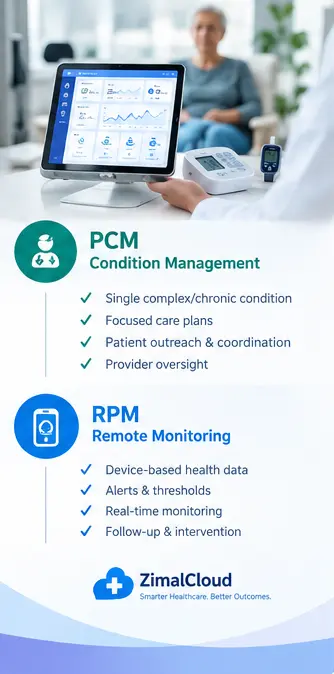
Remote Patient Monitoring (RPM) uses connected medical devices to collect and transmit patient health data outside the traditional clinical setting.
Depending on the patient's condition, RPM may involve monitoring measurements such as:
- Blood pressure
- Blood glucose
- Weight
- Pulse oximetry
- Other clinically relevant measurements
A typical RPM workflow can include:
Patient → Device → Data Transmission → RPM Dashboard → Alert → Care Team Review → Provider Action
RPM helps care teams identify changes in monitored health data and determine when patient follow-up or clinical intervention may be appropriate.
Key idea: RPM is primarily physiological-data monitoring focused.
PCM vs RPM: What's the Difference?
| Feature | PCM | RPM |
|---|---|---|
| Primary focus | One complex/chronic condition | Remote physiological measurements |
| Main purpose | Ongoing condition management | Monitoring patient health data |
| Requires connected device | Not necessarily | Typically yes |
| Care plans | Condition-specific | May support monitoring-related care |
| Patient outreach | Important | Often triggered by monitoring data |
| Data source | Clinical information, assessments, encounters, patient communication | Device-generated health measurements |
| Provider oversight | Yes | Yes |
| Best suited for | Patients needing focused management of a specific condition | Patients who benefit from regular remote measurement |
| Can workflows overlap? | Yes | Yes |
When Should Providers Use PCM?
PCM may be appropriate when a patient needs focused, ongoing management for a single complex chronic condition.
Providers may consider PCM when:
1. One condition requires focused attention
If a particular chronic condition requires regular management, follow-up, education, coordination, and documentation, PCM can provide a structured workflow around that condition.
2. The patient needs ongoing care between visits
PCM can help organize activities that occur outside traditional office encounters, including patient outreach, care-plan updates, medication-related coordination, and follow-up.
3. Care coordination is important
Patients with complex conditions may interact with multiple members of the care team. A structured PCM workflow can help keep activities and documentation organized.
4. The practice wants condition-specific visibility
Rather than managing every aspect of a patient's healthcare through one generalized workflow, PCM can provide a focused view of the condition being actively managed.
When Should Providers Use RPM?
RPM may be appropriate when objective health measurements collected remotely can help inform ongoing patient management.
Providers may consider RPM when:
1. Regular measurements are clinically useful
For patients whose care involves tracking measurements such as blood pressure, glucose, weight, or oxygen saturation, RPM can provide a structured way to collect and review those readings.
2. Patients can use appropriate monitoring devices
RPM generally depends on devices capable of collecting relevant health information and transmitting it for clinical review.
3. Changes in measurements may require attention
A remote monitoring workflow can help care teams identify readings that fall outside established parameters and determine whether follow-up is needed.
4. Providers want visibility between appointments
Instead of relying only on information collected during office visits, RPM can provide additional data points from the patient's day-to-day environment.
PCM and RPM Can Work Together
PCM vs RPM does not always have to be an either-or decision.
In appropriate situations, a patient may benefit from both condition-focused care management and remote monitoring.
For example, consider a patient with a chronic condition who needs:
- A condition-specific care plan
- Regular patient outreach
- Medication coordination
- Remote measurement collection
- Review of incoming readings
- Follow-up when measurements require attention
- Ongoing provider oversight
RPM can provide the data, while PCM can support the broader management and coordination of the specific condition.
The exact services, eligibility requirements, documentation, and billing rules should be evaluated based on the patient's circumstances and applicable Medicare or payer requirements.
PCM vs RPM: A Simple Way to Think About It
A simple distinction is:
PCM asks:
RPM asks:
PCM is centered on care management.
RPM is centered on remote monitoring.
When clinically appropriate, the two can complement each other within a connected healthcare workflow.
How Technology Can Support PCM and RPM
Managing these programs manually can create administrative challenges. A healthcare platform can help providers organize important activities in one place.
A connected PCM or RPM platform may support:
- Patient eligibility workflows
- Patient enrollment
- Care plans
- Device data
- Monitoring dashboards
- Alerts and thresholds
- Patient outreach
- Care-team coordination
- Provider review
- Time tracking
- Documentation
- Billing support
- Reports and analytics
For practices managing multiple care programs, centralized visibility can make it easier to understand what has happened, what requires attention, and which tasks are still outstanding.
PCM vs RPM: Which One Does Your Practice Need?
There is no universal answer because the appropriate program depends on the patient's clinical needs, condition, monitoring requirements, eligibility, payer rules, and practice workflow.
Consider PCM when the primary need is focused management of a specific complex or chronic condition.
Consider RPM when the primary need is ongoing collection and review of relevant health measurements from remote devices.
Consider whether both workflows may be appropriate when the patient needs condition-focused management plus clinically relevant remote monitoring.
Providers should verify current program requirements and payer-specific rules before enrollment, documentation, or billing.
Final Takeaway
The difference between PCM vs RPM becomes clearer when you look at their primary purpose.
PCM focuses on managing a specific chronic or complex condition. RPM focuses on remotely collecting and reviewing patient health measurements.
For healthcare organizations, understanding these differences can help create more organized workflows, improve visibility into ongoing care activities, and support appropriate patient management.
With a connected healthcare platform, PCM and RPM workflows can be managed through structured dashboards, care plans, monitoring tools, documentation, and reporting—helping care teams stay organized while supporting patients beyond the traditional office visit.