How Much Revenue Can a Medical Practice Generate With CCM?
CCM can create a recurring revenue opportunity for eligible medical practices while supporting better chronic care. Revenue depends on patient eligibility, enrollment, qualifying services, reimbursement, documentation, and billing accuracy. With efficient workflows and technology, practices can scale CCM while controlling administrative costs and maintaining quality care.
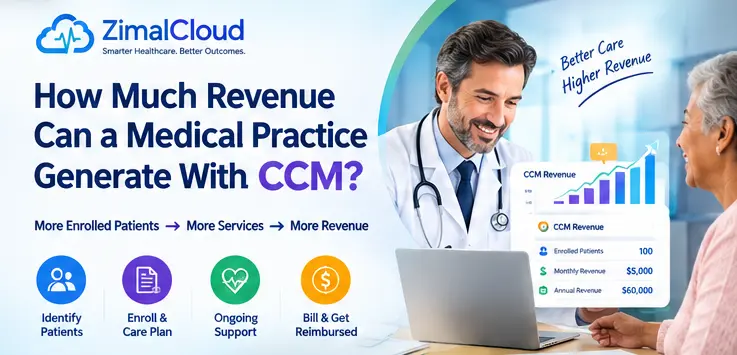
Table of contents
- How Much Revenue Can a Medical Practice Generate With CCM?
- What Is Chronic Care Management?
- How Does CCM Generate Revenue?
- CCM Revenue Examples
- What Determines CCM Revenue?
- 1. Number of Eligible Patients
- 2. Patient Enrollment
- 3. Services and Time Requirements
- 4. Documentation
- 5. Billing Accuracy
- Example: A Practice With 100 CCM Patients
- Revenue Is Not the Same as Profit
- How Technology Can Improve CCM Revenue Potential
- How to Increase CCM Revenue Without Sacrificing Care Quality
- Identify the Right Patients
- Build a Consistent Outreach Process
- Track Time and Activities
- Keep Care Plans Updated
- Reduce Administrative Work
- Monitor Claims and Denials
- CCM Revenue: A Long-Term Opportunity
- Final Thoughts
How Much Revenue Can a Medical Practice Generate With CCM?
Chronic Care Management (CCM) can create an additional revenue opportunity for eligible medical practices while helping providers deliver consistent, proactive care to patients with multiple chronic conditions.
But how much revenue can a practice actually generate with CCM?
The answer depends on factors such as the number of eligible patients, enrollment rate, monthly CCM services provided, reimbursement rates, documentation, and billing accuracy. With an organized CCM workflow, practices can build a predictable recurring revenue stream while improving patient engagement and care coordination.
What Is Chronic Care Management?
Chronic Care Management is a Medicare-covered service designed to support patients who have two or more chronic conditions expected to last at least 12 months or until the end of life.
CCM typically includes:
- Personalized care planning
- Medication management
- Care coordination
- Patient communication and follow-up
- Monitoring of chronic conditions
- Coordination with specialists
- Medication reconciliation
- Preventive care support
- Electronic care plan maintenance
Instead of waiting for patients to experience complications, CCM enables practices to maintain ongoing communication and coordination between visits.
How Does CCM Generate Revenue?
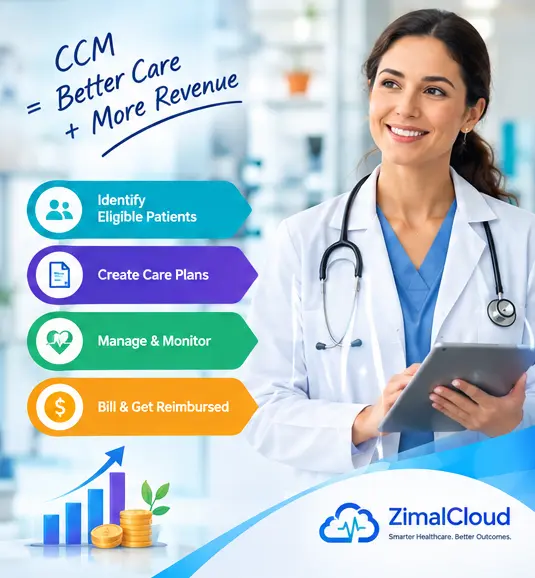
CCM can generate recurring monthly reimbursement when eligible patients receive qualifying services and the practice meets applicable billing and documentation requirements.
A simple revenue calculation is:
Monthly CCM Revenue = Number of Billable CCM Patients × Average Monthly Reimbursement per Patient
For example, if a practice has 100 eligible and enrolled patients and generates an average of $50 per patient per month, the potential monthly revenue would be:
100 × $50 = $5,000 per month
That could represent approximately:
$60,000 per year
These numbers are illustrative. Actual reimbursement depends on the services billed, payer requirements, patient eligibility, geographic and contractual factors, and the practice's ability to meet documentation and billing requirements.
CCM Revenue Examples
Consider several hypothetical practice scenarios:
| Enrolled CCM Patients | Example Average Revenue/Patient | Potential Monthly Revenue | Potential Annual Revenue |
|---|---|---|---|
| 25 | $50 | $1,250 | $15,000 |
| 50 | $50 | $2,500 | $30,000 |
| 100 | $50 | $5,000 | $60,000 |
| 250 | $50 | $12,500 | $150,000 |
| 500 | $50 | $25,000 | $300,000 |
Important: These are example calculations, not guaranteed Medicare reimbursement amounts. Practices should verify current CMS rules, applicable CPT codes, payer policies, patient eligibility, and documentation requirements before projecting revenue.
What Determines CCM Revenue?
Several factors influence how much revenue a medical practice can generate through CCM.
1. Number of Eligible Patients
The size of the practice's eligible patient population is one of the biggest factors.
A practice treating a large population of patients with conditions such as diabetes, hypertension, COPD, heart disease, or other chronic illnesses may have a larger pool of potential CCM patients.
However, not every patient with chronic conditions automatically qualifies for CCM. Eligibility requirements must be reviewed before enrollment.
2. Patient Enrollment
Having eligible patients is only the first step.
Practices need an effective process for:
- Identifying eligible patients
- Educating patients about CCM
- Obtaining required consent
- Creating care plans
- Delivering qualifying services
- Documenting activities
- Submitting appropriate claims
Better patient engagement can help practices establish a sustainable CCM program.
3. Services and Time Requirements
CCM reimbursement is connected to specific covered services and applicable billing requirements.
Depending on the patient's needs and the services provided, different CCM billing codes may apply.
Practices should carefully monitor service requirements and documentation rather than treating CCM as simply another monthly charge.
4. Documentation
Documentation is essential.
A CCM program should maintain appropriate records of activities such as:
- Patient communication
- Care coordination
- Medication management
- Care-plan updates
- Clinical interventions
- Time spent on qualifying services
- Provider oversight
Incomplete documentation can create billing problems and increase compliance risk.
5. Billing Accuracy
Even when a practice provides appropriate CCM services, billing errors can reduce revenue.
Common issues include:
- Incorrect patient eligibility
- Missing documentation
- Incorrect coding
- Incomplete claims
- Failure to meet payer requirements
- Duplicate billing
- Poor tracking of service time
A structured billing workflow can help reduce avoidable errors.
Example: A Practice With 100 CCM Patients
Imagine a primary care practice identifies 200 potentially eligible patients.
After patient outreach and enrollment, 100 patients participate in CCM.
If the practice averages $50 in reimbursable CCM revenue per enrolled patient each month:
100 × $50 = $5,000 monthly
Annualized:
$5,000 × 12 = $60,000
This does not mean the practice will automatically receive $60,000. Staffing costs, technology expenses, patient participation, payer rules, claim denials, and other operational factors affect actual net revenue.
The example simply demonstrates how recurring CCM reimbursement can scale with an eligible patient population.
Revenue Is Not the Same as Profit
One of the most important considerations for practice owners is the difference between revenue and profit.
CCM revenue may need to cover:
- Clinical staff time
- Care coordinators
- Provider oversight
- CCM software
- Patient outreach
- Training
- Billing operations
- Administrative expenses
- Compliance processes
For example, a practice generating $10,000 in monthly CCM revenue should not assume that the entire amount becomes profit.
The better question is:
How much net revenue can CCM generate after the cost of delivering the service?
How Technology Can Improve CCM Revenue Potential
Managing CCM manually can become difficult as enrollment increases.
A healthcare technology platform can help practices organize workflows such as:
Patient Identification → Eligibility → Enrollment → Care Plan → Outreach → Documentation → Time Tracking → Provider Review → Billing
A centralized CCM workflow can help staff reduce administrative work and maintain better visibility into patient activities.
For example, a platform such as ZimalCloud can bring CCM workflows into a broader healthcare platform alongside EHR and practice-management capabilities.
The goal is not simply to increase billing. The goal is to make it easier for practices to consistently deliver, document, monitor, and bill qualifying CCM services.
How to Increase CCM Revenue Without Sacrificing Care Quality
Practices should focus on operational efficiency rather than simply increasing enrollment.
Identify the Right Patients
Use clinical and eligibility criteria to identify patients who may benefit from CCM.
Build a Consistent Outreach Process
Create standardized workflows for calls, follow-ups, care-plan updates, and patient communication.
Track Time and Activities
Maintain accurate records of qualifying services and time according to applicable requirements.
Keep Care Plans Updated
A meaningful care plan should reflect the patient's current needs, goals, medications, and interventions.
Reduce Administrative Work
Automation can help staff manage reminders, tasks, documentation, and workflow tracking.
Monitor Claims and Denials
Regularly review billing performance to identify recurring claim problems.
CCM Revenue: A Long-Term Opportunity
CCM should not be viewed solely as a billing strategy.
A well-designed CCM program can create value in three areas:
Clinical Value: More consistent communication and coordination.
Operational Value: Better organization of chronic care workflows.
Financial Value: Potential recurring reimbursement for qualifying services.
When these three areas work together, CCM can become an important component of a medical practice's care-delivery and financial strategy.
Final Thoughts
So, how much revenue can a medical practice generate with CCM?
There is no single number that applies to every practice. Revenue depends on patient eligibility, enrollment, qualifying services, reimbursement, documentation, billing accuracy, operational costs, and payer requirements.
A practice with 100 participating patients could potentially generate thousands of dollars in monthly CCM revenue under certain reimbursement assumptions, while larger programs can generate substantially more.
The key is to build a compliant, efficient, patient-centered CCM workflow that makes it easier to identify eligible patients, deliver services, document care, track activities, and manage billing.
CCM can become more than an additional billing opportunity—it can become a structured way to deliver better ongoing care while creating a sustainable revenue stream for the practice.