7 Signs Your Practice Has an Operational Bottleneck
Is your medical practice losing valuable time to repeated data entry, missed follow-ups, delayed documentation, and disconnected systems? Discover 7 signs your practice has an operational bottleneck and learn practical ways to improve task visibility, streamline healthcare workflows, coordinate care programs, and support more efficient practice management with ZimalCloud.
Table of contents
- 7 Signs Your Practice Has an Operational Bottleneck
- What Is an Operational Bottleneck in a Medical Practice?
- 1. Your Staff Repeatedly Enter the Same Information
- 2. Patient Follow-Ups Depend on Staff Memory
- 3. Reports Require Multiple Spreadsheets
- 4. Clinical Documentation Is Frequently Delayed
- 5. Your Team Cannot Easily See Pending Work
- 6. Staff Spend Too Much Time Chasing Status Updates
- 7. Your Practice Struggles to Coordinate Multiple Care Programs
- How to Identify and Fix Operational Bottlenecks
- Step 1: Map Your Existing Workflows
- Step 2: Identify Repeated Tasks and Delays
- Step 3: Ask Staff Where Work Gets Stuck
- Step 4: Prioritize High-Impact Problems
- Step 5: Improve the Process and Measure Results
- How ZimalCloud Can Support More Connected Healthcare Workflows
- Conclusion
7 Signs Your Practice Has an Operational Bottleneck
Running a medical practice involves much more than treating patients. From appointment scheduling and patient documentation to insurance verification, billing, and follow-ups, every task must move smoothly for a practice to operate efficiently.
However, when processes become disconnected, staff may spend more time managing administrative work than supporting patient care. Repeated data entry, delayed documentation, missed follow-ups, and limited visibility into pending tasks can all indicate an operational bottleneck.
Healthcare operational bottlenecks are problems in workflows, systems, or communication that slow down routine activities and prevent teams from completing work efficiently.
Identifying these problems early can help medical practices improve coordination, reduce unnecessary administrative work, and create a more organized working environment.
In this guide, we explore seven common signs of operational bottlenecks in medical practices and practical ways to address them.
What Is an Operational Bottleneck in a Medical Practice?
An operational bottleneck occurs when a task, process, or system slows down the work that follows it. For example, if a provider completes a patient visit but the documentation remains unfinished, billing staff may need to wait before preparing a claim.
Similarly, when appointment information, clinical records, and billing details are stored in separate systems, staff may need to switch between applications to complete routine tasks.
These challenges can affect productivity, communication, revenue cycle operations, and the overall patient experience.
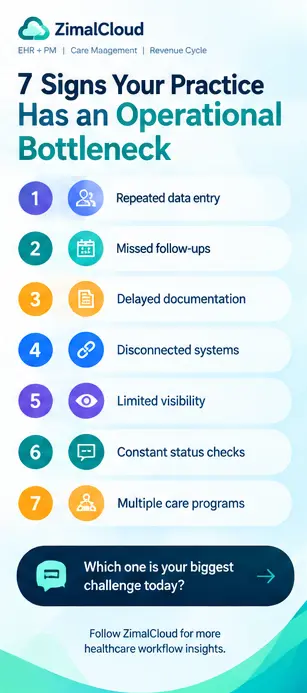
1. Your Staff Repeatedly Enter the Same Information
Duplicate data entry is one of the most common signs of inefficient healthcare workflows.
Staff may enter patient demographics into scheduling software, update clinical information in an EHR, and re-enter details into billing or other administrative systems. When these systems do not exchange information effectively, the same task may be repeated several times.
This can consume valuable staff time and increase the possibility of inconsistent or incorrect information.
How to improve it:
- Review where patient and administrative information is entered more than once.
- Identify opportunities to connect existing systems.
- Use standardized data-entry procedures.
- Consider an integrated EHR and practice management platform that supports appropriate information sharing.
Reducing unnecessary duplication can help staff spend more time on meaningful clinical and administrative responsibilities.
2. Patient Follow-Ups Depend on Staff Memory
Follow-ups are essential to coordinated care. Patients may need appointment reminders, test-result communication, care plan reviews, referrals, or ongoing chronic care outreach.
When these tasks depend primarily on sticky notes, spreadsheets, or individual reminders, important work can become difficult to track—especially when staff members are busy or unavailable.
How to improve it:
- Establish a centralized task-tracking process.
- Assign responsibility for each follow-up.
- Set appropriate reminders and due dates.
- Review outstanding tasks regularly.
- Document completed outreach and the next required action.
A structured follow-up workflow gives team members clearer visibility into what needs attention and who is responsible for completing it.
3. Reports Require Multiple Spreadsheets
Spreadsheets can be useful for specific reporting needs. However, when staff must repeatedly export, combine, and reconcile information from different systems, reporting can become unnecessarily complicated.
Practice managers may struggle to get a clear picture of appointment activity, outstanding claims, accounts receivable, care management tasks, or overall operational performance.
Manual reporting also makes it harder to maintain consistent information across departments.
How to improve it:
- Identify the reports your practice uses most frequently.
- Standardize definitions and reporting procedures.
- Reduce unnecessary manual data transfers.
- Use dashboards and reporting tools that bring relevant information together.
- Review key performance indicators on a consistent schedule.
Better reporting visibility helps practice leaders identify delays, understand workload patterns, and make more informed operational decisions.
4. Clinical Documentation Is Frequently Delayed
Clinical documentation supports continuity of care, communication between providers, and appropriate billing processes.
When notes, orders, care plans, or procedure reports remain incomplete, other team members may be unable to proceed with their responsibilities. Delayed documentation can also create additional work when staff must return to older encounters to resolve missing information.
How to improve it:
- Establish clear documentation expectations.
- Use appropriate templates for common encounter types.
- Make outstanding documentation visible to authorized team members.
- Create a consistent review and sign-off process.
- Monitor recurring documentation delays to identify their underlying causes.
Technology can support these efforts, but workflows should also reflect clinical judgment, organizational policies, and applicable documentation requirements.
5. Your Team Cannot Easily See Pending Work
When tasks are spread across emails, spreadsheets, separate applications, and verbal handoffs, it can be difficult to determine what remains unfinished.
For example, a practice manager may not know which claims need review, which patient follow-ups are overdue, or which notes are awaiting provider approval without contacting multiple staff members.
Limited visibility can create unnecessary communication and delay the completion of routine work.
How to improve it:
- Create a shared view of pending tasks where appropriate.
- Define task ownership and deadlines.
- Use status indicators such as pending, in progress, and completed.
- Establish escalation procedures for overdue or high-priority items.
- Review outstanding work during regular team check-ins.
A clear task management process helps everyone understand their responsibilities without relying on repeated status requests.
6. Staff Spend Too Much Time Chasing Status Updates
Frequent questions such as “Has the claim been submitted?”, “Who is reviewing this note?” or “Was the patient contacted?” can indicate that information is not easy to access.
Although communication is essential in healthcare, repeated status checks can interrupt focused work and increase the number of handoffs between departments.
How to improve it:
- Document task progress in a consistent location.
- Assign responsibility at each stage of the workflow.
- Define handoff procedures between clinical, administrative, and billing teams.
- Use notifications or task queues when appropriate.
- Review recurring communication gaps and address their root causes.
When staff can access accurate status information, they can spend less time chasing updates and more time completing their work.
7. Your Practice Struggles to Coordinate Multiple Care Programs
Practices offering services such as Chronic Care Management (CCM), Remote Patient Monitoring (RPM), Principal Care Management (PCM), or Behavioral Health Integration (BHI) may need to coordinate several workflows for the same patient.
If each program operates in a disconnected system, staff may struggle to locate relevant patient information, track outstanding responsibilities, and maintain consistent documentation.
At the same time, each program may have its own clinical, documentation, eligibility, and billing requirements that must be followed.
How to improve it:
- Establish clear workflows for each care program.
- Make relevant patient information available to authorized team members.
- Maintain appropriate program-specific documentation.
- Define responsibility for outreach, review, and escalation.
- Use technology that supports coordinated workflows while preserving necessary distinctions between programs.
A connected approach can improve visibility and coordination without eliminating the separate documentation and billing requirements that apply to individual services.
How to Identify and Fix Operational Bottlenecks
You do not need to redesign every process at once. Start by examining the tasks that create the most delays or repeated work.
Step 1: Map Your Existing Workflows
Choose a process such as patient registration, clinical documentation, claims submission, or care management. Document each step from beginning to completion.
Step 2: Identify Repeated Tasks and Delays
Look for duplicate data entry, unclear ownership, unnecessary handoffs, incomplete information, and tasks that regularly remain pending.
Step 3: Ask Staff Where Work Gets Stuck
Front-desk employees, nurses, providers, care coordinators, and billing teams often have different perspectives on the same workflow. Their feedback can reveal problems that are not obvious from reports alone.
Step 4: Prioritize High-Impact Problems
Focus first on bottlenecks that frequently delay work, create substantial rework, affect patient communication, or interfere with billing operations.
Step 5: Improve the Process and Measure Results
Standardize procedures, clarify task ownership, and evaluate whether workflow changes are helping. Useful measures may include documentation turnaround time, claim rejection rates, overdue follow-ups, duplicate entry frequency, and time spent preparing reports.
How ZimalCloud Can Support More Connected Healthcare Workflows
ZimalCloud provides an integrated healthcare software platform designed to support clinical and administrative workflows across medical practices.
Its EHR and Practice Management capabilities can help practices organize patient records, encounters, appointments, documentation, eligibility workflows, claims-related activities, payment posting, and reporting within a more connected operational environment.
For practices managing additional services, ZimalCloud also offers workflows for programs such as CCM, PCM, RPM, BHI, and specialty-specific GI operations.
The goal is to help practices evaluate fragmented processes and create a more organized approach to managing everyday work. Actual improvements depend on the practice's existing systems, configuration, implementation, and staff workflows.
Conclusion
Operational bottlenecks can develop gradually. Repeated data entry, missed follow-ups, spreadsheet-heavy reporting, delayed documentation, and unclear task ownership may seem like small problems individually, but together they can make daily practice operations more difficult.
By identifying these seven warning signs, reviewing existing workflows, and improving task visibility, medical practices can work toward more consistent processes and better coordination between teams.
The first step is understanding where work gets stuck.
Ready to review your healthcare workflows? Explore how ZimalCloud's EHR and Practice Management platform can support more connected clinical and administrative operations.
Visit ZimalCloud insight to learn more about its healthcare software solutions.