ERA vs EOB: Understanding the Difference
ERA and EOB are both related to healthcare claims, but they serve different purposes. An ERA gives providers detailed information about claim payments, adjustments, and remittance. An EOB explains to patients how their health plan processed a claim and what they may owe. Understanding the difference can help practices improve payment posting, reconciliation, denial management, and RCW.
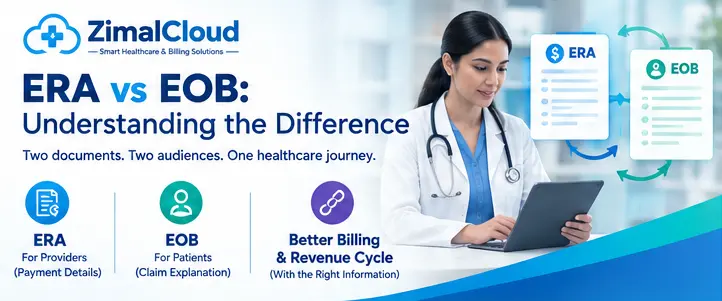
Table of contents
- Introduction
- What Is an ERA?
- Why Is an ERA Important?
- What Is an EOB?
- ERA vs EOB: What's the Difference?
- ERA vs EOB: A Simple Example
- What the Provider Receives
- What the Patient Receives
- How ERA Fits Into the Revenue Cycle
- How EOB Fits Into the Patient Billing Process
- Why Billing Teams Need to Understand ERAs
- 1. Payment Posting
- 2. Denial Management
- 3. Accounts Receivable Management
- 4. Reconciliation
- 5. Revenue Cycle Reporting
- Common ERA Codes: CARCs and RARCs
- CARC
- RARC
- ERA, EOB, and EFT: Don't Confuse Them
- ERA — Information About the Payment
- EOB — Explanation for the Patient
- EFT — Transfer of Funds
- How Technology Can Simplify ERA Management
- Best Practices for Managing ERA and EOB Workflows
- For ERA Management
- For EOB Management
- ERA vs EOB: Key Takeaways
Introduction
Healthcare billing involves several documents and electronic transactions, and two terms that are often confused are ERA and EOB.
Although both provide information about how a health insurance claim was processed, they serve different audiences and purposes.
An Electronic Remittance Advice (ERA) is primarily used by healthcare providers and billing teams to understand claim adjudication and payment details. An Explanation of Benefits (EOB) is generally provided to the patient to explain how the health plan processed the claim and what amount may be the patient's responsibility.
Understanding the difference between ERA and EOB can help medical practices improve payment posting, claim follow-up, patient communication, and overall revenue cycle management.
What Is an ERA?
ERA stands for Electronic Remittance Advice.
An ERA is an electronic explanation from a health plan to a healthcare provider about how a claim was processed and paid. It can explain payment amounts, adjustments, and other details associated with claim adjudication.
The standard HIPAA transaction for an ERA is the ASC X12N 835.
An ERA may contain information such as:
- Claim payment amounts
- Allowed or adjudicated amounts
- Adjustments
- Patient responsibility
- Contractual adjustments
- Claim or service-line payment information
- Adjustment reason codes
- Remittance advice remark codes
- Provider-level adjustments
CMS explains that adjustment information can be reported using Claim Adjustment Reason Codes (CARCs) and Remittance Advice Remark Codes (RARCs).
Why Is an ERA Important?
For billing teams, an ERA can make it easier to understand how a payer processed a claim and how the resulting payment should be reconciled.
Electronic remittance information can also support automated payment posting, reducing the need for staff to manually enter payment and adjustment information.
What Is an EOB?
EOB stands for Explanation of Benefits.
An EOB is a statement from a health plan explaining how a patient's healthcare claim was processed.
According to CMS, an EOB can show information such as:
- Patient information
- Health plan information
- Provider information
- Date of service
- Description of services
- Claim information
- Amounts covered by the health plan
- Amount the patient may owe
One important point is that an EOB is not a medical bill. It helps the patient understand how the health plan processed the claim and what amount may be their responsibility.
ERA vs EOB: What's the Difference?
The simplest way to understand the difference is to consider who uses the information and what they need it for.
| Feature | ERA | EOB |
|---|---|---|
| Full name | Electronic Remittance Advice | Explanation of Benefits |
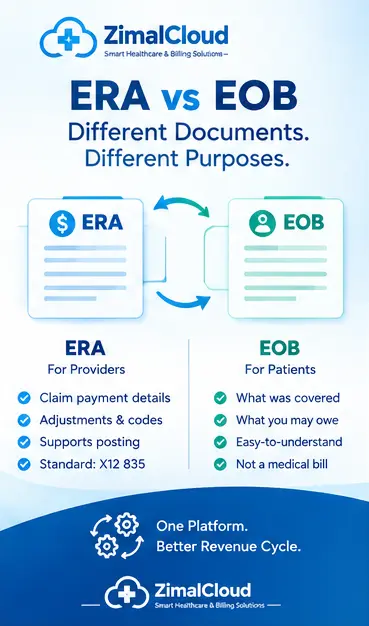
| Primary audience | Healthcare providers and billing teams | Patients |
| Main purpose | Explain claim adjudication and payment | Explain how insurance processed the patient's claim |
| Format | Electronic transaction | Paper or electronic statement |
| Standard | X12 835 | No single equivalent transaction standard in the same sense as the provider ERA |
| Payment details | Detailed payment and adjustment information | Patient-focused coverage and responsibility information |
| Adjustment codes | CARCs/RARCs and other remittance information | Patient-friendly explanation of claim processing |
| Payment posting | Can support automated posting | Generally used for patient understanding |
| Patient bill | Not a patient bill | Not a bill |
CMS identifies X12 835 as the adopted standard for electronic remittance advice.
ERA vs EOB: A Simple Example
Imagine a medical practice submits a claim for a patient's office visit.
The health plan processes the claim and determines:
- The provider submitted a specific charge.
- The payer allows a different amount under the applicable contract.
- The payer makes a payment.
- A portion may be assigned to patient responsibility.
What the Provider Receives
The provider may receive an ERA containing detailed payment and adjustment information.
The billing team can use this information to:
- Match the payment to the claim.
- Identify adjustments.
- Review patient responsibility.
- Post the payment.
- Investigate unpaid or denied amounts when necessary.
What the Patient Receives
The patient may receive an EOB explaining:
- What service was processed.
- What the health plan paid or covered.
- What amount may be the patient's responsibility.
The EOB helps the patient understand the claim before or alongside the provider's bill.
How ERA Fits Into the Revenue Cycle
ERA plays an important role after claims have been submitted and adjudicated.
A simplified revenue cycle can look like this:
Patient Visit → Documentation → Coding → Claim Submission → Claim Adjudication → ERA → Payment Posting → A/R Follow-Up
Once the ERA is received, the billing team can review the payer's response and update the patient's account accordingly.
For practices using electronic payment workflows, the ERA can also be associated with an Electronic Funds Transfer (EFT). CMS notes that a matching trace number can help providers connect the EFT with the associated ERA, a process known as reassociation.
How EOB Fits Into the Patient Billing Process
The EOB plays a different role.
It helps the patient understand the financial outcome of the claim.
A typical sequence may look like:
Patient Receives Care → Provider Submits Claim → Health Plan Processes Claim → EOB Explains Result → Provider Sends Applicable Bill
CMS advises patients to compare their medical bill with their EOB to check that the services and amounts are consistent.
Why Billing Teams Need to Understand ERAs
For healthcare organizations, understanding ERA information is important because it can affect several revenue cycle activities.
1. Payment Posting
ERA data can provide the information needed to post payments and adjustments to patient accounts.
2. Denial Management
Adjustment and remark codes can provide information about why a claim or service line was not paid as expected.
3. Accounts Receivable Management
Accurate payment and adjustment posting helps billing teams maintain more accurate accounts receivable information.
4. Reconciliation
ERA and EFT information can be used together to reconcile electronic payments with the claims and services they relate to.
5. Revenue Cycle Reporting
Accurate remittance data can support reporting on payments, adjustments, denials, and outstanding balances.
Common ERA Codes: CARCs and RARCs
One area that can make ERA information confusing is the use of standardized adjustment codes.
CARC
Claim Adjustment Reason Codes (CARCs) explain the reason for a financial adjustment to a claim or service line.
RARC
Remittance Advice Remark Codes (RARCs) can provide additional information about the adjustment.
CMS notes that HIPAA-covered health plans use standardized CARCs and RARCs rather than creating their own proprietary adjustment codes for this purpose.
For billing teams, understanding these codes can help determine whether an amount represents a contractual adjustment, patient responsibility, denial, or another type of adjustment.
ERA, EOB, and EFT: Don't Confuse Them
These three terms are closely related but describe different things.
ERA — Information About the Payment
The ERA explains how the payer processed and adjusted a claim.
EOB — Explanation for the Patient
The EOB explains the claim outcome to the patient, including coverage and potential patient responsibility.
EFT — Transfer of Funds
An EFT electronically transfers payment from the health plan to the provider's financial institution.
CMS describes EFT as the electronic transfer of healthcare payment funds, while ERA provides information about the payment and claim adjudication.
Think of it this way:
ERA = Payment explanation for the provider
EOB = Claim explanation for the patient
EFT = Movement of the money
How Technology Can Simplify ERA Management
Manual payment posting and reconciliation can create unnecessary administrative work, particularly for practices processing a high volume of claims.
Revenue cycle technology can help teams:
- Receive electronic remittance information
- Match payments with claims
- Identify adjustments
- Organize denial information
- Automate payment posting where supported
- Track outstanding balances
- Improve A/R visibility
- Reconcile payments
- Generate financial reports
CMS notes that ERA can provide efficiencies by allowing payment information to be automatically posted into accounting or billing applications.
The exact capabilities depend on the practice management system, payer, clearinghouse, and configuration.
Best Practices for Managing ERA and EOB Workflows
Healthcare organizations can improve their billing processes by establishing clear procedures for both provider-side remittance and patient-facing explanations.
For ERA Management
- Enroll with participating health plans for ERA where available.
- Connect ERA transactions to the appropriate billing workflow.
- Review adjustment and remark codes.
- Automate payment posting where appropriate.
- Reconcile ERA information with EFT deposits.
- Monitor unpaid and denied claims.
- Maintain accurate patient account balances.
CMS encourages providers to enroll for EFT and ERA with participating health plans.
For EOB Management
- Help patients understand that an EOB is not a bill.
- Compare patient bills with applicable EOB information.
- Make patient responsibility clear.
- Provide appropriate billing support when patients have questions.
- Direct coverage-related questions to the health plan when appropriate.
ERA vs EOB: Key Takeaways
The difference between ERA and EOB becomes much easier to understand when their audiences are considered.
ERA is primarily a provider-side remittance transaction that explains claim payment and adjustment information.
EOB is a patient-facing explanation of how a health plan processed healthcare services and what the patient may owe.
EFT is the electronic transfer of the payment itself.
For medical practices, effective ERA management can support payment posting, reconciliation, denial management, and revenue cycle operations. For patients, the EOB provides a clearer view of how their health plan processed their claim.
Understanding these differences can help both healthcare teams and patients navigate the billing process with greater clarity.