How FHIR APIs Are Changing Healthcare Data Exchange
FHIR APIs are transforming healthcare data exchange by providing standardized, API-based ways to connect EHRs, healthcare applications, patient portals, monitoring platforms, and analytics systems. By using common data structures and modern web technologies, FHIR can support interoperability, authorized data access, care coordination, and more connected digital healthcare workflows.
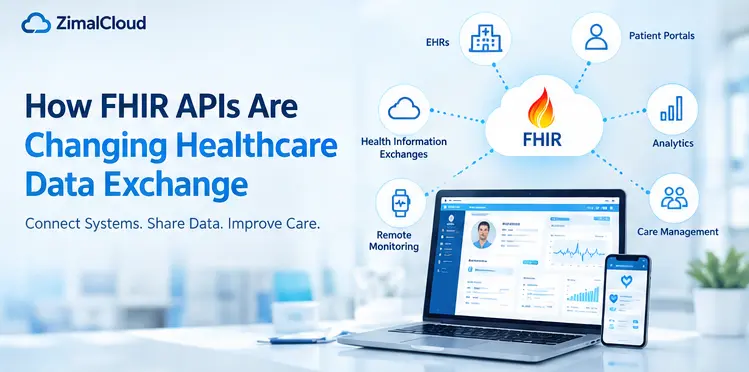
Table of contents
- Introduction
- What Is FHIR?
- What Is a FHIR API?
- Why FHIR APIs Matter for Healthcare
- 1. Better Interoperability
- 2. Faster Application Integration
- 3. Improved Access to Patient Information
- 4. Supports Patient-Centered Data Access
- How FHIR APIs Improve Healthcare Data Exchange
- FHIR and EHR Integration
- FHIR APIs and Healthcare Security
- SMART on FHIR
- FHIR APIs and Remote Patient Monitoring
- FHIR APIs and Healthcare Analytics
- Challenges of FHIR Implementation
- Data Mapping
- Terminology Differences
- Vendor Capabilities
- Security and Authorization
- Implementation Guides
- Data Quality
- The Future of Healthcare Data Exchange
- Conclusion
Introduction
Healthcare generates enormous amounts of data—from electronic health records and lab results to medications, claims, referrals, and patient-generated health information. The challenge is not simply collecting this data; it is exchanging it securely, consistently, and efficiently between different healthcare systems.
This is where FHIR APIs are making a major difference.
FHIR, which stands for Fast Healthcare Interoperability Resources, provides a modern, API-based approach to exchanging healthcare information. By using standardized data structures and web technologies, FHIR APIs can help healthcare applications communicate with EHRs, patient portals, health information exchanges, analytics platforms, and other digital health systems.
For healthcare organizations looking to modernize their technology infrastructure, understanding how FHIR APIs work—and where they fit into interoperability—is increasingly important.
What Is FHIR?
FHIR is a healthcare interoperability standard developed by HL7 International. It defines standardized ways to represent and exchange healthcare information.
Instead of every healthcare application creating its own data format, FHIR organizes information into standardized resources.
Examples include:
- Patient — demographic and administrative information
- Practitioner — information about healthcare professionals
- Observation — vital signs, laboratory results, and measurements
- Condition — diagnoses and health conditions
- MedicationRequest — medication orders and prescriptions
- Encounter — patient visits and interactions
- Procedure — procedures performed for a patient
- AllergyIntolerance — allergy information
- CarePlan — structured care plans and goals
These resources can be accessed and exchanged through APIs, making FHIR particularly useful for modern healthcare applications.
What Is a FHIR API?
A FHIR API allows software applications to request, create, update, and exchange healthcare information using standardized interfaces.
For example, an application may request information about a patient through an API rather than directly accessing another system's database.
A simplified example could look like:
The healthcare application could receive standardized patient information in a format such as JSON.
This API-based approach makes healthcare data exchange more compatible with the technologies already used to build modern web and mobile applications.
Why FHIR APIs Matter for Healthcare
Traditional healthcare systems have often relied on proprietary databases, custom interfaces, and point-to-point integrations. These approaches can make interoperability difficult when organizations need to connect multiple systems.
FHIR APIs provide a more standardized framework.
1. Better Interoperability
FHIR can help different healthcare applications exchange information using common data structures and API conventions.
For example, an EHR can potentially exchange patient information with:
- Patient-facing applications
- Remote patient monitoring platforms
- Clinical decision-support systems
- Health information exchanges
- Analytics platforms
- Care-management applications
This can reduce the need for completely custom integration approaches for every connection.
2. Faster Application Integration
FHIR APIs use familiar web technologies such as HTTP and RESTful APIs.
This makes the standard more accessible to modern software-development teams and can simplify the process of connecting healthcare applications.
Developers can work with standardized endpoints and resources instead of designing an entirely proprietary interface for every integration.
3. Improved Access to Patient Information
FHIR-based integrations can make it easier for authorized applications to access relevant patient information.
For example, a care-management application could retrieve information such as:
Patient → Conditions → Medications → Observations → Encounters → Care Plan
This can help healthcare teams work with information from multiple sources within a connected workflow.
4. Supports Patient-Centered Data Access
FHIR APIs are also important for applications that allow patients to access and interact with their health information.
Patient-facing applications can use standardized APIs to connect with participating healthcare systems and present relevant information in a more accessible digital experience.
This supports a broader shift toward healthcare experiences in which patients can access and manage their information across different digital tools.
How FHIR APIs Improve Healthcare Data Exchange
A modern healthcare data exchange workflow may look like this:
EHR → FHIR API → Healthcare Application → Authorized User
For example:
- A patient has an encounter with a healthcare provider.
- The EHR stores the encounter information.
- An authorized application requests the relevant FHIR resource.
- The FHIR API returns standardized data.
- The application processes and displays the information.
- Authorized healthcare professionals can use the information within their workflow.
The exact implementation depends on the systems involved, authentication requirements, data permissions, and the FHIR implementation guide being used.
FHIR and EHR Integration
EHR integration is one of the most important applications of FHIR APIs.
Healthcare organizations may need to connect an EHR with applications for:
- Care management
- Patient engagement
- Remote patient monitoring
- Behavioral health
- Population health
- Revenue-cycle workflows
- Clinical analytics
- Scheduling
- Referral management
Rather than creating a separate integration strategy for every application, organizations can use FHIR-based interfaces where supported.
However, FHIR does not automatically guarantee seamless interoperability. Real-world interoperability can still depend on implementation guides, supported resources, terminology, authentication, authorization, and vendor-specific capabilities.
FHIR APIs and Healthcare Security
Healthcare data is highly sensitive, so interoperability must be designed with security and privacy in mind.
FHIR itself is primarily a data-exchange standard. Security mechanisms are typically implemented alongside FHIR using technologies and frameworks such as:
- HTTPS/TLS
- OAuth 2.0
- OpenID Connect
- SMART on FHIR
- Role-based access controls
- Authentication and authorization
- Audit logging
- Data-minimization practices
Organizations also need to consider applicable healthcare privacy and security requirements when designing their integrations.
A secure API architecture should ensure that applications only access information they are authorized to access.
SMART on FHIR
One important development around FHIR is SMART on FHIR.
SMART on FHIR combines FHIR APIs with modern authorization and application-launch capabilities.
This can allow healthcare applications to launch within or alongside an EHR and request authorized access to specific healthcare information.
For example, a clinician may open a care-management application from an EHR workflow and allow the application to retrieve relevant patient information through FHIR APIs.
This creates a pathway toward more integrated healthcare application ecosystems.
FHIR APIs and Remote Patient Monitoring
FHIR can also support data exchange in remote care environments.
Consider a remote patient monitoring workflow:
Patient → Device → Monitoring Platform → FHIR API → EHR → Care Team
A monitoring platform may collect measurements such as blood pressure, weight, glucose, or pulse oximetry. Appropriate data can then be represented using standardized FHIR resources and exchanged with other systems.
This can help bring information from connected healthcare technologies into broader clinical workflows.
FHIR APIs and Healthcare Analytics
Healthcare organizations increasingly need data from multiple sources for reporting and analytics.
FHIR can provide a standardized structure for exchanging clinical information, potentially making it easier to connect operational applications with analytics environments.
Organizations can use healthcare data for activities such as:
- Population health analysis
- Care-gap identification
- Quality reporting
- Clinical research
- Patient engagement analysis
- Care-management monitoring
FHIR is not itself an analytics platform, but standardized data exchange can support the broader data pipeline.
Challenges of FHIR Implementation
Although FHIR can improve interoperability, implementation still requires careful planning.
Data Mapping
Existing systems may store information differently from FHIR resources. Organizations may need to map legacy data into appropriate FHIR structures.
Terminology Differences
Healthcare applications may use different coding systems or terminology. Consistent use of standards such as SNOMED CT, LOINC, RxNorm, and ICD can be important depending on the use case.
Vendor Capabilities
Not every healthcare system supports the same FHIR resources, operations, or implementation guides.
Security and Authorization
Organizations need appropriate authentication, authorization, consent, and access-control mechanisms.
Implementation Guides
FHIR provides a framework, but specific healthcare workflows often require implementation guides that define how FHIR should be used for a particular use case.
Data Quality
An API can make data easier to exchange, but it cannot automatically fix incomplete, inaccurate, or inconsistent source data.
The Future of Healthcare Data Exchange
FHIR represents an important shift from tightly coupled, proprietary integrations toward more standardized API-based interoperability.
As healthcare applications become increasingly connected, FHIR APIs can support ecosystems in which EHRs, patient applications, monitoring platforms, care-management systems, and analytics tools exchange information through standardized interfaces.
The long-term value is not simply faster data transfer. The larger goal is more connected healthcare information that can be accessed by authorized systems and users when it is needed.
For healthcare technology companies, adopting FHIR-ready architecture can also make it easier to build applications that integrate with a growing ecosystem of healthcare systems.
Conclusion
FHIR APIs are changing healthcare data exchange by providing a modern, standardized approach to connecting healthcare applications and systems.
They can support EHR integration, patient data access, care coordination, remote monitoring, analytics, and digital health applications while working with widely used web technologies.
However, successful interoperability requires more than simply exposing a FHIR endpoint. Healthcare organizations must also consider implementation guides, terminology, security, authorization, data quality, and vendor-specific capabilities.
For organizations building or modernizing healthcare software, FHIR can be an important foundation for creating a more connected and interoperable digital healthcare environment.