EHR Audit Logs: Healthcare Security, Compliance & Patient Data Protection
EHR audit logs strengthen healthcare security, HIPAA compliance, patient data protection, access monitoring, and EHR audit trail management for medical practices. Discover how electronic health record audit trails support HIPAA compliance efforts, improve user accountability, and enhance security monitoring across EHR and practice management software to protect sensitive patient data.
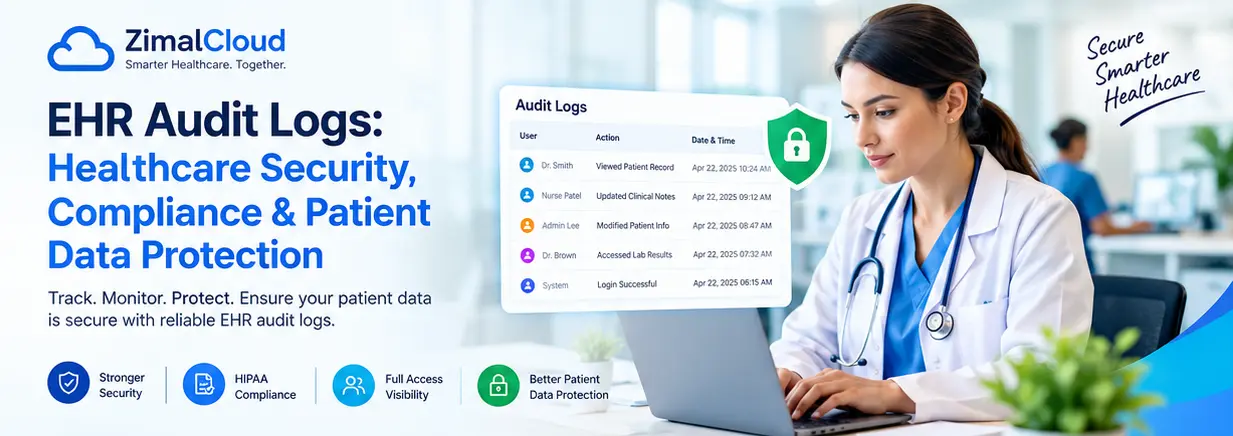
Table of contents
- EHR Audit Logs: Healthcare Security, Compliance & Patient Data Protection
- What Are EHR Audit Logs?
- Why Are Audit Logs Important in Healthcare?
- 1. Protect Patient Data and Privacy
- 2. Identify Unauthorized Access
- 3. Support HIPAA Compliance Efforts
- 4. Maintain Accurate and Accountable Clinical Records
- 5. Improve Medical Billing and Practice Management Oversight
- 6. Support Security Investigations and Incident Response
- 7. Strengthen Accountability Across Healthcare Teams
- What Information Should an EHR Audit Log Record?
- EHR Audit Logs and HIPAA Security Requirements
- Common EHR Audit Log Mistakes to Avoid
- Conclusion: Make Audit Visibility Part of Healthcare Security
EHR Audit Logs: Healthcare Security, Compliance & Patient Data Protection
Healthcare organizations manage sensitive patient information every day, including medical histories, diagnoses, prescriptions, clinical notes, laboratory results, and billing records. Protecting this information requires more than passwords and access permissions. Healthcare providers also need visibility into who accesses patient records, what changes are made, and when those activities occur.
This is where EHR audit logs become essential. An electronic health record (EHR) audit log records important activities within a healthcare information system, helping organizations monitor access, investigate suspicious activity, support compliance efforts, and strengthen patient data protection.
For modern medical practices, integrating reliable audit logging into EHR and practice management (PM) software can improve security visibility, accountability, and operational oversight.

What Are EHR Audit Logs?
EHR audit logs are electronic records of activities performed within an electronic health record system. Depending on the software, they may capture user logins, patient-record access, changes to clinical documentation, updates to patient demographics, and other security-relevant events.
An audit log can help answer important questions:
- Who accessed a patient's electronic health record?
- When was the record viewed or modified?
- What information was changed?
- Which user account performed the action?
- Was a record accessed or changed in an unusual way?
A healthcare audit trail provides a chronological history of relevant system activities. Authorized personnel can use these records to review events, investigate incidents, and understand how patient information is handled.
The exact information recorded depends on the EHR platform, its configuration, and the organization's policies.
Why Are Audit Logs Important in Healthcare?
Healthcare data is valuable and highly sensitive. Unauthorized access, inappropriate record changes, compromised accounts, and accidental disclosures can create privacy, security, and operational risks.
EHR audit logs help healthcare organizations maintain visibility into system activity rather than relying only on user permissions or manual reviews.
1. Protect Patient Data and Privacy
Patient privacy is a fundamental responsibility for healthcare providers. Audit logging helps organizations understand when protected health information (PHI) is accessed and whether that access appears appropriate.
For example, if a user accesses a patient record outside their normal responsibilities, an authorized reviewer may investigate the event using available audit information.
Audit logs do not prevent every privacy violation on their own. However, when combined with role-based access controls, authentication, monitoring, and staff training, they support a stronger healthcare data security strategy.
2. Identify Unauthorized Access
Healthcare organizations must be able to investigate potentially unauthorized access to electronic medical records.
EHR audit trails can help security teams review unusual access patterns, repeated failed logins where logged, unexpected record views, and changes made through particular accounts.
When supported by automated monitoring, these records can also help generate alerts for suspicious activities.
For example, repeated access to records unrelated to a user's assigned duties may warrant review. An audit event is not automatically proof of wrongdoing, so organizations should investigate the surrounding context before drawing conclusions.
3. Support HIPAA Compliance Efforts
For US healthcare organizations subject to the Health Insurance Portability and Accountability Act (HIPAA), audit controls are an important part of protecting electronic protected health information.
The HIPAA Security Rule includes requirements concerning mechanisms to record and examine activity in systems that contain or use electronic protected health information. Audit logs can support these efforts by providing records that authorized personnel can review.
However, having audit logs does not automatically make an EHR system or medical practice HIPAA compliant. Compliance depends on the full set of applicable administrative, physical, and technical safeguards, along with appropriate policies and implementation.
Healthcare organizations should review current regulatory requirements and obtain qualified compliance guidance when necessary.
4. Maintain Accurate and Accountable Clinical Records
Clinical documentation must be reliable, traceable, and appropriately managed.
Audit logs can help establish when information was entered, updated, or accessed. Where the EHR supports detailed version history, the audit trail may also help authorized reviewers understand changes to clinical notes, diagnoses, medication records, or treatment documentation.
This is particularly useful when a practice needs to investigate a documentation discrepancy or determine whether a change was made through an authorized account.
Audit logs complement clinical documentation workflows; they do not replace proper note-signing procedures, record-retention policies, or professional judgment.
5. Improve Medical Billing and Practice Management Oversight
Audit logging is important beyond clinical documentation. Practice management software handles patient demographics, insurance information, eligibility verification, claim submissions, payment posting, and billing-related updates.
Practice management audit logs can help authorized staff review:
- Changes to patient demographics and insurance details.
- Updates to billing records and claim information.
- User activity related to payment posting and adjustments.
- Access to administrative and financial records.
- Changes that require investigation or management review.
When EHR and PM workflows are integrated, appropriate audit trails across both systems can help practices understand activities across clinical and administrative processes.
The exact audit coverage varies by platform, so healthcare organizations should confirm which actions are logged in each connected application.
6. Support Security Investigations and Incident Response
When a security incident occurs, healthcare organizations need reliable information to understand what happened.
Audit logs can help authorized investigators establish a timeline of relevant activity, identify affected accounts, review access to patient information, and determine which records may require further investigation.
Useful audit records may include timestamps, user identifiers, actions performed, affected records, and the outcome of an activity.
To preserve their usefulness, audit logs should be protected against unauthorized modification or deletion, with access limited to appropriate personnel. Organizations should also define procedures for reviewing and retaining these records.
7. Strengthen Accountability Across Healthcare Teams
Healthcare practices depend on coordinated work among physicians, nurses, administrative staff, billing specialists, and other authorized professionals.
Individual user accounts and clear access permissions help associate system activities with the accounts that performed them. Audit trails provide additional visibility into those activities.
For example, a practice manager investigating an unexpected update to a patient record can review the available event history rather than relying entirely on recollections or informal explanations.
Accountability works best when combined with appropriate staff training, clear policies, and a fair process for investigating unusual activity.
What Information Should an EHR Audit Log Record?
The right audit-log configuration depends on the risks, workflows, and capabilities of the healthcare system. However, useful audit records commonly include the following information where supported.
| Audit log element | Why it matters |
|---|---|
| User ID or account | Identifies the account associated with an activity |
| Date and timestamp | Establishes when the event occurred |
| Action performed | Shows whether a record was viewed, created, updated, or otherwise processed |
| Patient record or resource | Identifies the record or system area involved |
| Change details | Helps authorized reviewers understand changes, where supported |
| Source or session details | May help identify the device, application, or session involved |
| Event outcome | Indicates whether an action succeeded or failed, where logged |
A strong EHR audit trail should provide enough context to support meaningful reviews while respecting privacy and limiting access to audit data.
It is also important to distinguish between an audit log and a simple application log. Application logs may capture technical events, while healthcare audit trails are designed to help establish relevant user and system activity. A platform may maintain several types of logs for different purposes.
EHR Audit Logs and HIPAA Security Requirements
For US healthcare organizations subject to HIPAA, audit controls are part of the Security Rule's technical safeguards. Section 164.312(b) addresses mechanisms for recording and examining activity in information systems that contain or use electronic protected health information. The Security Rule also includes requirements for access control, authentication, and protecting information from improper alteration or destruction.
In practice, organizations should consider several related measures:
- Audit controls: Record and examine relevant activity within systems that handle electronic protected health information.
- Access management: Limit access according to authorized roles and responsibilities.
- Risk analysis: Identify risks to the confidentiality, integrity, and availability of electronic protected health information.
- Routine review: Establish appropriate procedures for reviewing system activity and investigating suspicious events.
- Documentation: Maintain the policies and records required by applicable regulations.
- Incident response: Define procedures for responding to suspected or confirmed security incidents.
The US Department of Health and Human Services recommends that organizations configure audit and monitoring functions according to their needs and establish suitable review procedures.
HIPAA requirements apply according to an organization's circumstances and regulatory status. Audit-log capabilities alone do not establish compliance, and the appropriate implementation should be determined through a risk-based assessment.
Common EHR Audit Log Mistakes to Avoid
Even a system with audit-log functionality can leave important gaps if it is poorly configured or inadequately monitored.
Avoid these common mistakes:
- Enabling logs without reviewing them: Unexamined records may not help identify suspicious activity in time.
- Using shared accounts: Shared credentials can make it harder to associate events with individual users.
- Keeping logs accessible to too many people: Excessive permissions can expose sensitive audit information or increase tampering risks.
- Ignoring connected applications: Separate systems may record different parts of the same workflow.
- Relying only on automated alerts: Alerts need appropriate configuration and human review.
- Assuming audit logs guarantee compliance: Organizations must implement all applicable safeguards and procedures.
- Failing to test log completeness: Important events may be missed if logging is not configured and validated appropriately.
A documented audit-log management process can help address these gaps and improve the overall effectiveness of healthcare security controls.
Conclusion: Make Audit Visibility Part of Healthcare Security
EHR audit logs are an important component of healthcare data security. They help medical practices understand who accessed electronic patient records, review changes to clinical and administrative information, investigate unusual activity, and support compliance-related processes.
However, effective audit logging requires more than collecting events. Healthcare organizations should combine appropriate logging with role-based access controls, secure record storage, routine reviews, staff training, and a documented incident response process.
As practices evaluate EHR and practice management software, audit visibility should be a key consideration alongside usability, interoperability, workflow efficiency, and data protection.
Explore ZimalCloud's healthcare EHR + PM platform to learn how connected healthcare workflows can support your practice's clinical and administrative operations. When evaluating the platform, ask about available audit-log features, access monitoring, security controls, and reporting capabilities to determine whether they meet your organization's needs.