Benefits of Remote Patient Monitoring for Patients and Providers
Remote Patient Monitoring (RPM) helps healthcare teams stay connected with patients beyond the clinic. By collecting relevant health data through connected devices, RPM can support ongoing monitoring, patient engagement, proactive follow-up, and coordinated care. For providers, it adds visibility between visits and helps organize documentation, review, and care-management workflows.
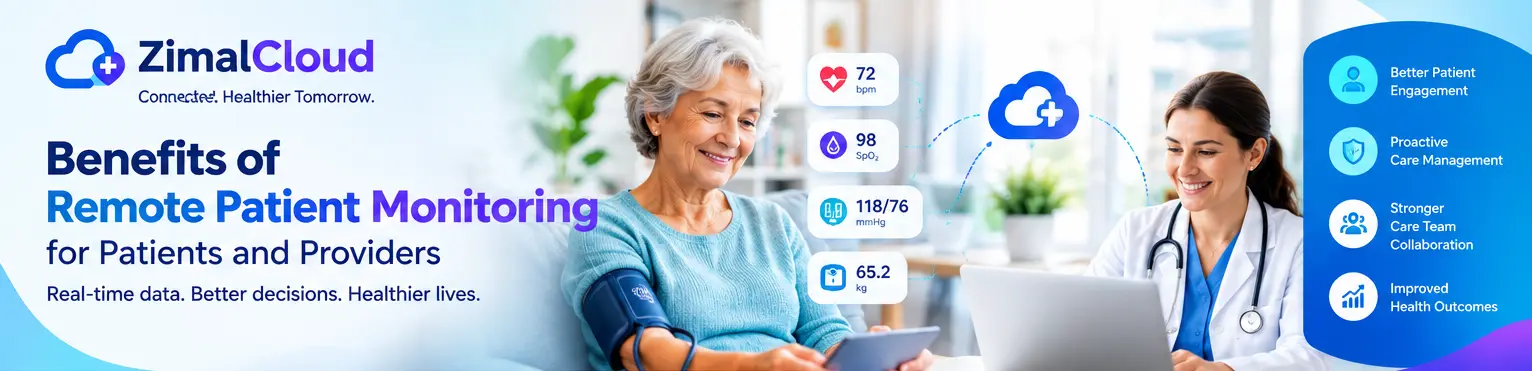
Table of contents
- Benefits of Remote Patient Monitoring for Patients and Providers
- What Is Remote Patient Monitoring?
- Why Is Remote Patient Monitoring Important?
- Benefits of Remote Patient Monitoring for Patients
- 1. Greater Convenience
- 2. More Convenient Ongoing Monitoring
- 3. Increased Patient Engagement
- 4. Better Communication With Care Teams
- 5. Support for Chronic Condition Management
- 6. Reduced Need for Some Routine In-Person Monitoring
- Benefits of Remote Patient Monitoring for Providers
- 7. Better Visibility Between Appointments
- 8. More Proactive Patient Management
- 9. Improved Care-Team Coordination
- 10. Better Documentation and Visibility
- 11. Support for Data-Driven Care
- 12. Integration With Other Healthcare Workflows
- Remote Patient Monitoring vs. Traditional Monitoring
- How Remote Patient Monitoring Works
- Step 1: Patient Enrollment
- Step 2: Device Setup
- Step 3: Data Collection
- Step 4: Data Transmission
- Step 5: Data Review
- Step 6: Patient Follow-Up
- Step 7: Provider Oversight
- What Makes an Effective RPM Program?
- Clear Patient Enrollment
- Appropriate Devices
- Reliable Data Collection
- Defined Review Processes
- Clear Communication
- Strong Documentation
- Connected Technology
- Challenges and Considerations of Remote Patient Monitoring
- Patient Technology Literacy
- Internet and Connectivity
- Data Volume
- Patient Engagement
- Privacy and Security
- Clinical Workflow Integration
- The Role of RPM in Connected Healthcare
- How ZimalCloud Supports Remote Patient Monitoring
- The Future of Remote Patient Monitoring
Benefits of Remote Patient Monitoring for Patients and Providers
Remote Patient Monitoring (RPM) is changing how healthcare teams monitor patients beyond the traditional clinical setting. Instead of relying only on in-person visits, RPM allows eligible patients to use connected devices to collect health information at home and share relevant readings with their care teams.
For providers, this can create greater visibility between appointments and support more proactive care management. For patients, it can make ongoing monitoring more convenient and help them stay more engaged with their care.
As healthcare continues to move toward connected and value-based models, Remote Patient Monitoring has become an important part of modern digital healthcare.
What Is Remote Patient Monitoring?
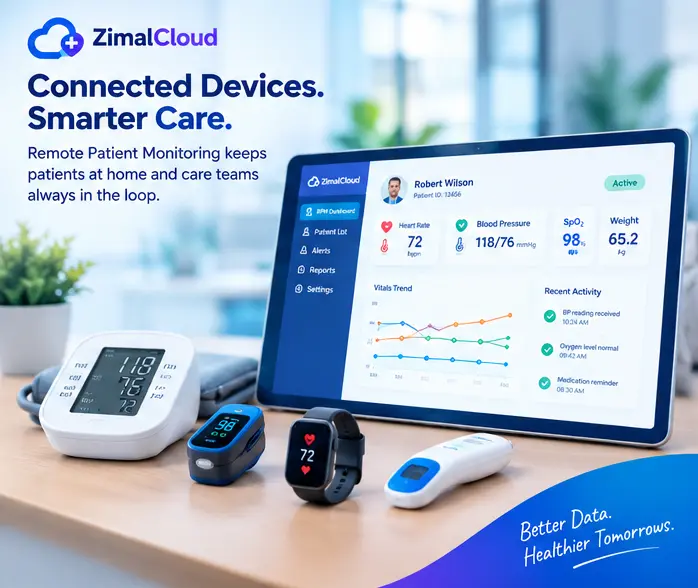
Remote Patient Monitoring (RPM) is a healthcare service that uses connected medical devices and digital technology to collect patient health data outside a traditional healthcare facility.
Depending on the patient's care plan, RPM may involve monitoring measurements such as:
- Blood pressure
- Blood glucose
- Body weight
- Pulse rate
- Blood oxygen levels
- Other clinically relevant measurements
The collected information can be transmitted to a healthcare platform where authorized care-team members can review it according to the patient's monitoring plan.
RPM is particularly useful for patients who require ongoing observation or have health conditions that benefit from regular monitoring between office visits.
Why Is Remote Patient Monitoring Important?
Traditional healthcare often provides only periodic snapshots of a patient's condition. A patient may visit a provider every few weeks or months, while important changes can occur between appointments.
RPM can help bridge this gap by providing a more continuous stream of relevant health information.
Instead of relying exclusively on what happens during an office visit, healthcare teams can use appropriately collected home measurements to gain additional insight into the patient's health between visits.
This can support:
- Earlier identification of concerning trends
- More informed follow-up
- Ongoing patient engagement
- Better communication between patients and care teams
- More convenient monitoring
- More coordinated chronic care
RPM does not replace in-person medical care. Rather, it can complement traditional healthcare when appropriately integrated into a patient's care plan.
Benefits of Remote Patient Monitoring for Patients
1. Greater Convenience
One of the biggest advantages of RPM is that monitoring can often take place from home.
Patients may not need to travel to a clinic simply to provide certain routine measurements. Depending on the monitoring program, connected devices can collect relevant information and transmit it to the healthcare team.
This can be particularly helpful for patients who have difficulty making frequent office visits.
2. More Convenient Ongoing Monitoring
Some health conditions require monitoring beyond occasional appointments.
RPM gives healthcare teams a way to receive relevant measurements between visits, helping create a broader picture of the patient's health over time.
For patients, this can provide greater continuity between scheduled appointments.
3. Increased Patient Engagement
RPM can encourage patients to take a more active role in their healthcare.
When patients regularly measure and review relevant health information as part of an established care plan, they may become more aware of how their health is changing.
This can support conversations with their healthcare providers and encourage participation in their care plan.
4. Better Communication With Care Teams
RPM can create additional opportunities for communication between patients and healthcare teams.
When monitoring data shows a change that requires attention, the care team can follow the practice's established workflow for reviewing the information and determining whether follow-up is appropriate.
This can make communication more structured than relying only on the patient's next scheduled appointment.
5. Support for Chronic Condition Management
RPM can be useful as part of care plans for patients who require ongoing monitoring.
Depending on the patient's condition and clinical plan, monitoring may include measurements such as blood pressure, blood glucose, weight, pulse rate, or oxygen saturation.
Regular information can help providers understand patterns and make better-informed decisions during follow-up.
6. Reduced Need for Some Routine In-Person Monitoring
RPM may reduce the need for certain routine monitoring visits when remote measurement is clinically appropriate.
However, it should not be viewed as a replacement for necessary examinations, diagnostic testing, or emergency medical care.
Instead, RPM can complement in-person care by extending monitoring beyond the clinic.
Benefits of Remote Patient Monitoring for Providers
7. Better Visibility Between Appointments
Healthcare providers often have limited information about what happens between scheduled visits.
RPM can provide additional patient-generated health information between appointments, giving care teams more data points to consider during appropriate clinical review.
This can help providers identify patterns that may not be visible from occasional office measurements alone.
8. More Proactive Patient Management
RPM can support a more proactive approach to patient management.
Rather than waiting exclusively for the next scheduled appointment, care teams can review relevant monitoring information according to the patient's care plan and established clinical protocols.
When a reading or trend requires attention, the appropriate team member can follow the practice's escalation and follow-up process.
9. Improved Care-Team Coordination
RPM involves more than collecting readings. Successful programs require clear workflows for:
- Patient enrollment
- Device management
- Data review
- Documentation
- Patient communication
- Provider oversight
- Follow-up
- Time tracking where applicable
- Reporting
A centralized RPM workflow can help different members of the care team understand what needs to be reviewed and completed.
10. Better Documentation and Visibility
Manual processes can make it difficult to maintain consistent RPM documentation.
A dedicated RPM platform can organize patient measurements, care plans, review activities, notes, tasks, and reports in one location.
This creates a clearer operational record and can reduce the need to maintain information across disconnected spreadsheets, applications, or portals.
11. Support for Data-Driven Care
RPM generates a stream of patient data that can provide useful context for healthcare professionals.
Instead of looking at one isolated measurement, providers may be able to review measurements over time and consider trends alongside the patient's broader clinical information.
This can support more informed conversations and care decisions when combined with clinical judgment.
12. Integration With Other Healthcare Workflows
RPM becomes more useful when it is connected to the rest of the patient's healthcare journey.
For example, an RPM workflow can be integrated with:
- Electronic health records
- Patient demographics
- Care plans
- Medication information
- Diagnoses
- Clinical notes
- Care-management programs
- Provider review
- Billing workflows
An integrated approach can reduce duplicate data entry and help care teams work from a more complete patient record.
Remote Patient Monitoring vs. Traditional Monitoring
Traditional monitoring generally depends on measurements taken during scheduled healthcare encounters.
RPM extends monitoring into the patient's everyday environment.
| Traditional Monitoring | Remote Patient Monitoring |
|---|---|
| Primarily clinic-based | Can occur in the patient's home |
| Periodic measurements | Ongoing measurements according to the care plan |
| Limited information between visits | Additional patient-generated data between visits |
| More dependent on scheduled appointments | Supports monitoring between appointments |
| Manual data collection may be common | Connected devices can transmit measurements |
| Follow-up occurs during established encounters | Care teams can follow defined monitoring workflows |
The best approach depends on the patient's needs, clinical circumstances, available technology, and provider judgment. RPM is designed to complement—not eliminate—traditional healthcare.
How Remote Patient Monitoring Works
A typical RPM workflow can be broken into several stages.
Step 1: Patient Enrollment
The healthcare team determines whether RPM is appropriate and establishes the patient's monitoring plan.
Step 2: Device Setup
The patient receives an appropriate connected monitoring device and instructions for its use.
Step 3: Data Collection
The patient takes measurements according to the established monitoring schedule.
Step 4: Data Transmission
The device or connected system sends relevant measurements to the healthcare platform.
Step 5: Data Review
Authorized care-team members review the information according to the patient's care plan and organizational workflow.
Step 6: Patient Follow-Up
If follow-up is appropriate, the care team communicates with the patient and documents the relevant activity.
Step 7: Provider Oversight
Providers can review the patient's information and determine whether adjustments to the care plan or additional evaluation are appropriate.
This workflow creates a connection between home monitoring and professional healthcare oversight.
What Makes an Effective RPM Program?
Simply giving a patient a connected device is not enough to create a successful RPM program.
An effective program should include:
Clear Patient Enrollment
Patients should understand why they are participating and how the monitoring process works.
Appropriate Devices
Devices should be suitable for the patient's monitoring needs and care plan.
Reliable Data Collection
The workflow should make it practical for patients to take and transmit measurements consistently.
Defined Review Processes
Healthcare organizations should establish who reviews incoming information and how potentially concerning readings are handled.
Clear Communication
Patients should know how and when to communicate with their care team.
Strong Documentation
Monitoring activities, reviews, communication, and relevant clinical decisions should be documented appropriately.
Connected Technology
An RPM platform should ideally integrate with the broader patient record and healthcare workflow rather than creating another isolated portal.
Challenges and Considerations of Remote Patient Monitoring
Although RPM offers important advantages, healthcare organizations should also consider potential challenges.
Patient Technology Literacy
Some patients may need assistance learning how to use connected devices and digital platforms.
Internet and Connectivity
RPM may depend on reliable device connectivity, internet access, or compatible technology.
Data Volume
Continuous monitoring can generate significant amounts of information. Healthcare teams need effective workflows to prioritize and review relevant data.
Patient Engagement
Patients may become less consistent with measurements over time. Clear education, reminders, and appropriate follow-up can help support participation.
Privacy and Security
Healthcare organizations must protect patient information and use appropriate security, privacy, access-control, and compliance practices.
Clinical Workflow Integration
RPM should fit naturally into the organization's existing care processes. If staff must repeatedly move between disconnected systems, the benefits of remote monitoring may be reduced.
The Role of RPM in Connected Healthcare
Remote Patient Monitoring is most valuable when it is treated as part of a broader healthcare ecosystem rather than as a standalone technology.
When RPM data connects with patient records, care plans, chronic care programs, clinical documentation, and appropriate billing workflows, healthcare organizations can create a more coordinated experience.
For example, a patient may participate in RPM and Chronic Care Management (CCM) while also receiving specialty care. Keeping these workflows connected can help the care team maintain better visibility into the patient's overall care journey.
How ZimalCloud Supports Remote Patient Monitoring
ZimalCloud provides an integrated healthcare platform that brings Remote Patient Monitoring into the same environment as other clinical and operational workflows.
Its RPM capabilities can include:
- RPM dashboard
- Device-oriented care plans
- Patient review
- Care-team management
- Medication information
- Diagnosis and procedure-code support
- Device management
- Worklists
- Time tracking
- Review and sign workflows
- Pending approvals
- Reporting
Because RPM operates within a centralized patient hub, teams can connect monitoring activities with other services and patient information instead of relying on a separate RPM portal.
This approach can help practices create a more connected workflow from patient enrollment and monitoring to clinical review, documentation, and applicable billing processes.
The Future of Remote Patient Monitoring
Healthcare is increasingly moving toward models that emphasize continuous, connected, and patient-centered care.
RPM is an important part of this transition because it allows healthcare organizations to extend certain monitoring activities beyond the walls of the clinic.
As connected devices, cloud healthcare platforms, and digital workflows continue to evolve, RPM can become an increasingly integrated component of chronic care and preventive health strategies.
The key is not simply collecting more data. The real value comes from turning relevant patient data into organized workflows, meaningful clinical review, and appropriate follow-up