Medical Billing Workflow: From Eligibility Verification to Payment Posting
Medical billing workflow connects every step from patient registration and insurance eligibility verification to coding, claim submission, payment posting, denial management, and A/R. A streamlined process helps healthcare practices improve billing accuracy, reduce administrative friction, monitor claims, and maintain better visibility into their revenue cycle.
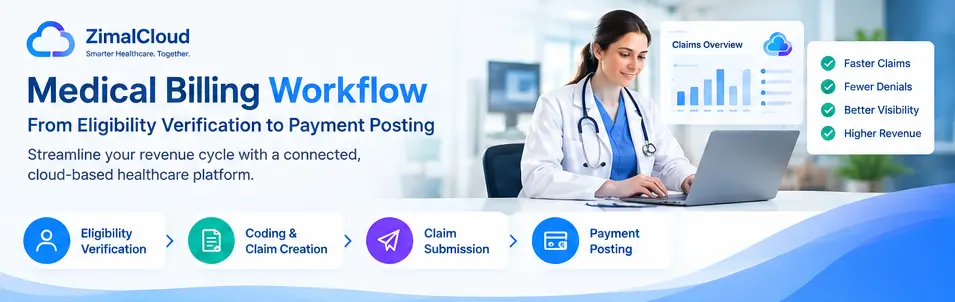
Table of contents
- Introduction
- What Is a Medical Billing Workflow?
- 1. Patient Registration
- Why It Matters
- 2. Insurance Eligibility Verification
- Why Eligibility Verification Is Important
- 3. Appointment and Encounter Management
- 4. Clinical Documentation
- 5. Medical Coding
- Why Accurate Coding Matters
- 6. Charge Capture
- 7. Claim Creation
- 8. Claim Scrubbing and Validation
- 9. Claim Submission
- 10. Claim Adjudication
- 11. Payment Posting
- 12. Denial Management
- Track Denials by Category
- 13. Patient Billing
- 14. Accounts Receivable Management
- 15. Reporting and Revenue-Cycle Analytics
- Common Medical Billing Workflow Challenges
- 1. Inaccurate Patient Information
- 2. Eligibility Errors
- 3. Coding Errors
- 4. Manual Data Entry
- 5. Poor Claim Visibility
- 6. Delayed Payment Posting
- 7. Limited Reporting
- How Technology Can Improve Medical Billing Workflows
- Benefits of a Connected Workflow
- Medical Billing Workflow Best Practices
- Verify Insurance Early
- Maintain Accurate Patient Data
- Support Coding With Documentation
- Validate Claims Before Submission
- Track Claims After Submission
- Post Payments Promptly
- Analyze Denials
- Monitor A/R Regularly
- Use Meaningful Reports
- Medical Billing Workflow: A Simple Overview
- Conclusion
Introduction
A well-managed medical billing workflow is essential for keeping healthcare practices financially healthy. From verifying a patient's insurance eligibility to posting payments, every step affects claim accuracy, reimbursement speed, and revenue-cycle performance.
When billing processes are fragmented or handled manually, practices may experience claim denials, delayed payments, inaccurate patient balances, and increased administrative work.
A streamlined workflow connects eligibility verification, documentation, coding, claim submission, payment processing, and reporting into one coordinated process.
This guide explains the major steps in the medical billing workflow and how practices can improve efficiency, accuracy, and revenue-cycle visibility.
What Is a Medical Billing Workflow?
A medical billing workflow is the sequence of administrative and financial activities used to submit healthcare services for reimbursement and collect payments.
A typical workflow follows this path:
Patient Registration → Eligibility Verification → Appointment & Encounter → Documentation → Medical Coding → Claim Creation → Claim Submission → Claim Adjudication → Payment Posting → Denial Management → Patient Billing → Reporting
Each stage depends on accurate information from the previous step. Errors early in the process can create problems later, making workflow coordination especially important.
1. Patient Registration
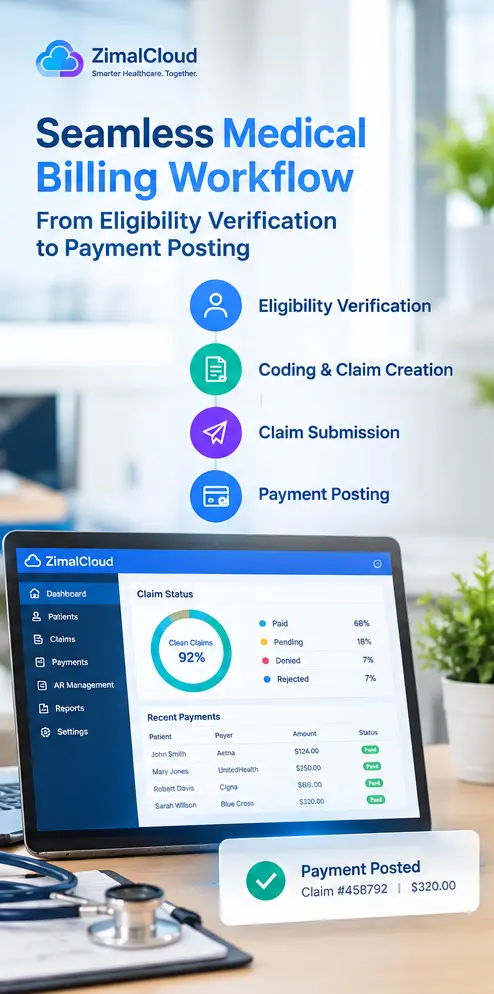
The medical billing process begins when patient information is collected.
Important registration information may include:
- Patient name and contact information
- Date of birth
- Address
- Insurance information
- Policy and member ID
- Subscriber information
- Employer information when applicable
- Referring provider information
- Patient financial responsibility
Accurate registration reduces the risk of incorrect claims and helps billing teams identify missing information before services are provided.
Why It Matters
Incorrect demographic or insurance information can result in rejected claims, eligibility problems, and payment delays.
2. Insurance Eligibility Verification
Insurance eligibility verification confirms whether a patient's insurance is active and whether the planned service may be covered.
Billing or front-office staff may verify:
- Insurance status
- Effective and termination dates
- Copayment
- Deductible
- Coinsurance
- Coverage limitations
- Referral requirements
- Prior authorization requirements
- In-network or out-of-network status
Why Eligibility Verification Is Important
Checking eligibility before an appointment can help practices identify potential coverage issues before the claim is submitted.
It can also give patients a clearer understanding of their expected financial responsibility.
3. Appointment and Encounter Management
After eligibility is confirmed, the patient's appointment and encounter information should be accurately recorded.
The encounter may include:
- Reason for visit
- Provider information
- Date and time of service
- Procedures performed
- Diagnoses
- Clinical documentation
- Orders and referrals
- Patient history and relevant information
Accurate encounter documentation provides the foundation for medical coding and claim creation.
4. Clinical Documentation
Providers document the services delivered during the patient encounter.
Documentation should support the services being billed and contain the information required for accurate coding and reimbursement.
Depending on the service, documentation may include:
- History and examination
- Assessment
- Diagnosis
- Treatment provided
- Procedures performed
- Medical decision-making
- Follow-up instructions
- Care plans
Strong documentation helps coding and billing teams create claims that accurately represent the care provided.
5. Medical Coding
The next step is translating clinical documentation into standardized medical codes.
Common coding systems include:
- ICD-10-CM for diagnoses
- CPT for many professional services and procedures
- HCPCS for specific healthcare services, supplies, and products
Coders review documentation and assign appropriate codes based on the services provided and applicable coding requirements.
Why Accurate Coding Matters
Coding errors can contribute to:
- Claim denials
- Claim rejections
- Underpayments
- Overpayments
- Compliance concerns
- Delayed reimbursement
Accurate coding is therefore an important part of an effective revenue-cycle workflow.
6. Charge Capture
Charge capture ensures that billable services provided during the encounter are properly recorded.
The billing team may review:
- Procedures
- Office visits
- Diagnostic services
- Supplies
- Medications when applicable
- Other billable services
The objective is to ensure that documented services are neither missed nor incorrectly billed.
7. Claim Creation
Once the necessary information has been collected and coded, the claim is prepared.
A medical claim typically contains information such as:
- Patient details
- Insurance information
- Provider information
- Diagnosis codes
- Procedure codes
- Dates of service
- Charges
- Modifiers when applicable
- Place of service
Before submission, claims should be reviewed for missing or inconsistent information.
8. Claim Scrubbing and Validation
Claim scrubbing is the process of checking claims for potential errors before they are submitted to a payer.
Automated or manual validation may identify issues such as:
- Missing patient information
- Invalid codes
- Incorrect insurance information
- Missing modifiers
- Formatting problems
- Duplicate claims
- Inconsistent data
Resolving issues before submission can reduce avoidable claim rejections.
9. Claim Submission
After validation, claims are submitted to the appropriate payer.
Many practices use a clearinghouse to help transmit claims electronically and perform additional validation.
The workflow may look like:
Practice Management System → Clearinghouse → Insurance Payer
Electronic claim submission can help reduce manual paperwork and provide better visibility into claim status.
10. Claim Adjudication
After receiving a claim, the payer reviews it according to the patient's coverage and applicable payment rules.
The payer may:
- Approve the claim
- Partially approve the claim
- Deny the claim
- Request additional information
- Apply patient responsibility
- Determine the allowed amount
The resulting payment information is typically communicated through an Explanation of Benefits (EOB) or Electronic Remittance Advice (ERA).
11. Payment Posting
Payment posting is the process of recording payments and adjustments in the practice's billing system.
Payments may come from:
- Insurance companies
- Patients
- Secondary payers
- Other authorized sources
Payment posting may include recording:
- Insurance payment
- Patient responsibility
- Contractual adjustments
- Deductibles
- Copayments
- Coinsurance
- Denials
- Remaining balances
Accurate payment posting helps ensure that the patient's account reflects the correct financial status.
12. Denial Management
Not every claim is paid successfully on the first submission.
Common reasons for denials may include:
- Eligibility problems
- Incorrect coding
- Missing information
- Lack of authorization
- Timely filing issues
- Non-covered services
- Documentation issues
- Incorrect patient information
A structured denial-management process helps billing teams identify the reason for denial, correct the issue when appropriate, and determine the next action.
Track Denials by Category
Practices can monitor denial trends by:
- Payer
- Provider
- Procedure
- Diagnosis
- Denial reason
- Location
- Date of service
This information can reveal recurring workflow problems.
13. Patient Billing
After insurance processing, any remaining patient responsibility can be billed according to the practice's policies.
Patient statements may show:
- Original charge
- Insurance payment
- Adjustments
- Copayment
- Deductible
- Coinsurance
- Remaining balance
Clear statements can make it easier for patients to understand what they owe.
14. Accounts Receivable Management
Accounts receivable, commonly called A/R, represents outstanding amounts owed to the healthcare organization.
Billing teams may monitor:
- Current A/R
- Aging balances
- Insurance A/R
- Patient A/R
- Denied claims
- Outstanding claims
- Unpaid balances
A/R monitoring helps practices identify accounts that require follow-up.
15. Reporting and Revenue-Cycle Analytics
The final part of the workflow involves analyzing billing and payment data.
Useful metrics may include:
- Clean claim rate
- Claim denial rate
- Days in A/R
- Collection rate
- Payment posting turnaround
- Outstanding balances
- A/R aging
- Payer performance
- Claim volume
- Reimbursement trends
Regular reporting can help practices identify bottlenecks and improve their revenue-cycle processes.
Common Medical Billing Workflow Challenges
Healthcare organizations may encounter several challenges during billing operations.
1. Inaccurate Patient Information
Incorrect demographics or insurance information can lead to claim problems.
2. Eligibility Errors
If coverage is not verified properly, claims may be submitted to inactive or incorrect insurance plans.
3. Coding Errors
Incorrect diagnosis or procedure coding can result in denials and payment delays.
4. Manual Data Entry
Repeated data entry across multiple systems increases administrative workload and can introduce errors.
5. Poor Claim Visibility
Without centralized tracking, staff may struggle to determine whether a claim was submitted, rejected, denied, or paid.
6. Delayed Payment Posting
When payments are not posted promptly, account balances and A/R reports may not accurately reflect the practice's financial position.
7. Limited Reporting
Without meaningful revenue-cycle reports, practices may have difficulty identifying recurring problems.
How Technology Can Improve Medical Billing Workflows
Healthcare technology can connect different stages of the billing process and reduce unnecessary manual work.
A modern practice management and revenue-cycle platform can help teams manage:
- Patient registration
- Eligibility verification
- Insurance information
- Encounter management
- Medical coding
- Claim creation
- Claim submission
- Clearinghouse connectivity
- ERA processing
- Payment posting
- A/R tracking
- Denial management
- Financial reporting
Benefits of a Connected Workflow
A centralized system can provide:
Better Visibility
Teams can track billing activity from encounter through payment.
Reduced Administrative Work
Automation can reduce repetitive data entry and manual processes.
Improved Accuracy
Validation and standardized workflows can help identify errors earlier.
Faster Follow-Up
Staff can identify unpaid or denied claims that require attention.
Better Revenue-Cycle Insights
Dashboards can provide information about claims, payments, denials, and A/R.
Medical Billing Workflow Best Practices
Practices can strengthen their billing processes by following several core principles:
Verify Insurance Early
Confirm eligibility and coverage before services whenever possible.
Maintain Accurate Patient Data
Keep demographic and insurance information current.
Support Coding With Documentation
Ensure documentation accurately supports the services and diagnoses reported.
Validate Claims Before Submission
Identify potential errors before claims reach the payer.
Track Claims After Submission
Monitor claim status rather than treating submission as the end of the process.
Post Payments Promptly
Keep financial records and patient balances up to date.
Analyze Denials
Look beyond individual denied claims and identify recurring causes.
Monitor A/R Regularly
Review aging and outstanding balances to prioritize follow-up.
Use Meaningful Reports
Track operational and financial metrics that help identify workflow bottlenecks.
Medical Billing Workflow: A Simple Overview
The complete workflow can be summarized as:
1. Patient Registration
↓
2. Eligibility Verification
↓
3. Appointment & Encounter
↓
4. Clinical Documentation
↓
5. Medical Coding
↓
6. Charge Capture
↓
7. Claim Creation
↓
8. Claim Scrubbing
↓
9. Claim Submission
↓
10. Payer Adjudication
↓
11. Payment Posting
↓
12. Denial Management
↓
13. Patient Billing
↓
14. A/R Management
↓
15. Reporting & Analytics
This connected approach helps practices maintain visibility across the entire revenue cycle.
Conclusion
An effective medical billing workflow does more than submit claims. It connects patient registration, eligibility verification, documentation, coding, claim submission, payment posting, denial management, and accounts receivable into a coordinated process.
When each stage is handled accurately and monitored consistently, healthcare organizations can improve billing visibility, reduce avoidable administrative issues, and create a more organized revenue-cycle operation.
For modern healthcare practices, integrating billing workflows with practice management, EHR, eligibility, claims, payment, and reporting tools can provide a more connected approach to revenue-cycle management.