How Automation Can Improve Claims Processing
Automation can make healthcare claims processing faster, more accurate, and easier to manage. From eligibility checks and claim creation to submission, status tracking, payment posting, and denial management, automated workflows reduce manual work, minimize errors, improve visibility, and help healthcare organizations strengthen their revenue cycle.
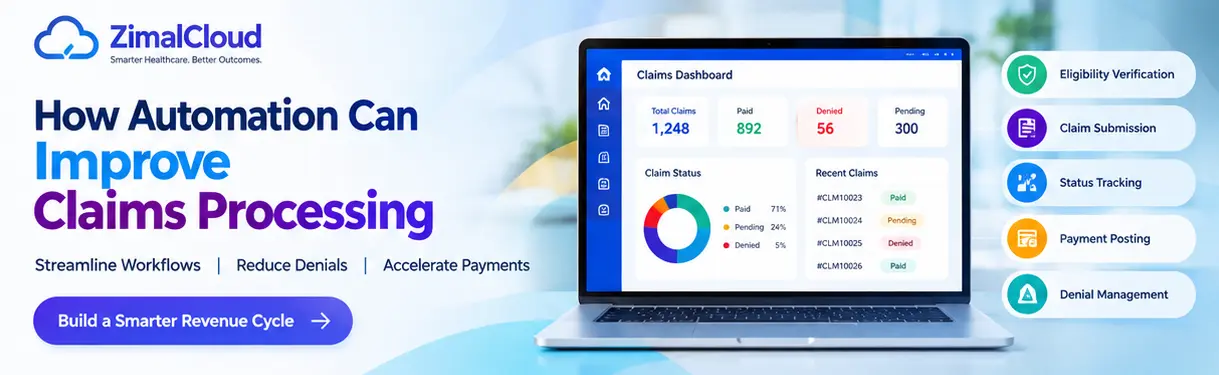
Table of contents
- How Automation Can Improve Claims Processing
- What Is Claims Processing Automation?
- Why Traditional Claims Processing Can Be Challenging
- 1. Automate Insurance Eligibility Verification
- 2. Reduce Manual Data Entry
- 3. Improve Claim Accuracy Before Submission
- 4. Speed Up Electronic Claim Submission
- 5. Automate Claim Status Tracking
- 6. Make Denial Management More Efficient
- 7. Streamline Payment Posting
- 8. Improve Accounts Receivable Visibility
- 9. Reduce Repetitive Administrative Work
- 10. Improve Revenue Cycle Efficiency
- Automation Does Not Replace Human Oversight
- Key Benefits of Claims Processing Automation
- Faster Processing
- Fewer Manual Errors
- Better Visibility
- More Efficient Staff Workflows
- Faster Issue Identification
- Better Denial Follow-Up
- Improved Scalability
- What Should You Look for in Claims Automation Software?
- How an Automated Claims Workflow Can Look
- Final Thoughts
How Automation Can Improve Claims Processing
Healthcare claims processing is a critical part of the revenue cycle. Every submitted claim represents an opportunity for a healthcare organization to receive timely and accurate reimbursement. However, manual claims workflows can involve repetitive data entry, eligibility verification, coding checks, claim submission, status tracking, payment posting, and denial follow-up.
When these tasks are handled manually, even small errors can create delays, rejected claims, additional administrative work, and payment issues.
Claims processing automation can help healthcare organizations streamline these workflows by using technology to handle repetitive tasks, identify potential problems, and provide better visibility throughout the claims lifecycle.
What Is Claims Processing Automation?

Claims processing automation uses software and digital workflows to reduce manual intervention throughout the medical claims process.
Depending on the system, automation can support activities such as:
- Patient and insurance data validation
- Eligibility verification
- Claim creation
- Coding and documentation checks
- Claim scrubbing
- Electronic claim submission
- Claim status tracking
- Electronic remittance processing
- Payment posting
- Denial identification
- Accounts receivable follow-up
- Revenue cycle reporting
The goal is not necessarily to remove people from the process. Instead, automation can allow billing teams to spend less time on repetitive administrative work and more time addressing exceptions and complex claims.
Why Traditional Claims Processing Can Be Challenging
A typical claims workflow may involve multiple people, systems, and steps.
A billing team may need to:
- Collect patient information.
- Verify insurance eligibility.
- Review clinical and billing documentation.
- Assign or validate codes.
- Create the claim.
- Check the claim for errors.
- Submit the claim.
- Monitor its status.
- Review payer responses.
- Post payments.
- Identify denials.
- Correct and resubmit claims when necessary.
When many of these activities depend on manual processes, organizations may encounter:
- Data-entry errors
- Missing information
- Duplicate work
- Delayed submissions
- Difficulty tracking claim status
- Increased administrative workload
- Slow denial follow-up
- Limited visibility into accounts receivable
Automation can connect these steps into a more consistent workflow.
1. Automate Insurance Eligibility Verification
Insurance eligibility is an important step before submitting healthcare claims.
Automated eligibility verification can check insurance information electronically and help identify issues such as:
- Inactive coverage
- Incorrect insurance information
- Missing policy details
- Coverage limitations
- Patient responsibility information
By identifying potential insurance issues earlier, billing teams can address problems before they result in unnecessary claim delays or rework.
2. Reduce Manual Data Entry
Manual data entry can consume significant administrative time.
Claims automation can transfer relevant information between connected workflows, reducing the need for staff to repeatedly enter the same information.
For example, information from a patient's encounter can flow into the billing workflow, where appropriate data can be used to prepare a claim.
This can help:
- Reduce repetitive work
- Minimize transcription errors
- Improve data consistency
- Speed up claim preparation
3. Improve Claim Accuracy Before Submission
Submitting an incomplete or inaccurate claim can lead to rejection or additional processing work.
Automated claim-scrubbing tools can check claims for potential problems before submission.
Depending on the system, checks may identify:
- Missing required information
- Invalid or inconsistent data
- Coding-related issues
- Insurance information problems
- Duplicate claims
- Formatting issues
Early detection gives billing teams an opportunity to correct problems before sending the claim to the payer.
4. Speed Up Electronic Claim Submission
Once a claim has passed the necessary checks, automation can support electronic submission.
Instead of relying on manual processes for every claim, organizations can establish standardized workflows that move claims through the appropriate submission process.
This can help billing teams:
- Process claims more consistently
- Reduce administrative delays
- Track submission activity
- Handle larger claim volumes more efficiently
5. Automate Claim Status Tracking
Following up on claim status manually can be time-consuming, particularly for organizations handling large numbers of claims.
Automated systems can help monitor claim activity and organize information based on status.
For example, claims can be categorized as:
Submitted → Accepted → In Process → Paid → Denied → Needs Follow-Up
This gives billing teams a clearer view of which claims require attention.
6. Make Denial Management More Efficient
Claim denials can create additional work and delay reimbursement.
Automation can help identify denied claims and organize them according to factors such as:
- Denial reason
- Payer
- Claim type
- Date
- Patient account
- Follow-up status
Some systems can also support workflow rules that route specific claims to the appropriate staff member.
This allows teams to focus their attention on claims that need human review rather than manually searching through large volumes of accounts.
7. Streamline Payment Posting
Electronic remittance information can contain important details about how claims were processed.
Automated payment posting can help transfer relevant payment and adjustment information into the billing system, reducing manual entry.
This can make it easier to:
- Record payments
- Apply adjustments
- Identify outstanding balances
- Reconcile accounts
- Track payer responses
Staff can then spend more time reviewing exceptions and resolving discrepancies.
8. Improve Accounts Receivable Visibility
Automation can provide better visibility into outstanding claims and accounts receivable.
Dashboards can organize information such as:
- Open claims
- Aging accounts
- Pending payments
- Denials
- Outstanding balances
- Payer activity
- Follow-up tasks
With this information available in one place, revenue cycle teams can more easily identify areas that require attention.
9. Reduce Repetitive Administrative Work
One of the biggest benefits of automation is the reduction of repetitive tasks.
Instead of manually performing the same action for every claim, predefined workflows can handle routine processes automatically.
For example:
Eligibility Check → Claim Creation → Claim Validation → Submission → Status Monitoring → Payment Posting
Automating appropriate parts of this workflow can allow staff to concentrate on exceptions, payer issues, complex claims, and patient-related concerns.
10. Improve Revenue Cycle Efficiency
Claims processing is closely connected to the overall healthcare revenue cycle.
When claims move through the system efficiently, organizations can gain better visibility into:
- Submitted claims
- Rejected claims
- Denied claims
- Payments
- Outstanding balances
- Accounts receivable
- Revenue cycle performance
Automation can therefore support a more connected approach to revenue cycle management rather than treating each billing task as an isolated activity.
Automation Does Not Replace Human Oversight
Although automation can handle many routine activities, human oversight remains important.
Healthcare claims can involve complex clinical documentation, payer-specific requirements, coding considerations, exceptions, and unusual circumstances.
A strong claims automation strategy should therefore combine:
Automation + Human Expertise + Exception Management
Routine tasks can be automated, while billing specialists can focus on situations that require judgment and investigation.
Key Benefits of Claims Processing Automation
Healthcare organizations may experience several operational benefits when appropriate claims workflows are automated.
Faster Processing
Automated workflows can reduce delays caused by repetitive manual tasks.
Fewer Manual Errors
Automated data transfer and validation can reduce certain types of data-entry and processing errors.
Better Visibility
Dashboards and workflow tracking can provide a clearer view of claim status.
More Efficient Staff Workflows
Billing teams can spend less time on repetitive activities.
Faster Issue Identification
Automated validation can help identify potential problems earlier in the process.
Better Denial Follow-Up
Denials can be organized and routed according to predefined workflows.
Improved Scalability
Automated workflows can help organizations manage growing claim volumes without increasing every administrative task proportionally.
What Should You Look for in Claims Automation Software?
When evaluating a healthcare claims automation solution, consider whether it supports the complete claims lifecycle.
Important capabilities may include:
- Eligibility verification
- Claim creation
- Claim scrubbing
- Electronic claim submission
- Clearinghouse connectivity
- Claim status tracking
- ERA processing
- Automated payment posting
- Denial management
- Accounts receivable tracking
- Reporting and analytics
- Role-based access
- Audit trails
- Integration with EHR and practice-management systems
The most useful solution depends on the organization's size, payer mix, workflow, specialty, and existing technology environment.
How an Automated Claims Workflow Can Look
A streamlined claims process may follow this structure:
Patient Registration
↓
Insurance Eligibility Verification
↓
Patient Encounter
↓
Coding & Documentation Review
↓
Automated Claim Validation
↓
Electronic Claim Submission
↓
Claim Status Tracking
↓
ERA & Payment Posting
↓
Denial Management
↓
Accounts Receivable Follow-Up
↓
Revenue Cycle Reporting
This connected approach can help reduce unnecessary handoffs and improve visibility across the billing process.
Final Thoughts
Claims processing is one of the most important components of the healthcare revenue cycle. When too many steps depend on manual work, organizations can face unnecessary administrative effort, processing delays, and avoidable errors.
Healthcare claims processing automation can streamline repetitive activities such as eligibility verification, claim validation, submission, status tracking, payment posting, and denial management.
The strongest approach is not simply to automate everything. Instead, healthcare organizations should automate appropriate routine workflows while keeping experienced professionals involved where human review and decision-making are needed.
With the right technology and workflow design, automation can help create a more connected, transparent, and efficient claims process.