Endoscopy vs Colonoscopy: Understanding the Procedures
Endoscopy and colonoscopy both use flexible scopes to examine the digestive tract, but they focus on different areas. Upper endoscopy examines the esophagus, stomach, and duodenum, while colonoscopy examines the rectum and colon. Learn about their purposes, preparation, procedures, findings, risks, and key differences.
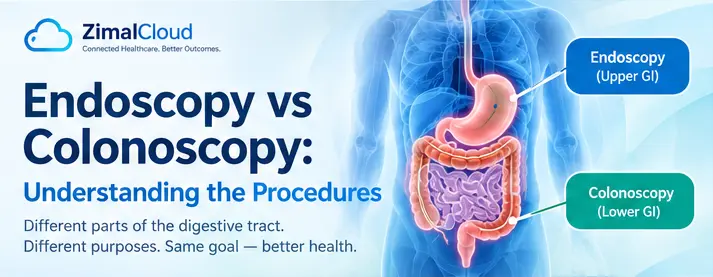
Table of contents
- Endoscopy vs Colonoscopy: Understanding the Procedures
- What Is an Endoscopy?
- What Does an Upper Endoscopy Examine?
- Why Is an Endoscopy Performed?
- What Is a Colonoscopy?
- What Does a Colonoscopy Examine?
- Why Is a Colonoscopy Performed?
- Endoscopy vs Colonoscopy: Key Differences
- Endoscopy vs Colonoscopy: How the Procedures Work
- How an Upper Endoscopy Works
- How a Colonoscopy Works
- Preparation: Endoscopy vs Colonoscopy
- Upper Endoscopy Preparation
- Colonoscopy Preparation
- What Can Doctors Find During an Endoscopy?
- What Can Doctors Find During a Colonoscopy?
- Can Endoscopy and Colonoscopy Be Done Together?
- Endoscopy vs Colonoscopy: Which One Do You Need?
- Risks and Considerations
- The Role of Technology in Modern GI Procedures
- Final Thoughts
Endoscopy vs Colonoscopy: Understanding the Procedures
Endoscopy and colonoscopy are two commonly used procedures that allow healthcare professionals to examine the inside of the digestive tract. Although both use a flexible camera-equipped scope, they examine different parts of the gastrointestinal (GI) system and are used for different diagnostic and treatment purposes.
Understanding the difference between endoscopy vs colonoscopy can help patients and healthcare teams better understand what each procedure involves, why it may be recommended, and how they differ in preparation, examination area, and follow-up.
Medical note: This article is for general educational purposes and does not replace advice from a qualified healthcare professional. Preparation, sedation, procedure techniques, and follow-up can vary depending on the patient and clinical situation.
What Is an Endoscopy?
An upper endoscopy, also called esophagogastroduodenoscopy (EGD), is a procedure used to examine the upper part of the digestive tract.
A healthcare professional uses a thin, flexible tube called an endoscope. The endoscope has a camera and light that allow the clinician to view the lining of the digestive tract on a monitor.
What Does an Upper Endoscopy Examine?
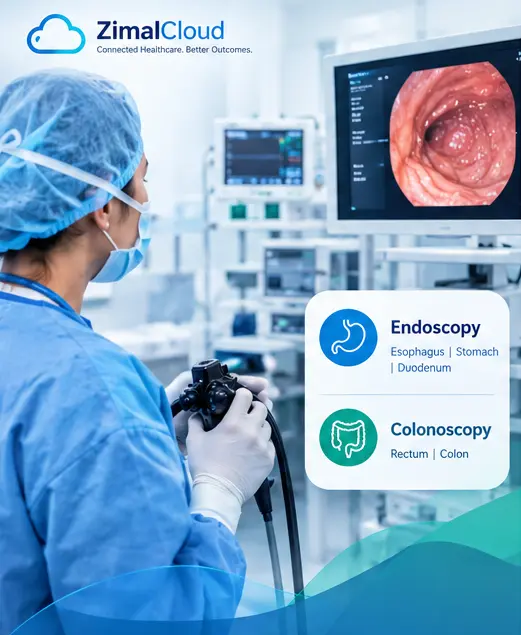
An upper endoscopy typically examines:
- Esophagus — the tube connecting the mouth to the stomach
- Stomach
- Duodenum — the first section of the small intestine
Why Is an Endoscopy Performed?
An upper endoscopy may be recommended to investigate symptoms or conditions such as:
- Persistent upper abdominal discomfort
- Difficulty swallowing
- Persistent heartburn or reflux symptoms
- Nausea or vomiting
- Unexplained upper GI bleeding
- Anemia when an upper GI source is suspected
- Gastritis
- Peptic ulcers
- Abnormal findings from other tests
- Suspected gastrointestinal disease
During the procedure, the clinician may also take biopsy samples or perform certain treatments when clinically appropriate.
What Is a Colonoscopy?
A colonoscopy is a procedure used to examine the large intestine, also called the colon, and usually the rectum.
The clinician uses a flexible instrument called a colonoscope, which has a camera and light at its tip. The scope is carefully guided through the rectum into the colon.
What Does a Colonoscopy Examine?
A colonoscopy primarily examines:
- Rectum
- Colon
- In some cases, the end of the small intestine, called the terminal ileum
Why Is a Colonoscopy Performed?
A colonoscopy may be used for:
- Colorectal cancer screening
- Investigating blood in the stool
- Changes in bowel habits
- Persistent diarrhea
- Unexplained abdominal pain
- Unexplained anemia
- Investigation of suspected inflammatory bowel disease
- Follow-up of previously identified polyps or abnormalities
A colonoscopy can also allow clinicians to remove certain polyps or obtain tissue samples during the procedure.
Endoscopy vs Colonoscopy: Key Differences
The biggest difference between an upper endoscopy and a colonoscopy is which part of the digestive system is examined.
| Feature | Upper Endoscopy | Colonoscopy |
|---|---|---|
| Also called | EGD | Colonoscopy |
| Main area examined | Upper digestive tract | Large intestine |
| Entry point | Mouth | Rectum |
| Examines | Esophagus, stomach, duodenum | Rectum and colon |
| Common purpose | Investigate upper GI symptoms | Screening and investigating lower GI symptoms |
| Biopsy possible | Yes | Yes |
| Polyp removal | Certain upper-GI lesions may be treated depending on findings | Polyps can often be removed during colonoscopy |
| Preparation | Usually fasting | Usually bowel preparation |
| Sedation | Often used | Often used |
Endoscopy vs Colonoscopy: How the Procedures Work
Although both procedures use flexible scopes with cameras, the actual examination process is different.
How an Upper Endoscopy Works
Before an upper endoscopy, the patient is generally instructed to fast for a specified period so the upper digestive tract can be examined safely and clearly.
During the procedure:
- The patient is positioned appropriately.
- Sedation or anesthesia may be provided depending on the clinical setting.
- The endoscope is gently introduced through the mouth.
- The clinician guides it through the esophagus and into the stomach and duodenum.
- The digestive tract lining is examined.
- Biopsies or appropriate treatments may be performed if necessary.
- The scope is removed.
The procedure itself is generally relatively short, although the total visit may take longer because of preparation and recovery.
How a Colonoscopy Works
Colonoscopy requires more extensive preparation because the colon needs to be sufficiently clean for the clinician to see the intestinal lining.
Before the procedure, patients are typically given instructions for bowel preparation, which may include dietary changes and a prescribed bowel-cleansing solution.
During the procedure:
- The patient is positioned for the examination.
- Sedation or anesthesia may be provided.
- The colonoscope is inserted through the rectum.
- The scope is carefully advanced through the colon.
- The clinician examines the intestinal lining.
- Polyps may be removed when appropriate.
- Biopsies may be taken when clinically indicated.
- The scope is withdrawn while the colon is examined again.
Preparation: Endoscopy vs Colonoscopy
Preparation is one of the most noticeable differences between these procedures.
Upper Endoscopy Preparation
Preparation generally involves:
- Fasting before the procedure
- Following specific medication instructions
- Discussing medications and medical conditions with the care team
- Arranging transportation if sedation is used
The exact fasting and medication instructions should come from the healthcare provider performing the procedure.
Colonoscopy Preparation
Colonoscopy preparation generally involves:
- Following a specific diet before the procedure
- Avoiding certain foods according to the provider's instructions
- Taking a prescribed bowel-preparation solution
- Following instructions about medications
- Arranging transportation when sedation is used
Good bowel preparation is important because residual stool can make it more difficult to identify abnormalities.
What Can Doctors Find During an Endoscopy?
An upper endoscopy can help identify abnormalities involving the upper digestive tract, including:
- Inflammation
- Ulcers
- Narrowing or strictures
- Bleeding sources
- Abnormal tissue
- Certain infections or gastrointestinal disorders
- Tumors or other suspicious lesions
Biopsies may be taken to help determine the cause of an abnormal finding.
What Can Doctors Find During a Colonoscopy?
A colonoscopy can help identify:
- Colon polyps
- Colorectal cancer
- Inflammation
- Bleeding sources
- Diverticular disease
- Abnormal tissue
- Changes associated with inflammatory bowel disease
One important advantage of colonoscopy is that certain polyps can be removed during the same procedure, potentially preventing them from developing into colorectal cancer.
Can Endoscopy and Colonoscopy Be Done Together?
Yes. In some clinical situations, a healthcare professional may recommend both an upper endoscopy and colonoscopy during the same appointment.
This may be useful when a patient has symptoms that could originate from different areas of the digestive tract or when multiple diagnostic questions need to be evaluated.
The decision depends on the patient's symptoms, medical history, risk factors, previous findings, and the clinician's judgment.
Endoscopy vs Colonoscopy: Which One Do You Need?
The appropriate procedure depends primarily on the symptoms or clinical question being investigated.
An upper endoscopy may be more appropriate when the concern involves the:
Esophagus → Stomach → Duodenum
A colonoscopy may be more appropriate when the concern involves the:
Rectum → Colon
For example:
- Difficulty swallowing → Upper endoscopy may be considered
- Persistent upper abdominal symptoms → Upper endoscopy may be considered
- Blood in stool → Colonoscopy may be considered
- Colorectal cancer screening → Colonoscopy may be recommended
- Persistent changes in bowel habits → Colonoscopy may be considered
The final decision should always be made by the patient's healthcare professional.
Risks and Considerations
Both procedures are generally considered safe when performed by appropriately trained healthcare professionals, but no medical procedure is completely risk-free.
Potential risks can include:
- Bleeding
- Infection
- Reaction to sedation or anesthesia
- Perforation of the digestive tract
- Abdominal discomfort or bloating
- Complications related to biopsy or polyp removal
The level of risk depends on the patient's health, the procedure performed, and whether additional treatments are required.
Patients should discuss their medications, allergies, medical conditions, and any concerns with their healthcare team before the procedure.
The Role of Technology in Modern GI Procedures
Modern GI practices increasingly use digital technology to support the procedure lifecycle—from scheduling and preparation to documentation, coding, follow-up, and billing.
A connected GI workflow can help teams manage:
- Patient scheduling
- Procedure preparation
- Pre-procedure documentation
- Endoscopy documentation
- Structured findings
- Biopsy information
- Automated report workflows
- CPT and ICD coding support
- Provider review
- Final report generation
- Follow-up tasks
- Billing workflows
For GI practices, connecting these steps can reduce repetitive administrative work and help clinicians spend more time focused on patient care.
Final Thoughts
Endoscopy vs colonoscopy is primarily a difference in the part of the digestive tract being examined.
An upper endoscopy evaluates the esophagus, stomach, and duodenum, while a colonoscopy evaluates the rectum and colon.
Both procedures can play an important role in diagnosing gastrointestinal conditions, obtaining tissue samples, and performing certain treatments. For GI practices, effective digital workflows can also help connect scheduling, procedure documentation, reporting, coding, and follow-up into a more efficient care process.
Understanding these differences helps patients and healthcare teams make sense of the purpose, preparation, and workflow associated with each procedure.
FAQ
Frequently asked questions
Is an endoscopy the same as a colonoscopy?
No. An upper endoscopy examines the upper digestive tract, including the esophagus, stomach, and duodenum. A colonoscopy examines the rectum and colon.
Is a colonoscopy an endoscopy?
Technically, both procedures use an endoscope to examine the digestive tract. However, in everyday medical terminology, the term endoscopy often refers specifically to an upper endoscopy or EGD, while colonoscopy refers to examination of the colon.
Which procedure requires bowel preparation?
A colonoscopy generally requires bowel preparation because the colon needs to be cleaned before examination. Upper endoscopy generally requires fasting rather than a full bowel cleanse.
Can biopsies be taken during both procedures?
Yes. When clinically appropriate, tissue samples can be collected during both upper endoscopy and colonoscopy.
Can polyps be removed during a colonoscopy?
Yes. Many polyps can be removed during colonoscopy using techniques appropriate to their size, location, and appearance.
How long does an endoscopy or colonoscopy take?
Procedure times vary depending on the patient and findings. The total appointment can take longer because of preparation, sedation, recovery, and discharge instructions.