What Is Remote Patient Monitoring (RPM)?
Remote Patient Monitoring (RPM) allows healthcare providers to monitor patients' health data from outside a traditional clinical setting. Using connected devices and digital technology, RPM can collect vital signs, share information with care teams, identify changes early, and support timely interventions—helping patients stay connected to care from the comfort of home.
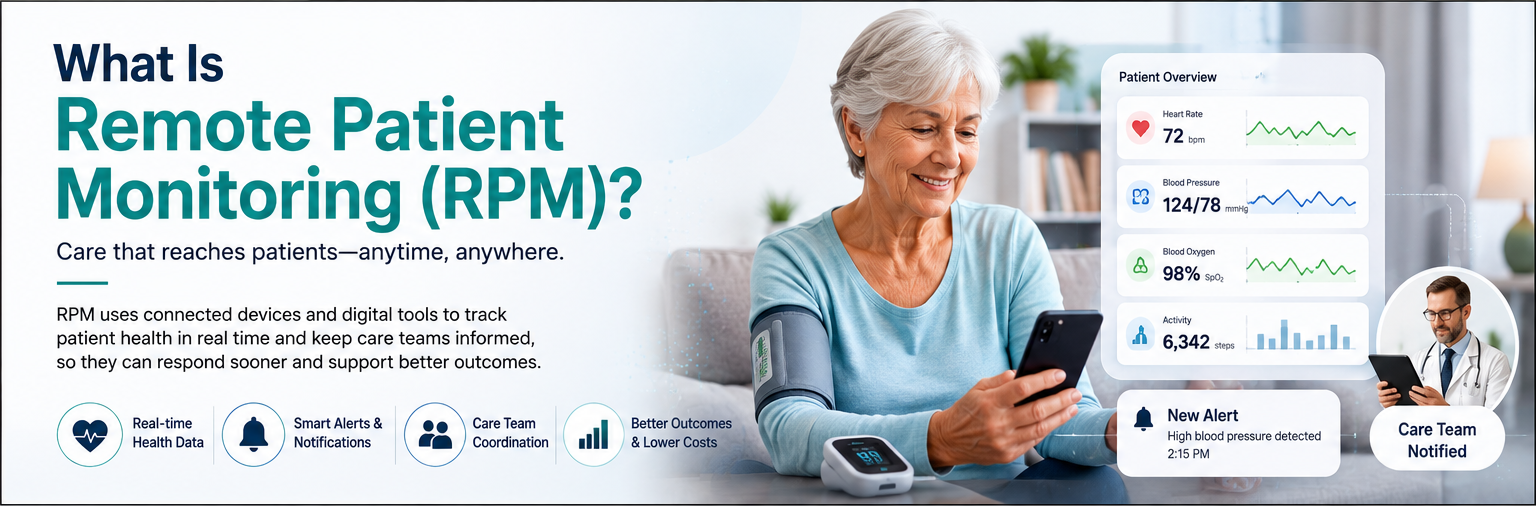
Table of contents
- What Is Remote Patient Monitoring?
- How Does Remote Patient Monitoring Work?
- 1. The Patient Uses a Connected Device
- 2. Health Data Is Transmitted
- 3. The Care Team Reviews the Information
- 4. Alerts Can Highlight Concerning Changes
- 5. The Care Team Responds
- Why Is RPM Important?
- Common Devices Used in RPM
- Blood Pressure Monitors
- Glucose Monitors
- Pulse Oximeters
- Digital Weight Scales
- Wearable Devices
- Who Can Benefit From Remote Patient Monitoring?
- Benefits of Remote Patient Monitoring
- 1. More Continuous Visibility
- 2. Earlier Recognition of Changes
- 3. Greater Patient Engagement
- 4. Convenient Care
- 5. Better Care Coordination
- 6. Support for Proactive Care
- What Does the Patient Experience Look Like?
- The Role of Healthcare Technology in RPM
- Challenges of Remote Patient Monitoring
- Technology Adoption
- Connectivity
- Data Overload
- Privacy and Security
- Clinical Workflow
- Patient Engagement
- RPM vs. Traditional Patient Monitoring
- The Future of Remote Patient Monitoring
- Final Takeaway
Healthcare doesn't always have to happen inside a clinic.
With today's connected technology, patients can measure certain health information at home while healthcare professionals monitor that information remotely. This approach is known as Remote Patient Monitoring (RPM).
RPM connects patients and care teams through digital devices, software, and secure data-sharing technologies. Instead of relying only on occasional appointments, providers can receive health information between visits and use it to support ongoing care.
The result is a healthcare model that can be more connected, proactive, and convenient.
What Is Remote Patient Monitoring?
Remote Patient Monitoring is a healthcare approach that allows providers to collect and monitor patient-generated health data from a distance.
Patients may use connected medical devices to measure information such as:
- Blood pressure
- Blood glucose
- Heart rate
- Blood oxygen levels
- Weight
- Temperature
- Other health measurements relevant to their care
Depending on the technology, measurements can be transmitted electronically to a healthcare platform where authorized members of the care team can review them.
RPM is different from simply having a video appointment with a doctor. Telehealth primarily connects patients and providers for virtual interactions, while RPM focuses on collecting and monitoring health data outside the traditional clinical setting.
How Does Remote Patient Monitoring Work?
Although RPM programs can vary, the basic process is straightforward.
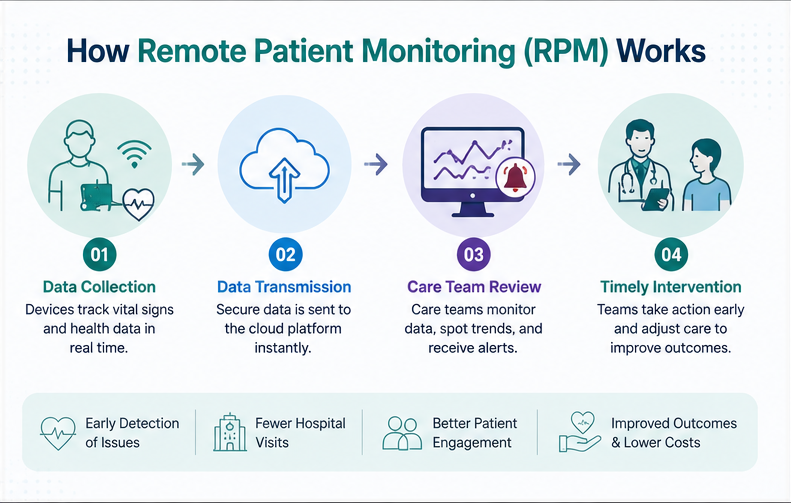
1. The Patient Uses a Connected Device
A patient uses an appropriate monitoring device at home.
For example, someone managing high blood pressure may use a connected blood pressure monitor to record readings regularly.
The device may automatically transfer measurements to a smartphone, tablet, hub, or another connected system.
2. Health Data Is Transmitted
The collected information is securely transmitted to an RPM platform or healthcare system.
Instead of requiring the patient to manually call the clinic with every measurement, connected technology can streamline the movement of data.
3. The Care Team Reviews the Information
Authorized healthcare professionals can review incoming measurements, trends, and other relevant information.
Rather than focusing only on one isolated reading, providers may be able to observe changes over time.
4. Alerts Can Highlight Concerning Changes
RPM platforms may be configured to identify measurements that fall outside predefined parameters.
When appropriate, an alert can notify the care team that a patient's data requires attention.
An alert does not automatically mean that an emergency exists. It simply provides an opportunity for the appropriate healthcare professional to review the situation and determine what action, if any, is needed.
5. The Care Team Responds
Based on the patient's situation and clinical judgment, the care team may contact the patient, provide guidance, adjust the care plan, schedule an appointment, or recommend additional evaluation.
This creates a continuous connection between patient data and clinical care.
Why Is RPM Important?
Traditional healthcare often depends on information collected during scheduled appointments.
But health conditions don't pause between visits.
A patient's blood pressure, glucose levels, weight, or symptoms can change significantly between appointments. RPM provides another way to capture relevant information during everyday life.
This can give healthcare teams additional insight into how a patient is doing outside the clinic.
RPM can support:
- Earlier identification of potential problems
- Ongoing disease management
- More informed clinical decisions
- Greater patient engagement
- Better communication between patients and care teams
- Convenient monitoring from home
- More continuous care
Common Devices Used in RPM
Remote Patient Monitoring can involve different types of connected devices depending on the patient's condition and care plan.
Blood Pressure Monitors
Connected blood pressure monitors can record systolic and diastolic blood pressure along with pulse measurements.
Glucose Monitors
For appropriate patients, connected glucose-monitoring devices can provide information that helps care teams understand glucose patterns.
Pulse Oximeters
These devices measure blood oxygen saturation and pulse rate and may be used in certain respiratory or other monitoring programs.
Digital Weight Scales
Connected scales can help care teams track changes in weight over time, which can be useful in managing certain conditions.
Wearable Devices
Some RPM programs may incorporate wearable technology capable of collecting selected health or activity measurements.
The specific device should be selected based on the patient's clinical needs, care plan, usability, and appropriate healthcare guidance.
Who Can Benefit From Remote Patient Monitoring?
RPM can be useful in a variety of healthcare scenarios.
It may support patients who need ongoing monitoring for conditions such as:
- Hypertension
- Diabetes
- Certain cardiovascular conditions
- Respiratory conditions
- Chronic diseases requiring regular measurements
- Post-discharge monitoring
- Other situations where remote health data can support clinical management
RPM isn't necessarily appropriate for every patient or every condition. The value comes from matching the right monitoring approach to the right clinical need.
Benefits of Remote Patient Monitoring
1. More Continuous Visibility
RPM can give care teams access to health information between appointments, creating a broader view of a patient's condition.
2. Earlier Recognition of Changes
Regular measurements can make changes or trends easier to identify than occasional readings collected only during office visits.
3. Greater Patient Engagement
Patients can become more involved in their care by regularly measuring and reviewing relevant health information.
4. Convenient Care
Patients can complete appropriate monitoring activities at home rather than traveling to a healthcare facility for every measurement.
5. Better Care Coordination
When RPM data is integrated into clinical workflows, it can help care teams coordinate monitoring, follow-up, and patient communication.
6. Support for Proactive Care
Instead of waiting until the next scheduled appointment to discover that a patient's condition has changed, providers may have opportunities to respond earlier when clinically appropriate.
What Does the Patient Experience Look Like?
A successful RPM program should be simple enough to fit naturally into a patient's daily routine.
For example:
Morning → Measure → Data Transmitted → Care Team Reviews → Follow-Up When Needed
The patient takes the appropriate measurement using a connected device. The information moves into the monitoring platform, where authorized members of the care team can review it.
If the data shows a concerning trend or measurement, the care team can determine whether follow-up is appropriate.
The technology supports the process—but clinical judgment remains at the center of care.
The Role of Healthcare Technology in RPM
Technology is what makes modern RPM possible.
A typical RPM ecosystem can connect:
Patient → Medical Device → Connectivity → RPM Platform → Healthcare Team
The platform may provide dashboards, trend reports, notifications, documentation tools, and other workflow features.
Integration with electronic health records and other healthcare systems can further reduce information silos and help providers incorporate remote data into broader patient care.
However, technology should complement clinical workflows rather than create unnecessary complexity.
Challenges of Remote Patient Monitoring
RPM offers significant potential, but implementing it effectively requires planning.
Technology Adoption
Patients need devices and applications that are understandable and easy to use.
Connectivity
Reliable connectivity is important for transferring measurements from the patient's device to the monitoring platform.
Data Overload
Collecting information is only useful if healthcare teams can review and act on meaningful data. Poorly designed systems can create unnecessary notifications and workload.
Privacy and Security
Patient health information must be handled using appropriate privacy and security safeguards.
Clinical Workflow
Healthcare organizations need clear processes defining who monitors incoming information, who responds to alerts, and how follow-up is documented.
Patient Engagement
Patients are more likely to participate when the technology is convenient, understandable, and clearly connected to their care.
RPM vs. Traditional Patient Monitoring
The biggest difference is where and when health information is collected.
| Traditional Monitoring | Remote Patient Monitoring |
|---|---|
| Often collected during appointments | Can be collected at home |
| Periodic measurements | Potentially more frequent measurements |
| Patient travels to a facility | Monitoring can happen remotely |
| Information may be limited to visit dates | Can provide information between visits |
| Follow-up often occurs at scheduled intervals | Follow-up may occur when clinically appropriate |
RPM doesn't necessarily replace traditional healthcare. Instead, it can extend care beyond the walls of the clinic.
The Future of Remote Patient Monitoring
As healthcare becomes increasingly connected, RPM is becoming an important part of the broader digital health ecosystem.
Advances in connected devices, cloud platforms, data analytics, artificial intelligence, and healthcare interoperability may make it easier to collect, organize, and interpret health information remotely.
The future isn't simply about collecting more patient data.
It's about collecting useful information, delivering it securely to the appropriate care team, and turning that information into meaningful action.
Final Takeaway
Remote Patient Monitoring changes the way healthcare teams can stay connected with patients.
By combining connected medical devices, secure data transmission, monitoring platforms, and clinical expertise, RPM can extend healthcare beyond the traditional clinic and support more continuous patient care.
The most valuable part of RPM isn't the device itself.
It's the connection between the patient's everyday health data and the healthcare professionals who can use that information to support better care.