RPM vs Telehealth: Understanding the Difference
RPM and telehealth both bring healthcare beyond the traditional clinic, but they serve different purposes. Remote Patient Monitoring uses connected devices to collect and review patient health data, while telehealth enables remote consultations, communication, and care delivery. Learn how RPM and telehealth differ, how they can work together, and when each approach benefit patients and providers.
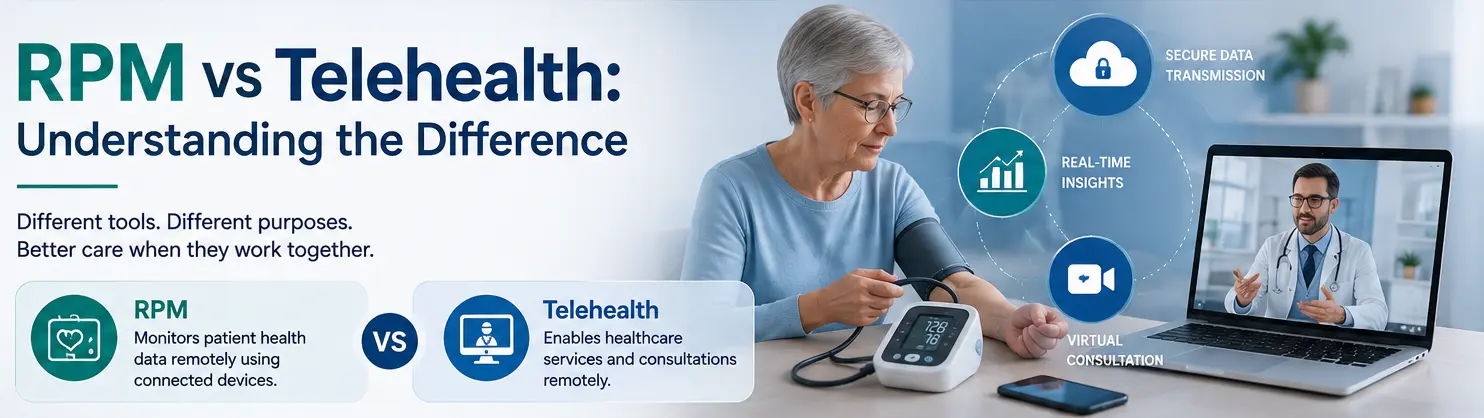
Table of contents
- Introduction
- What Is Remote Patient Monitoring (RPM)?
- Example
- What Is Telehealth?
- RPM vs Telehealth: The Key Difference
- RPM vs Telehealth Comparison
- How Does RPM Work?
- 1. Patient Enrollment
- 2. Device Setup
- 3. Data Collection
- 4. Data Transmission
- 5. Clinical Review
- 6. Follow-Up
- How Does Telehealth Work?
- 1. Appointment or Service Scheduling
- 2. Virtual Connection
- 3. Clinical Interaction
- 4. Care Decision
- 5. Follow-Up
- Can RPM and Telehealth Be Used Together?
- Benefits of Remote Patient Monitoring
- Continuous Visibility
- Patient Engagement
- Convenient Monitoring
- Trend Identification
- Proactive Care
- Benefits of Telehealth
- Greater Convenience
- Expanded Access
- Flexible Follow-Up
- Better Communication
- RPM and Telehealth Are Not Replacements for Each Other
- Which One Does a Healthcare Practice Need?
- Consider RPM When:
- Consider Telehealth When:
- Consider Both When:
- What About Medicare and Billing?
- Choosing the Right Technology
- Final Thoughts
Introduction
Healthcare delivery is no longer limited to the traditional clinic visit. Digital health technologies now allow providers to communicate with patients, monitor health conditions, and deliver care beyond the walls of a medical practice.
Two terms that are often used together are Remote Patient Monitoring (RPM) and Telehealth. While both use technology to support remote care, they are not the same thing.
Telehealth generally enables healthcare services to be delivered remotely, while RPM specifically focuses on collecting and reviewing patient health data from connected devices.
Understanding the difference can help healthcare organizations choose the right technology, workflows, and care model for their patients.
What Is Remote Patient Monitoring (RPM)?
Remote Patient Monitoring (RPM) is a healthcare service that allows providers to monitor patients outside the traditional clinical setting by collecting health-related data electronically.
Patients may use connected medical devices to measure information such as:
- Blood pressure
- Blood glucose
- Weight
- Heart rate
- Oxygen saturation
- Other relevant physiological measurements
The collected information can be transmitted to the healthcare team for review. Clinical staff can monitor trends, identify potentially concerning changes, communicate with patients when appropriate, and incorporate the information into ongoing care.
Example
A patient with hypertension receives a connected blood pressure monitor. The patient takes measurements at home, and the readings are transmitted electronically to the healthcare team.
The provider or clinical staff can review the readings over time and determine whether additional follow-up or clinical action is appropriate.
RPM is primarily about monitoring patient health data remotely.
What Is Telehealth?
Telehealth is a broader concept that encompasses the use of electronic and telecommunications technologies to support healthcare delivery at a distance.
Telehealth can include services such as:
- Video consultations
- Telephone visits
- Secure messaging
- Virtual follow-up appointments
- Remote consultations
- Patient education
- Communication between healthcare professionals
- Other technology-enabled healthcare services
For example, a patient may have a video appointment with their physician instead of traveling to the clinic for a routine follow-up.
Telehealth is primarily about delivering healthcare services remotely.
RPM vs Telehealth: The Key Difference
The simplest way to understand the difference is:
Telehealth connects patients and healthcare professionals remotely. RPM connects patient health data with the healthcare team.
Telehealth often involves communication or a virtual interaction.
RPM involves collecting, transmitting, and reviewing physiological health data.
These approaches can also work together.
For example, a patient might use RPM to send blood pressure readings to their care team and then have a telehealth appointment to discuss those readings.
RPM vs Telehealth Comparison
| Feature | RPM | Telehealth |
|---|---|---|
| Primary purpose | Monitor patient health data remotely | Deliver healthcare services remotely |
| Main focus | Physiological data | Communication and care delivery |
| Typical technology | Connected medical devices and monitoring platforms | Video, telephone, messaging, and virtual-care platforms |
| Patient interaction | Often involves regular measurements and monitoring | Usually involves a scheduled or asynchronous interaction |
| Data collected | Blood pressure, glucose, weight, oxygen saturation, etc. | Information shared during a virtual encounter |
| Provider activity | Review and respond to relevant patient data | Conduct consultation, follow-up, education, or other remote services |
| Can it operate continuously? | Often designed for ongoing monitoring | Usually organized around specific interactions or encounters |
| Can they work together? | Yes | Yes |
How Does RPM Work?
A typical RPM workflow can involve several steps.
1. Patient Enrollment
An eligible patient is enrolled in a remote monitoring program based on their clinical needs and applicable requirements.
2. Device Setup
The patient receives an appropriate connected medical device, such as a blood pressure monitor or scale.
3. Data Collection
The patient uses the device to record measurements according to the care plan or monitoring workflow.
4. Data Transmission
The measurement is electronically transmitted to the healthcare platform or monitoring system.
5. Clinical Review
Authorized healthcare personnel review the information and look for relevant trends or changes.
6. Follow-Up
When clinically appropriate, the care team may communicate with the patient or take other appropriate actions.
This creates a continuous feedback loop between the patient, device, data, and care team.
How Does Telehealth Work?
Telehealth typically follows a different workflow.
1. Appointment or Service Scheduling
The patient schedules a virtual appointment or receives instructions for another remote service.
2. Virtual Connection
The patient connects with the healthcare professional through video, telephone, messaging, or another supported communication method.
3. Clinical Interaction
The provider discusses symptoms, concerns, treatment, medications, or follow-up needs with the patient.
4. Care Decision
Based on the available information, the provider determines appropriate next steps.
5. Follow-Up
The patient may receive additional instructions, referrals, prescriptions where appropriate, or another appointment.
The central element is remote communication between the patient and healthcare professional.
Can RPM and Telehealth Be Used Together?
Yes.
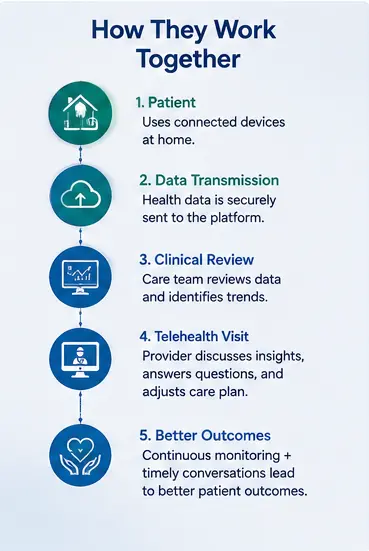
In fact, combining RPM and telehealth can create a more connected remote-care experience.
Consider a patient with hypertension.
RPM can provide the healthcare team with regular blood pressure readings from the patient's home.
Telehealth can provide a convenient way for the provider and patient to discuss those readings, review symptoms, answer questions, and determine appropriate next steps.
The two technologies therefore address different parts of the remote-care process.
RPM provides ongoing health data.
Telehealth provides remote interaction and care delivery.
Benefits of Remote Patient Monitoring
RPM can offer several potential advantages for appropriate patients and clinical programs.
Continuous Visibility
Regular measurements can provide clinicians with information between traditional office visits.
Patient Engagement
Patients can participate more actively in monitoring their own health.
Convenient Monitoring
Patients may be able to record measurements from home rather than traveling to a healthcare facility for every check.
Trend Identification
Repeated measurements can provide a clearer picture of how a patient's condition changes over time.
Proactive Care
When relevant changes are identified, care teams may be able to follow up sooner rather than waiting for the next scheduled visit.
Benefits of Telehealth
Telehealth can also provide important benefits.
Greater Convenience
Patients can connect with healthcare professionals without always needing to travel to a clinic.
Expanded Access
Virtual care can make it easier for some patients to communicate with providers, particularly when distance or mobility creates barriers.
Flexible Follow-Up
Certain follow-up services can be delivered remotely when clinically appropriate.
Better Communication
Video visits, telephone calls, and secure messaging can help maintain communication between patients and healthcare teams.
RPM and Telehealth Are Not Replacements for Each Other
One common misconception is that RPM and telehealth are competing technologies.
They are better understood as complementary tools.
Telehealth can provide the communication channel.
RPM can provide ongoing physiological information.
For example:
Patient → Connected Device → RPM Platform → Clinical Team → Telehealth Visit → Patient
This connected approach can give providers both real-time patient interaction and ongoing health data.
Which One Does a Healthcare Practice Need?
The answer depends on the practice's goals and patient population.
Consider RPM When:
- Patients require ongoing physiological monitoring
- Connected devices can provide clinically relevant measurements
- The care team needs visibility between office visits
- The organization wants to establish a remote monitoring workflow
Consider Telehealth When:
- Patients need remote consultations
- Follow-up care can appropriately be delivered virtually
- Travel to the clinic creates unnecessary barriers
- Providers need a convenient way to communicate with patients remotely
Consider Both When:
Patients need both ongoing physiological monitoring and regular remote interaction with their care team.
What About Medicare and Billing?
RPM and telehealth are distinct services and should not be treated as interchangeable for billing purposes.
Eligibility, documentation, consent, technology, time, coding, and other requirements can vary depending on the service and payer.
Healthcare organizations should verify current CMS guidance and applicable payer requirements before establishing workflows or submitting claims.
Because Medicare and payer policies can change, practices should use current official guidance when determining whether a particular service is covered and how it should be documented and billed.
Choosing the Right Technology
When implementing RPM or telehealth, healthcare organizations should look beyond individual features.
A modern digital health platform should ideally support:
- Secure patient communication
- Device and data connectivity
- Patient engagement
- Clinical workflows
- EHR integration
- Notifications and task management
- Documentation
- Reporting and analytics
- Appropriate security and privacy safeguards
- Interoperability
The goal is to create a connected workflow rather than another isolated technology system.
Final Thoughts
RPM and telehealth both extend healthcare beyond the traditional clinic, but they serve different purposes.
RPM focuses on collecting and monitoring patient health data remotely, while telehealth focuses on delivering healthcare services and communication through digital technologies.
The two can work especially well together. RPM can give care teams ongoing visibility into patient measurements, while telehealth can provide the communication channel needed to discuss those measurements and deliver appropriate remote care.
For healthcare organizations building modern digital-care programs, understanding the distinction between RPM and telehealth is an important first step toward creating efficient, connected, and patient-centered workflows.