How AI Is Transforming Healthcare Practice Management
AI is transforming healthcare practice management by automating administrative tasks, optimizing scheduling, improving documentation, supporting billing, enhancing patient communication, and turning healthcare data into actionable insights. With strong privacy, security, and human oversight, AI can help practices improve efficiency, reduce workload, strengthen care coordination.
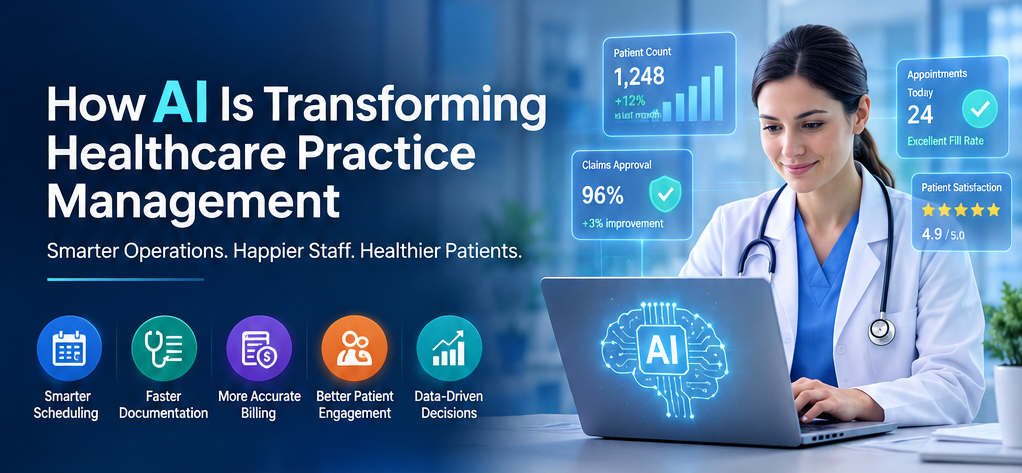
Table of contents
- 1. Automating Administrative Work
- 2. Smarter Appointment Scheduling
- 3. Improving Clinical Documentation
- 4. Enhancing Patient Communication
- 5. Supporting Revenue Cycle Management
- 6. Turning Healthcare Data Into Actionable Insights
- 7. Supporting Care Coordination
- 8. Improving Patient Engagement
- 9. Helping Practice Leaders Make Better Decisions
- 10. Strengthening Compliance and Security
- Challenges of Implementing AI in Healthcare Practice Management
- The Future of AI in Practice Management
- Conclusion
Artificial intelligence (AI) is rapidly changing how healthcare organizations manage daily operations, coordinate care, and engage with patients. While AI was once associated mainly with clinical research and diagnostics, it is now becoming an important part of healthcare practice management.
From automating administrative tasks to improving scheduling, documentation, communication, and data analysis, AI can help healthcare practices operate more efficiently while allowing staff to spend more time focused on patients.
1. Automating Administrative Work
Healthcare practices handle a significant amount of administrative work, including appointment scheduling, patient registration, insurance verification, billing, and documentation.
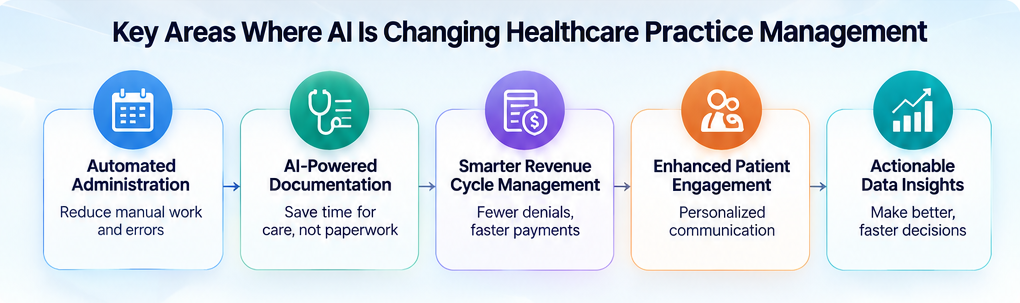
AI-powered tools can automate repetitive processes, reducing manual workloads and helping staff complete tasks faster. Automated workflows can also reduce data-entry errors and create more consistent processes across the practice.
2. Smarter Appointment Scheduling
Missed appointments and inefficient scheduling can affect both patient satisfaction and practice revenue.
AI can analyze appointment patterns, patient preferences, provider availability, and cancellation trends to support smarter scheduling. Automated reminders through text, email, or patient portals can also help reduce no-shows.
AI-assisted scheduling can make it easier to fill canceled appointments and optimize provider calendars without requiring staff to manage every scheduling decision manually.
3. Improving Clinical Documentation
Documentation is an essential part of healthcare, but it can also consume considerable time.
AI-powered ambient documentation and speech-to-text technologies can help capture relevant information from patient-provider conversations and organize it into structured clinical notes. Providers can then review and approve the documentation rather than creating every note from scratch.
This can reduce administrative burden while helping practices maintain organized patient records.
4. Enhancing Patient Communication
Patients increasingly expect convenient and responsive communication from their healthcare providers.
AI-powered chatbots and virtual assistants can answer routine questions, provide appointment information, send reminders, collect basic information, and guide patients toward appropriate resources.
When designed with appropriate safeguards, these tools can extend communication beyond normal office hours while allowing staff to focus on more complex patient needs.
5. Supporting Revenue Cycle Management
Revenue cycle management is another area where AI can make a significant difference.
AI systems can identify potential billing errors, analyze claims, flag missing information, and help practices identify patterns associated with claim denials. By detecting problems earlier, practices can potentially reduce delays and improve the efficiency of their billing workflows.
AI does not replace the need for trained billing professionals, but it can provide them with tools to identify and prioritize issues more efficiently.
6. Turning Healthcare Data Into Actionable Insights
Modern healthcare practices generate large amounts of data from electronic health records, scheduling systems, billing platforms, remote monitoring devices, and patient engagement tools.
AI can analyze these datasets to identify trends and patterns that may be difficult to detect manually. Practice leaders can use these insights to monitor operational performance, understand patient engagement, evaluate workflows, and identify opportunities for improvement.
The goal is not simply to collect more data, but to turn existing information into useful insights for better decision-making.
7. Supporting Care Coordination
AI can help connect information across different parts of the healthcare workflow.
For example, AI-powered systems can help identify patients who may need follow-up, monitor care-management tasks, prioritize outreach, and surface relevant information for care teams.
This can be particularly useful for practices managing patients with chronic conditions or coordinating care across multiple providers.
8. Improving Patient Engagement
AI can support more personalized patient experiences by analyzing available information and adapting communication to individual needs.
Automated educational messages, reminders, follow-up communications, and personalized engagement strategies can encourage patients to stay connected with their care plans.
However, personalization should always be balanced with privacy, transparency, and appropriate human oversight.
9. Helping Practice Leaders Make Better Decisions
Healthcare practice managers must make decisions about staffing, scheduling, patient volume, resource utilization, and operational performance.
AI analytics can provide dashboards and predictive insights that help leaders understand what is happening within their practice. Instead of relying solely on historical reports, managers can use AI-assisted analysis to identify emerging trends and potential operational problems.
This can support more proactive practice management.
10. Strengthening Compliance and Security
Healthcare organizations must protect sensitive patient information and comply with applicable privacy and security requirements.
AI can assist with monitoring workflows, identifying unusual activity, organizing compliance-related information, and detecting potential risks. However, implementing AI also introduces new considerations around data governance, access controls, transparency, vendor management, and security.
Healthcare organizations should evaluate AI solutions carefully and ensure that their use aligns with applicable laws, regulations, organizational policies, and security requirements.
Challenges of Implementing AI in Healthcare Practice Management
Despite its benefits, AI implementation requires careful planning.
Practices should consider:
- Data privacy and security: Patient information must be handled securely.
- Accuracy: AI-generated information should be reviewed when errors could affect patient care or operations.
- Human oversight: AI should support healthcare professionals rather than remove appropriate human judgment.
- Integration: AI tools should work effectively with existing healthcare systems and workflows.
- Staff training: Employees need to understand how to use AI tools appropriately.
- Transparency: Organizations should understand how AI systems use and process information.
- Cost and scalability: Practices should evaluate whether an AI solution delivers measurable operational value.
The Future of AI in Practice Management
AI is moving healthcare practice management from primarily reactive administration toward more automated, data-driven, and proactive operations.
The most effective implementations will not simply add AI to existing processes. Instead, healthcare organizations will redesign workflows around where AI can reduce repetitive work, improve access to information, support staff, and enhance the patient experience.
AI is ultimately a tool. Its value depends on how thoughtfully it is implemented, monitored, and integrated into healthcare operations.
Conclusion
AI is transforming healthcare practice management by helping organizations automate administrative tasks, optimize scheduling, improve documentation, support revenue cycle processes, strengthen patient engagement, and make better use of healthcare data.
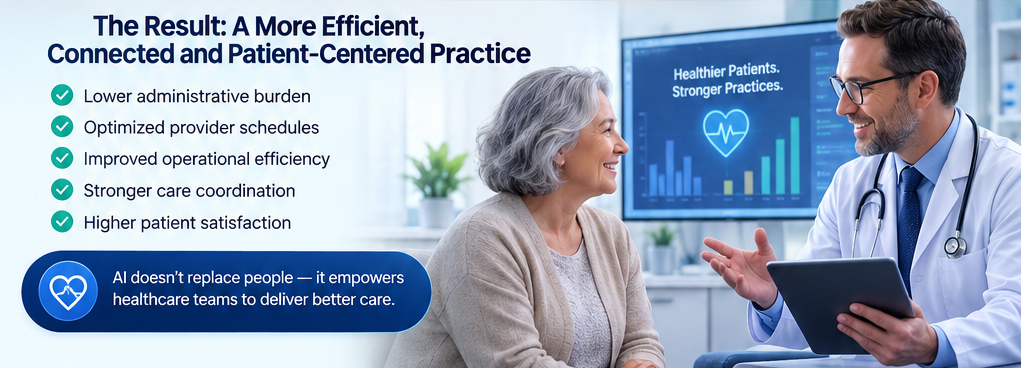
For healthcare practices, the opportunity is not about replacing people with technology. It is about using technology to reduce unnecessary workload and give healthcare teams more time and information to deliver efficient, patient-centered care.