Healthcare Data Exchange: A Guide for Medical Practices
Healthcare data exchange enables medical practices to securely share patient information between EHRs, laboratories, pharmacies, hospitals, and other healthcare providers. This guide explains how healthcare data exchange works, its benefits, common challenges, interoperability standards, security considerations, and practical steps practices can take to improve coordinated, and efficient.
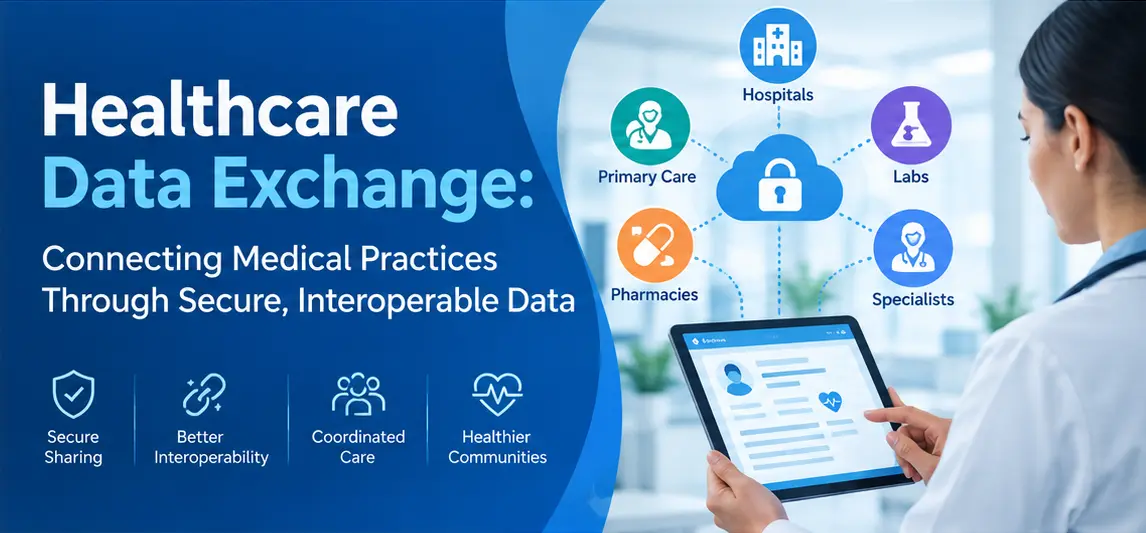
Table of contents
- Healthcare Data Exchange: A Guide for Medical Practices
- What Is Healthcare Data Exchange?
- Why Healthcare Data Exchange Matters for Medical Practices
- Healthcare data exchange can help practices:
- How Does Healthcare Data Exchange Work?
- 1. Data Is Created
- 2. Data Is Formatted
- 3. Data Is Transmitted
- 4. Data Is Received
- 5. Information Is Used in Care
- What Types of Healthcare Data Can Be Exchanged?
- Clinical Information
- Administrative Information
- Healthcare Data Exchange and EHR Interoperability
- Foundational Interoperability
- Structural Interoperability
- Semantic Interoperability
- Organizational Interoperability
- Common Healthcare Data Exchange Standards
- HL7
- FHIR
- DICOM
- APIs
- Benefits of Healthcare Data Exchange for Medical Practices
- 1. Better Access to Patient Information
- 2. Improved Care Coordination
- 3. Less Manual Data Entry
- 4. More Efficient Referrals
- 5. Reduced Information Gaps
- 6. More Efficient Workflows
- Challenges of Healthcare Data Exchange
- Fragmented Healthcare Systems
- Data Standardization
- Data Quality
- Privacy and Security
- Workflow Integration
- Healthcare Data Exchange Security
- Important security considerations include:
- Healthcare Data Exchange and Patient Privacy
- How Medical Practices Can Prepare for Healthcare Data Exchange
- Step 1: Identify Information Gaps
- Step 2: Map Current Workflows
- Step 3: Evaluate EHR Capabilities
- Step 4: Establish Security Controls
- Step 5: Test With a Limited Workflow
- Step 6: Measure Results
- Healthcare Data Exchange Best Practices
- Use Standards-Based Integration
- Prioritize Data Quality
- Integrate Exchange Into Workflows
- Apply Strong Access Controls
- Monitor Data Exchange
- Train Staff
- Review Performance Regularly
- The Future of Healthcare Data Exchange
- Conclusion
Healthcare Data Exchange: A Guide for Medical Practices
Modern healthcare depends on information. A patient's medical history, medications, laboratory results, allergies, diagnoses, referrals, and treatment plans may be stored across different healthcare organizations and technology systems.
Healthcare data exchange allows this information to move securely between authorized healthcare providers, systems, and organizations. When implemented effectively, it can help medical practices access relevant patient information when they need it and reduce unnecessary administrative work.
This guide explains healthcare data exchange in simple terms and explores why it matters for medical practices.
What Is Healthcare Data Exchange?
Healthcare data exchange is the electronic sharing of health information between authorized healthcare systems, organizations, and professionals.
For example, when a patient visits a primary care practice after receiving treatment at a hospital, the practice may need access to information such as:
- Recent diagnoses
- Laboratory results
- Medication information
- Allergies
- Clinical notes
- Imaging reports
- Discharge information
- Referral details
Instead of relying entirely on paper documents, phone calls, faxes, or manual data entry, healthcare data exchange can allow relevant information to be transferred electronically between connected systems.
The goal is not simply to move data. The information should be accessible, understandable, secure, and useful to authorized healthcare professionals.
Why Healthcare Data Exchange Matters for Medical Practices
Medical practices often work with multiple healthcare organizations and technology platforms. A patient may receive care from a primary care provider, specialist, hospital, pharmacy, laboratory, and imaging center.
Without effective data exchange, information can become fragmented.
Healthcare data exchange can help practices:
- Access patient information more efficiently
- Reduce duplicate data entry
- Improve care coordination
- Support clinical decision-making
- Reduce unnecessary duplicate testing
- Improve communication between providers
- Streamline referrals
- Support more complete patient records
- Reduce administrative workload
Better access to relevant information can also help healthcare professionals develop a more complete understanding of a patient's care history.
How Does Healthcare Data Exchange Work?
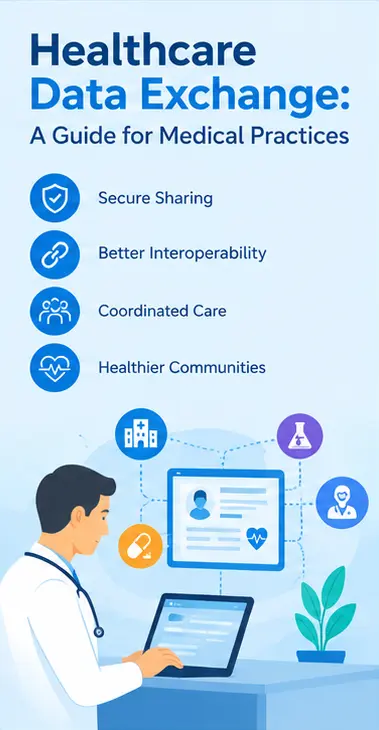
Healthcare data exchange generally involves several components working together.
1. Data Is Created
Patient information is generated through healthcare activities.
Examples include:
- A physician documenting an encounter
- A laboratory completing a test
- A pharmacy processing a prescription
- A hospital documenting a patient's admission or discharge
The information is typically stored in an electronic health record (EHR) or another healthcare information system.
2. Data Is Formatted
Healthcare systems need a common way to structure information so that another system can understand it.
Interoperability standards help systems exchange structured information consistently.
3. Data Is Transmitted
The information is securely transmitted between authorized systems.
Depending on the healthcare environment, exchange may occur through APIs, health information networks, interfaces, or other interoperability technologies.
4. Data Is Received
The receiving healthcare system processes the information and makes appropriate data available to authorized users.
For example, a physician may be able to view external laboratory results directly within an EHR workflow.
5. Information Is Used in Care
The final step is using the exchanged information to support patient care, coordination, documentation, and other authorized healthcare activities.
What Types of Healthcare Data Can Be Exchanged?
Healthcare data exchange can involve many types of clinical and administrative information.
Common examples include:
Clinical Information
- Patient demographics
- Diagnoses
- Medical histories
- Allergies
- Medications
- Vital signs
- Clinical notes
- Laboratory results
- Imaging reports
- Immunization records
- Procedures
- Care plans
Administrative Information
- Referrals
- Appointments
- Insurance-related information
- Provider information
- Encounter information
- Patient registration data
The specific information exchanged depends on the systems, workflows, permissions, regulations, and interoperability capabilities involved.
Healthcare Data Exchange and EHR Interoperability
EHR interoperability refers to the ability of different healthcare systems to exchange and use information effectively.
Simply connecting two systems does not necessarily mean they are fully interoperable.
For example, one system may send patient information successfully, but the receiving system may not be able to interpret or integrate that information properly.
Effective interoperability involves several levels.
Foundational Interoperability
Systems can technically exchange information.
Structural Interoperability
Systems use agreed-upon formats and structures so information can be processed consistently.
Semantic Interoperability
The receiving system can understand the meaning of the exchanged information.
Organizational Interoperability
Healthcare organizations establish the policies, workflows, agreements, and processes necessary to make information exchange useful in practice.
For medical practices, all of these elements can influence how effectively healthcare data exchange works.
Common Healthcare Data Exchange Standards
Standards help different healthcare applications communicate with one another.
Some commonly encountered healthcare interoperability standards and technologies include:
HL7
Health Level Seven International (HL7) develops widely used standards for exchanging healthcare information.
Traditional HL7 messaging standards have been used extensively for exchanging clinical and administrative information between healthcare systems.
FHIR
Fast Healthcare Interoperability Resources (FHIR) is an HL7 standard designed to support healthcare information exchange using modern web technologies and structured resources.
FHIR is increasingly important for API-based healthcare interoperability and application integration.
DICOM
Digital Imaging and Communications in Medicine (DICOM) is widely used for medical imaging information.
It supports the storage, transmission, retrieval, and management of medical images and related information.
APIs
Application programming interfaces, or APIs, provide a structured way for software systems to communicate.
In healthcare, APIs can enable authorized applications and systems to request and exchange specific information.
Benefits of Healthcare Data Exchange for Medical Practices
Implementing effective data exchange can provide benefits across clinical and administrative workflows.
1. Better Access to Patient Information
Healthcare professionals can access relevant information from other authorized systems without relying entirely on manual requests.
This can provide greater visibility into a patient's care history.
2. Improved Care Coordination
When multiple providers participate in a patient's care, information exchange can help them coordinate services more effectively.
For example, a primary care practice may need information from a specialist or hospital to continue appropriate follow-up care.
3. Less Manual Data Entry
Electronic exchange can reduce the need to manually enter information that already exists in another system.
This can save staff time and reduce opportunities for transcription errors.
4. More Efficient Referrals
Data exchange can support referral workflows by allowing relevant patient information to move between referring and receiving providers.
5. Reduced Information Gaps
When important records are stored in separate systems, providers may have an incomplete picture of a patient's history.
Data exchange can help reduce these information gaps when the appropriate systems are connected.
6. More Efficient Workflows
Integrated information can reduce unnecessary switching between systems, manual document handling, and repeated requests for patient records.
Challenges of Healthcare Data Exchange
Despite its potential benefits, healthcare data exchange can be challenging.
Fragmented Healthcare Systems
Medical practices may work with hospitals, laboratories, pharmacies, specialists, and other organizations using different technology platforms.
Connecting these systems can require significant technical coordination.
Data Standardization
Healthcare information can be complex. Different systems may structure, label, or represent information differently.
Standards can help, but implementation differences can still create interoperability challenges.
Data Quality
Exchanged information is only useful when it is accurate, complete, and appropriately matched to the correct patient.
Poor-quality or outdated information can create problems for clinical workflows.
Privacy and Security
Healthcare information is sensitive. Organizations must implement appropriate safeguards for protecting patient information during storage and exchange.
Security considerations can include:
- Authentication
- Authorization
- Encryption
- Access controls
- Audit logs
- Secure APIs
- Monitoring
- Data governance
Workflow Integration
Technology alone does not guarantee successful adoption.
Healthcare data exchange should fit naturally into clinical and administrative workflows. If staff must use complicated processes to access information, adoption may be limited.
Healthcare Data Exchange Security
Security is a critical component of healthcare information exchange.
Medical practices should consider how information is protected throughout its lifecycle.
Important security considerations include:
Access control: Only authorized individuals and systems should have access to appropriate information.
Authentication: Users and connected systems should be properly authenticated.
Encryption: Data should be protected during transmission and, where appropriate, while stored.
Auditability: Systems should maintain appropriate records of access and activity.
Data minimization: Organizations should exchange only the information necessary for the intended purpose where applicable.
Monitoring: Unusual access patterns and security events should be monitored and addressed.
Practices should also follow the privacy and security requirements applicable to their jurisdiction and healthcare environment.
Healthcare Data Exchange and Patient Privacy
Healthcare data exchange must balance accessibility with privacy.
Before implementing an exchange solution, a medical practice should understand:
- What information will be exchanged
- Who can access it
- Why the information is being exchanged
- Where the information will be stored
- How access is controlled
- How activity is monitored
- What legal and regulatory requirements apply
Policies and technical controls should work together to protect patient information.
How Medical Practices Can Prepare for Healthcare Data Exchange
Medical practices do not need to transform everything at once. A structured approach can make interoperability projects easier to manage.
Step 1: Identify Information Gaps
Start by identifying where staff currently struggle to obtain patient information.
For example:
- Hospital records
- Specialist reports
- Laboratory results
- Medication information
- Referral documentation
Step 2: Map Current Workflows
Document how information currently moves through the practice.
Ask:
- Where does information originate?
- How is it received?
- Who processes it?
- Where is it stored?
- Where are delays occurring?
Step 3: Evaluate EHR Capabilities
Review the practice's current EHR and other healthcare applications.
Look for capabilities such as:
- Interoperability support
- API connectivity
- FHIR support
- External record retrieval
- Referral integration
- Laboratory interfaces
- Health information exchange connectivity
Step 4: Establish Security Controls
Define appropriate access controls, authentication mechanisms, monitoring processes, and security policies before expanding data exchange.
Step 5: Test With a Limited Workflow
Instead of attempting to connect every system immediately, start with a clearly defined use case.
For example, a practice could initially focus on receiving laboratory results electronically.
Step 6: Measure Results
Track practical outcomes such as:
- Time spent retrieving records
- Manual data-entry requirements
- Referral processing time
- Duplicate information
- Staff workflow issues
- Data quality problems
The results can help determine where additional improvements are needed.
Healthcare Data Exchange Best Practices
Medical practices can improve their interoperability initiatives by following several practical principles.
Use Standards-Based Integration
Standards can make it easier for systems from different vendors to communicate.
Prioritize Data Quality
Patient information should be accurate, complete, current, and appropriately matched.
Integrate Exchange Into Workflows
Information should appear where healthcare professionals already work whenever practical.
Apply Strong Access Controls
Users should receive access based on their roles and responsibilities.
Monitor Data Exchange
Organizations should monitor exchange activity and investigate unusual events.
Train Staff
Employees should understand how information exchange works and how to handle patient information securely.
Review Performance Regularly
Interoperability should be treated as an ongoing process rather than a one-time technology implementation.
The Future of Healthcare Data Exchange
Healthcare data exchange is moving toward more connected and standards-based digital healthcare environments.
Modern interoperability approaches increasingly emphasize APIs, structured data, automation, and real-time access to information.
Artificial intelligence and healthcare analytics may also depend on access to reliable, well-structured healthcare data.
However, technological connectivity alone is not enough. Future healthcare data exchange will continue to depend on data quality, security, privacy, standards, governance, and practical clinical workflows.
Conclusion
Healthcare data exchange is an important part of modern medical practice. By enabling authorized healthcare information to move between connected systems, it can help practices improve information access, care coordination, and operational workflows.
Successful implementation requires more than connecting software. Medical practices should consider interoperability standards, data quality, security, privacy, workflow integration, staff training, and ongoing monitoring.
A practical, standards-based approach can help practices build a more connected healthcare environment while keeping patient information protected.