Gastroenterology (GI) Practice Management: A Complete Guide
Learn how modern GI practices can streamline referrals, scheduling, insurance verification, consultations, endoscopy and colonoscopy workflows, procedure reporting, coding, claims, payments, and follow-up. Discover how automation, AI, analytics, and integrated workflows can reduce administrative work, improve efficiency, and support a stronger revenue cycle.
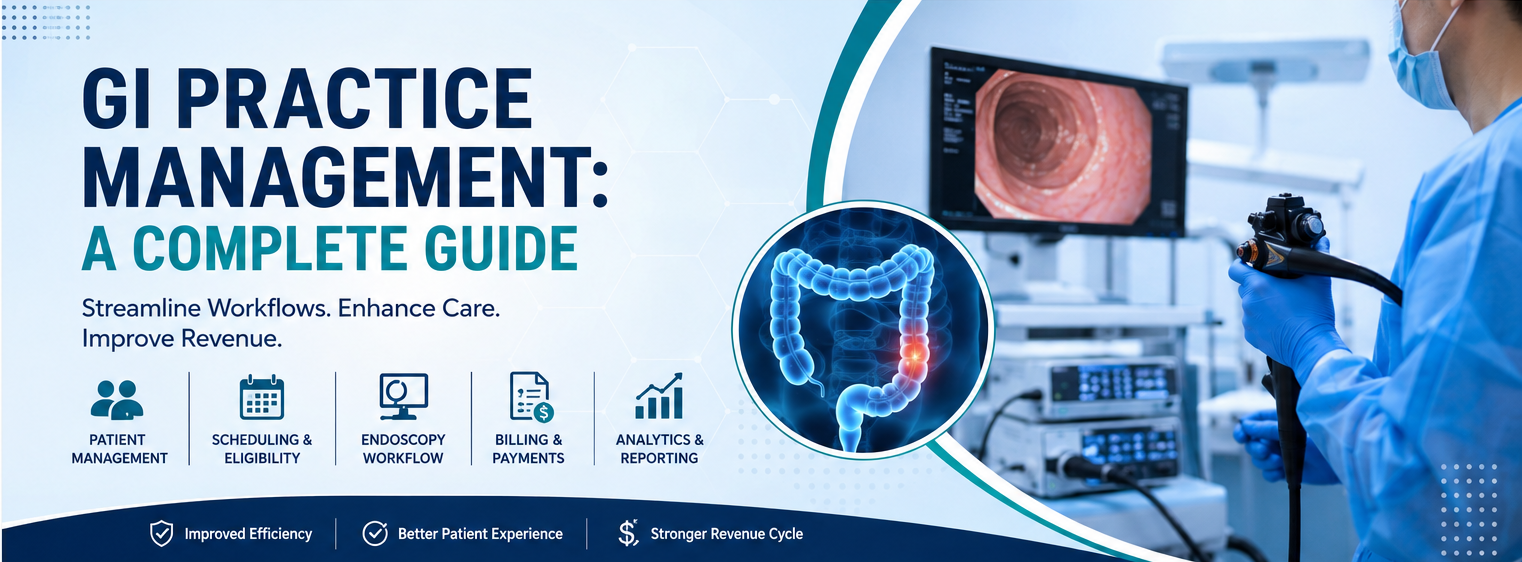
Table of contents
- What Is GI Practice Management?
- The GI Practice Management Workflow
- 1. Patient Referral Management
- Why referral management matters
- 2. Appointment and Scheduling Management
- Smart scheduling
- 3. Insurance Eligibility and Authorization
- 4. GI Patient Intake
- Patient Information
- Clinical Information
- GI-Specific Information
- 5. GI Consultation Management
- Clinical decision support
- 6. Procedure Planning
- 7. Endoscopy and Colonoscopy Management
- Procedure Information
- Findings
- Interventions
- Outcome
- 8. Automated GI Procedure Reports
- 9. ICD-10 and CPT Coding
- 10. Charge Capture
- 11. Claims Management
- 12. ERA and Payment Posting
- 13. Denial Management
- 14. Patient Billing and Collections
- 15. Patient Communication
- 16. GI Practice Analytics
- Operational Metrics
- Revenue Cycle Metrics
- Clinical Metrics
- Benefits of a Modern GI Practice Management System
- 1. Reduced Administrative Work
- 2. Faster Patient Processing
- 3. Better Procedure Management
- 4. Improved Revenue Cycle
- 5. Fewer Errors
- 6. Better Patient Experience
- What Should a GI Practice Management System Include?
- How AI Can Improve GI Practice Management
- Choosing the Right GI Practice Management Software
- Workflow Flexibility
- EHR Integration
- Procedure Support
- Billing Integration
- Interoperability
- Security
- Reporting
- Scalability
- The Future of GI Practice Management
- Conclusion
Managing a gastroenterology (GI) practice involves much more than scheduling appointments and documenting patient visits. From referrals and insurance eligibility to endoscopy scheduling, procedure documentation, coding, billing, claims, payments, and follow-up care, every step must work together efficiently.
A modern GI Practice Management system helps gastroenterologists and their staff connect these workflows in one place. By reducing repetitive data entry, automating administrative tasks, and improving revenue-cycle visibility, practices can spend less time managing paperwork and more time delivering quality patient care.
This guide explains the key components of GI practice management and how technology can help build a more efficient, scalable gastroenterology practice.
What Is GI Practice Management?
GI Practice Management refers to the administrative, clinical-support, financial, and operational processes required to run a gastroenterology practice.
Unlike a general practice-management workflow, GI practices often require specialized support for procedures such as:
- Upper GI endoscopy (EGD)
- Colonoscopy
- Flexible sigmoidoscopy
- Capsule endoscopy
- ERCP
- EUS
- Esophageal dilation
- Biopsy and polypectomy
- Hemorrhoid procedures
A well-designed GI practice management workflow connects the patient's journey from referral to appointment, consultation, procedure, documentation, billing, payment, and follow-up.
The GI Practice Management Workflow
A streamlined GI workflow can be visualized as:
Patient Referral
↓
Appointment & Registration
↓
Insurance Eligibility & Authorization
↓
GI Consultation
↓
Procedure Planning & Scheduling
↓
Pre-Procedure Assessment
↓
Endoscopy / Colonoscopy
↓
Procedure Documentation
↓
Diagnosis & Procedure Coding
↓
Charge Capture & Claim Submission
↓
ERA / Payment Posting
↓
Patient Billing & Follow-Up
↓
Clinical Follow-Up
The goal is to allow information captured at one stage to automatically flow into the next stage instead of being entered repeatedly.
1. Patient Referral Management
The GI patient journey often starts with a referral from a primary care provider, another specialist, or another healthcare organization.
A GI practice management solution should allow staff to capture:
- Patient demographics
- Referring provider
- Referral reason
- Diagnosis or suspected condition
- Referral date
- Insurance information
- Supporting clinical documents
- Prior test results
- Referral status
Why referral management matters
Poor referral management can result in:
- Lost referrals
- Delayed appointments
- Duplicate data entry
- Missing clinical information
- Patient dissatisfaction
- Lost revenue opportunities
A centralized referral dashboard can help staff monitor referrals from received → reviewed → scheduled → completed.
2. Appointment and Scheduling Management
GI practices frequently manage different appointment types, including:
- New patient consultations
- Follow-up visits
- Colonoscopy
- EGD
- Combined EGD + colonoscopy
- Procedure follow-ups
- Pre-procedure appointments
- Post-procedure visits
A specialized scheduling system should support provider availability, procedure-room availability, equipment requirements, and staff scheduling.
Smart scheduling
Instead of simply assigning a time slot, the system can consider:
Provider + Procedure Room + Equipment + Staff + Patient + Appointment Type
This helps reduce scheduling conflicts and improves utilization of procedure rooms.
3. Insurance Eligibility and Authorization
Insurance verification is an important part of GI practice management because many procedures require eligibility verification and, depending on the payer and procedure, prior authorization.
The workflow may include:
- Capture insurance information.
- Verify patient eligibility.
- Check benefits.
- Determine authorization requirements.
- Submit authorization when required.
- Track authorization status.
- Attach authorization information to the scheduled procedure.
Automating these steps can reduce administrative workload and help prevent avoidable claim denials.
4. GI Patient Intake
Before the consultation or procedure, staff may need to collect extensive information.
A GI-specific intake workflow can include:
Patient Information
- Demographics
- Contact information
- Emergency contact
- Insurance
Clinical Information
- Chief complaint
- Medical history
- Surgical history
- Medication list
- Allergies
- Family history
- Social history
GI-Specific Information
- Abdominal pain
- GERD symptoms
- Dysphagia
- Rectal bleeding
- Change in bowel habits
- Constipation
- Diarrhea
- Weight loss
- Previous colonoscopy
- Previous EGD
- Family history of colorectal cancer
Digital forms can allow patients to complete much of this information before arriving at the practice.
5. GI Consultation Management
During the consultation, the provider reviews the patient's history, symptoms, medications, previous procedures, laboratory results, and imaging.
The EHR should make relevant information available without forcing the physician to search across multiple screens.
A GI consultation may include:
- Chief complaint
- History of present illness
- Review of systems
- Physical examination
- Assessment
- Diagnosis
- Treatment plan
- Recommended procedure
- Follow-up plan
Clinical decision support
The system can also help providers identify relevant information, such as previous procedures, pathology results, abnormal laboratory results, and medication history.
6. Procedure Planning
Once a procedure is recommended, the practice needs to coordinate multiple administrative and clinical activities.
For example:
Colonoscopy Recommended
→ Confirm indication
→ Verify insurance
→ Check authorization requirement
→ Schedule procedure
→ Assign provider
→ Assign procedure room
→ Send preparation instructions
→ Complete pre-procedure assessment
→ Perform procedure
→ Document findings
→ Generate report
→ Code procedure
→ Submit claim
→ Schedule follow-up
A connected workflow reduces the chance that an important step is missed.
7. Endoscopy and Colonoscopy Management
GI practices require specialized procedure documentation.
An endoscopy module may capture:
Procedure Information
- Procedure type
- Indication
- Date and time
- Performing physician
- Sedation information
- Scope information
- Procedure location
Findings
- Esophagus
- Stomach
- Duodenum
- Colon segments
- Polyps
- Lesions
- Bleeding
- Inflammation
- Diverticulosis
- Hemorrhoids
Interventions
- Biopsy
- Polypectomy
- Hemostasis
- Dilation
- Injection
- Other therapeutic interventions
Outcome
- Complications
- Specimens
- Recommendations
- Follow-up interval
Structured documentation can make procedure reporting more consistent and easier to review.
8. Automated GI Procedure Reports
One of the biggest opportunities for improving GI practice efficiency is reducing manual report creation.
Instead of creating reports from scratch, the system can use structured procedure data to generate a standardized report.
For example:
Patient Information
↓
Procedure Information
↓
Indication
↓
Medications / Sedation
↓
Findings
↓
Interventions
↓
Specimens
↓
Complications
↓
Impression
↓
Recommendations
The physician can review and edit the generated report before finalizing it.
9. ICD-10 and CPT Coding
Accurate coding is essential for GI practices because coding directly affects claims and reimbursement.
A GI practice management platform can assist staff and providers by connecting documented procedures and diagnoses with appropriate coding workflows.
Common coding categories may include:
- Evaluation and management services
- Colonoscopy
- Upper GI endoscopy
- Biopsy
- Polypectomy
- Hemostasis
- Dilation
- Other GI procedures
The system should support ICD-10 diagnosis coding and CPT/HCPCS procedure coding, while ensuring that final coding decisions remain subject to appropriate professional review and payer requirements.
10. Charge Capture
After a procedure is completed, charges need to be captured accurately.
A connected system can transfer information from the procedure documentation into the billing workflow.
For example:
Procedure Completed
→ Procedure documented
→ Diagnosis recorded
→ Charges generated
→ Coding reviewed
→ Claim created
This minimizes duplicate entry and helps reduce missed charges.
11. Claims Management
The GI revenue cycle continues after the claim is created.
A strong billing workflow should support:
- Claim creation
- Claim validation
- Clearinghouse submission
- Claim status
- Rejections
- Denials
- Corrected claims
- Resubmissions
- Payer responses
A claims dashboard can help billing teams quickly identify claims that require attention.
12. ERA and Payment Posting
After claims are processed, electronic remittance advice (ERA) provides information about payer adjudication.
The system should help staff track:
Claim → Adjudication → ERA → Payment → Adjustment → Patient Responsibility
Automated or semi-automated payment posting can reduce manual work and improve accounts-receivable visibility.
13. Denial Management
Denials can significantly affect GI practice revenue.
A useful denial-management workflow should identify:
- Denial reason
- Payer
- Procedure
- Diagnosis
- Provider
- Claim date
- Amount denied
- Corrective action
- Resubmission status
Analytics can help practices identify recurring denial patterns and address the underlying causes.
14. Patient Billing and Collections
Patients may have financial responsibility after insurance processing.
A modern system should provide:
- Patient statements
- Outstanding balance
- Copay tracking
- Deductible information
- Payment history
- Online payment options
- Payment plans where applicable
- Communication history
Clear billing information can improve the patient experience while helping practices collect outstanding balances.
15. Patient Communication
GI practices often need to communicate with patients before and after procedures.
Automated communication can include:
- Appointment reminders
- Procedure preparation instructions
- Arrival instructions
- Medication reminders
- Follow-up reminders
- Results notifications
- Patient messages
For procedures such as colonoscopy, timely preparation instructions are particularly important because inadequate preparation can affect procedure quality and scheduling.
16. GI Practice Analytics
Practice managers need visibility into both clinical operations and financial performance.
A GI analytics dashboard may track:
Operational Metrics
- New referrals
- Scheduled appointments
- Procedure volume
- No-show rate
- Cancellation rate
- Provider utilization
- Room utilization
Revenue Cycle Metrics
- Charges
- Collections
- Outstanding AR
- Days in AR
- Claim rejection rate
- Denial rate
- Payment rate
Clinical Metrics
- Procedure completion
- Follow-up compliance
- Pathology tracking
- Screening colonoscopy volume
- Procedure findings
Analytics can help identify bottlenecks and opportunities for improvement.
Benefits of a Modern GI Practice Management System
A well-integrated GI platform can provide several benefits.
1. Reduced Administrative Work
Automation eliminates repetitive tasks and reduces manual data entry.
2. Faster Patient Processing
Information can flow from registration to clinical documentation and billing without repeated entry.
3. Better Procedure Management
GI-specific workflows make it easier to schedule, document, and track procedures.
4. Improved Revenue Cycle
Connected charge capture, coding, claims, ERA, and payment workflows can improve financial visibility.
5. Fewer Errors
Structured workflows can reduce missing information and inconsistent documentation.
6. Better Patient Experience
Digital intake, reminders, communication, and payment options can make the patient journey easier.
What Should a GI Practice Management System Include?
A comprehensive solution should ideally include:
| Module | Key Functions |
|---|---|
| Patient Management | Registration, demographics, insurance |
| Referral Management | Referral intake, tracking, documentation |
| Scheduling | Visits, procedures, rooms, providers |
| Eligibility | Insurance verification and benefits |
| GI EHR | Clinical documentation and patient history |
| Procedure Management | EGD, colonoscopy and other GI procedures |
| Procedure Reporting | Structured and automated reports |
| Coding | ICD-10, CPT/HCPCS workflows |
| Charge Capture | Procedure and encounter charges |
| Claims | Submission, rejection and denial management |
| ERA | Remittance processing |
| Payments | Posting, adjustments and reconciliation |
| Patient Billing | Statements and patient responsibility |
| Communication | Reminders, messaging and notifications |
| Analytics | Clinical, operational and financial dashboards |
How AI Can Improve GI Practice Management
Artificial intelligence can further automate administrative and documentation workflows.
Potential applications include:
- AI-assisted clinical documentation
- Automated procedure report generation
- Medical coding assistance
- Chart summarization
- Referral summarization
- Patient communication
- Claim-quality checks
- Denial pattern analysis
- Revenue-cycle analytics
However, AI-generated clinical or coding information should be reviewed by qualified professionals before it is finalized or submitted.
Choosing the Right GI Practice Management Software
Before selecting a GI platform, practices should evaluate:
Workflow Flexibility
Can the software adapt to the practice's actual GI workflow?
EHR Integration
Can clinical documentation and billing data flow between systems?
Procedure Support
Does it support the procedures the practice performs?
Billing Integration
Can it manage the complete revenue cycle?
Interoperability
Does it support healthcare data exchange and relevant standards?
Security
Does the vendor provide appropriate safeguards for protected health information (PHI)?
Reporting
Can managers easily monitor operational and financial performance?
Scalability
Can the platform support additional providers, locations, and procedure rooms?
The Future of GI Practice Management
The future of gastroenterology practice management is moving toward connected, automated, and data-driven workflows.
Instead of separate systems for referrals, scheduling, clinical documentation, procedure reporting, coding, claims, payments, and patient communication, practices can benefit from a unified platform where information moves seamlessly throughout the patient journey.
The result is a more efficient workflow:
Referral → Appointment → Consultation → Procedure → Report → Coding → Claim → Payment → Follow-Up
When these processes are connected, GI practices can reduce administrative complexity, improve operational visibility, support better patient experiences, and create a more efficient revenue cycle.
Conclusion
GI Practice Management is the foundation for efficiently operating a modern gastroenterology practice. From the first referral to the final payment and follow-up, every step contributes to both patient experience and practice performance.
A specialized GI practice management solution should go beyond basic scheduling and billing. It should connect patient management, referrals, appointments, eligibility, GI consultations, endoscopy and colonoscopy workflows, procedure reporting, coding, claims, payments, communication, and analytics into one streamlined ecosystem.
For growing GI practices, the right technology can turn fragmented administrative processes into a connected workflow—helping staff work more efficiently while giving providers more time to focus on patient care.