FHIR vs HL7: What’s the Difference?
FHIR and HL7 are two important healthcare interoperability standards. HL7 v2 uses message-based communication and remains widely used by hospitals and legacy systems, while FHIR uses modern resources, APIs, JSON, and web technologies. Learn how they differ, where each is used, and how healthcare organizations can use both to build connected digital health ecosystems.
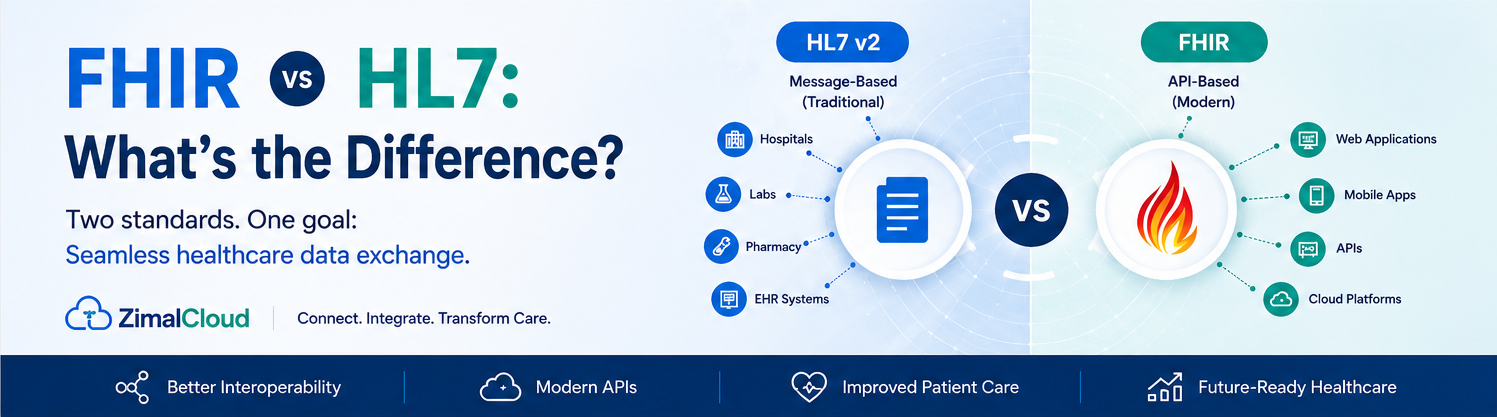
Table of contents
- What Is HL7?
- Example of HL7 v2
- What Is FHIR?
- HL7 vs FHIR: The Key Difference
- FHIR vs HL7 Comparison
- How Does HL7 Work?
- How Does FHIR Work?
- Why Is FHIR Important for Healthcare?
- Patient-facing applications
- Healthcare APIs
- Remote Patient Monitoring
- Care Management
- AI and Analytics
- Does FHIR Replace HL7?
- FHIR and HL7 Can Work Together
- Which One Should Healthcare Organizations Use?
- HL7 may be appropriate when:
- FHIR may be appropriate when:
- The Future of Healthcare Interoperability
- Final Thoughts
Healthcare organizations rely on standards to exchange patient information between electronic health records (EHRs), laboratories, pharmacies, hospitals, health apps, and other systems. Two of the most commonly discussed standards are HL7 and FHIR.
Although they are closely related, HL7 and FHIR are not exactly the same thing. Understanding the difference can help healthcare organizations make better decisions about interoperability, integrations, APIs, and modern healthcare technology.
What Is HL7?
HL7, short for Health Level Seven, refers to a family of international standards designed to support the exchange of healthcare information between different systems.
HL7 has been widely used for decades to connect systems such as:
- Electronic Health Records (EHRs)
- Laboratory Information Systems (LIS)
- Radiology systems
- Hospital information systems
- Pharmacy systems
- Billing platforms
- Clinical applications
One of the most commonly used HL7 standards is HL7 Version 2 (HL7 v2). It uses structured messages to communicate events and clinical information between systems.
For example, when a patient is admitted to a hospital, an HL7 message can notify another connected system about the admission.
Example of HL7 v2
An HL7 v2 message might look something like:
MSH|^~\&|Hospital|Main|EHR|Main|202609031200||ADT^A01|12345|P|2.5
PID|1||987654||Smith^John||19800101|M
While this format is efficient for system-to-system communication, it can be difficult for developers and modern applications to work with directly.
What Is FHIR?
FHIR, or Fast Healthcare Interoperability Resources, is a newer healthcare interoperability standard developed by HL7.
FHIR was designed to make healthcare data easier to exchange using modern web technologies such as:
- REST APIs
- HTTP
- JSON
- XML
- OAuth and other modern security technologies
Instead of exchanging large, complex messages, FHIR organizes healthcare information into smaller building blocks called Resources.
Examples include:
- Patient
- Practitioner
- Observation
- Condition
- Medication
- Encounter
- AllergyIntolerance
- DiagnosticReport
- CarePlan
For example, a patient's basic information can be represented as a FHIR Patient resource and accessed through an API.
HL7 vs FHIR: The Key Difference
The simplest way to understand the relationship is:
HL7 is a broader family of healthcare interoperability standards, while FHIR is a modern standard within the HL7 ecosystem designed for easier, API-based data exchange.
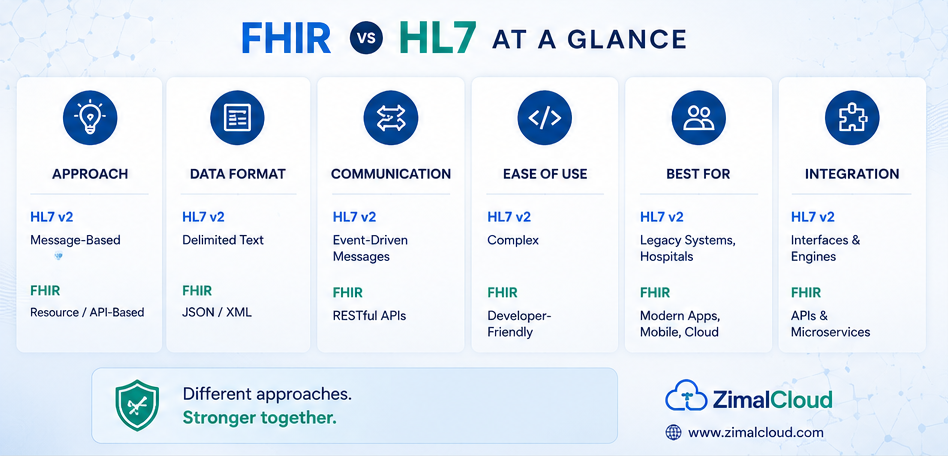
FHIR doesn't replace every HL7 standard. Instead, it provides a modern approach to interoperability that works particularly well with web and mobile applications.
FHIR vs HL7 Comparison
| Feature | HL7 v2 | FHIR |
|---|---|---|
| Technology | Message-based | Resource/API-based |
| Data exchange | Structured messages | Resources |
| Common format | Delimited text | JSON, XML |
| APIs | Not inherently API-focused | RESTful APIs |
| Developer experience | More complex | Generally easier |
| Web compatibility | Limited | Strong |
| Mobile applications | More difficult | Well suited |
| Real-time integration | Commonly used | Well suited |
| Legacy systems | Excellent support | Increasing support |
| Modern interoperability | Possible | Designed for it |
How Does HL7 Work?
Traditional HL7 v2 communication is often based on messages triggered by specific healthcare events.
For example:
Patient Registration → HL7 Message → Receiving System
A hospital registration system might send an ADT (Admission, Discharge, Transfer) message to an EHR, laboratory system, or billing application.
Different message types can communicate information such as:
- Patient registration
- Patient admission
- Lab orders
- Lab results
- Medication information
- Patient transfers
- Discharges
This event-driven approach has made HL7 v2 extremely valuable for connecting healthcare systems.
How Does FHIR Work?
FHIR takes a different approach by representing healthcare information as individual resources.
For example:
Patient → FHIR API → Application
An application could request a patient's information through a FHIR API:
GET /Patient/12345
The server could return information in JSON format:
{
"resourceType": "Patient",
"id": "12345",
"name": [
{
"family": "Smith",
"given": ["John"]
}
]
}
This makes healthcare information easier for applications, developers, and services to consume.
Why Is FHIR Important for Healthcare?
Modern healthcare increasingly depends on applications that need access to information from multiple systems.
Consider a healthcare ecosystem containing:
EHR → AI Platform → Patient App → RPM Device → Care Management System
Each system needs to exchange information reliably.
FHIR can help these systems communicate using standardized resources and APIs.
This is particularly useful for:
Patient-facing applications
Patients can use applications to access health information from connected healthcare systems.
Healthcare APIs
Developers can build applications that communicate with EHRs and other healthcare platforms using standardized APIs.
Remote Patient Monitoring
FHIR can help represent and exchange patient observations and other clinical information generated by connected devices.
Care Management
Care teams can integrate patient information from multiple sources into coordinated workflows.
AI and Analytics
Standardized healthcare data can make it easier for AI and analytics platforms to consume information from different systems.
Does FHIR Replace HL7?
No.
This is one of the most important points to understand.
Healthcare organizations still rely heavily on established HL7 standards, particularly HL7 v2, because many hospitals and clinical systems have been using them for years.
FHIR provides a modern interoperability approach rather than simply eliminating older standards.
In many real-world environments, organizations use both HL7 and FHIR.
For example:
Legacy EHR → HL7 v2 → Integration Engine → FHIR API → Modern Application
This allows organizations to connect existing healthcare infrastructure with newer applications and services.
FHIR and HL7 Can Work Together
FHIR and traditional HL7 technologies can coexist within the same healthcare ecosystem.
An integration platform might receive an HL7 v2 message from a hospital system, transform the information, and make it available through a FHIR API.
For example:
Hospital System
↓
HL7 v2 Message
↓
Integration Layer
↓
FHIR Resources
↓
Healthcare Application
This approach can help organizations modernize interoperability without replacing every legacy system.
Which One Should Healthcare Organizations Use?
The answer depends on the organization's technology environment and integration requirements.
HL7 may be appropriate when:
- Connecting legacy hospital systems
- Working with existing EHR integrations
- Receiving ADT messages
- Integrating laboratory systems
- Supporting established healthcare workflows
- Maintaining existing interfaces
FHIR may be appropriate when:
- Building modern healthcare applications
- Developing APIs
- Supporting patient-facing applications
- Integrating mobile applications
- Connecting cloud platforms
- Building modern interoperability infrastructure
- Supporting AI and analytics applications
In many cases, the best strategy is not HL7 versus FHIR, but HL7 and FHIR together.
The Future of Healthcare Interoperability
Healthcare interoperability is moving toward more connected, API-driven ecosystems.
FHIR plays an important role in this transition because it was designed with modern application development and web technologies in mind.
However, healthcare organizations cannot simply abandon existing infrastructure. Hospitals and practices still operate many systems that depend on established HL7 interfaces.
The future will therefore likely involve a combination of:
HL7 + FHIR + APIs + Integration Engines + Cloud Platforms
Together, these technologies can help healthcare organizations connect legacy infrastructure with modern digital health applications.
Final Thoughts
HL7 and FHIR are both important components of healthcare interoperability, but they serve different purposes.
HL7 v2 is widely used for exchanging healthcare messages between established clinical systems, while FHIR provides a more modern, resource-based and API-friendly approach to exchanging healthcare information.
For healthcare organizations modernizing their technology infrastructure, understanding both standards is essential.
Rather than viewing FHIR as a complete replacement for HL7, organizations can use FHIR alongside existing HL7 interfaces to create a more connected, scalable, and future-ready healthcare ecosystem.