AI vs Traditional Medical Billing Workflows: What's the Difference?
AI is changing how medical practices manage billing. Compare AI-assisted and traditional medical billing workflows, from coding and claim validation to payment posting, denial management, accounts receivable, and reporting. Learn how automation can reduce repetitive work, improve visibility, and help billing teams focus on complex revenue-cycle tasks.
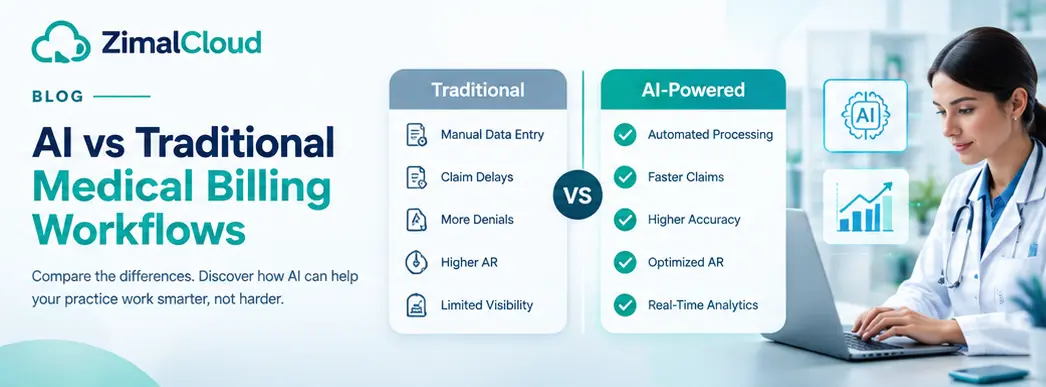
Table of contents
- AI vs Traditional Medical Billing Workflows: What's the Difference?
- What Is Traditional Medical Billing?
- Common characteristics of traditional billing
- What Is AI-Powered Medical Billing?
- AI vs Traditional Medical Billing: Side-by-Side Comparison
- 1. Data Entry
- Traditional Approach
- AI-Assisted Approach
- 2. Medical Coding
- Traditional Coding Workflow
- AI-Assisted Coding
- 3. Claim Scrubbing and Validation
- Traditional Workflow
- AI-Assisted Workflow
- 4. Denial Management
- Traditional Denial Workflow
- AI-Assisted Denial Workflow
- 5. Payment Posting
- 6. Accounts Receivable Management
- Traditional AR Management
- AI-Assisted AR Management
- 7. Reporting and Revenue-Cycle Visibility
- 8. Staff Productivity
- Traditional model
- AI-assisted model
- Does AI Replace Medical Billers?
- Benefits of AI-Assisted Medical Billing
- Faster Processing
- Reduced Repetitive Work
- Better Error Detection
- Improved Denial Visibility
- Better Payment Reconciliation
- Improved Staff Productivity
- Better Revenue-Cycle Visibility
- Limitations of AI Medical Billing
- When Should a Medical Practice Consider AI Billing Automation?
- How to Transition From Traditional to AI-Assisted Billing
- Step 1: Identify repetitive tasks
- Step 2: Measure the current workflow
- Step 3: Start with automation opportunities
- Step 4: Keep humans in the loop
- Step 5: Monitor results
- Step 6: Expand gradually
- AI vs Traditional Billing: Which Is Better?
- The Future of Medical Billing
- Conclusion
AI vs Traditional Medical Billing Workflows: What's the Difference?
Medical billing is one of the most important administrative functions in a healthcare practice. It connects clinical services with claims, insurance payments, patient balances, and revenue.
But the way practices manage billing is changing.
Traditional medical billing workflows often depend on manual data entry, repetitive claim reviews, spreadsheets, payer portals, and staff-driven follow-up. AI-powered medical billing workflows can automate parts of these processes, identify patterns, reduce repetitive work, and help billing teams focus on exceptions and more complex tasks.
The goal is not simply to replace people with technology. The goal is to create a faster, more connected, and more efficient medical billing workflow where automation handles repetitive tasks and billing professionals remain involved where human judgment is important.
What Is Traditional Medical Billing?
Traditional medical billing relies heavily on manual processes and staff intervention.
A typical workflow may look like:
Patient visit → Documentation → Coding → Claim creation → Claim review → Claim submission → Payer adjudication → Payment posting → Denial follow-up → Patient billing
At multiple stages, employees may need to review information, enter data, check payer portals, identify errors, and update billing records.
For a small practice with a manageable claim volume, this may be workable. As the practice grows, however, repetitive manual processes can become increasingly difficult to manage.
Common characteristics of traditional billing
Traditional workflows may involve:
- Manual data entry
- Manual claim review
- Spreadsheet-based tracking
- Repeated payer portal checks
- Manual payment posting
- Manual denial identification
- Separate billing applications
- Staff-driven claim follow-up
- Manual reporting and reconciliation
These processes can work, but they may consume significant staff time.
What Is AI-Powered Medical Billing?
AI-powered medical billing uses artificial intelligence, automation, rules, and data-driven workflows to assist with repetitive and complex billing activities.
Depending on the system, AI and automation can support tasks such as:
- Documentation analysis
- Coding assistance
- Claim validation
- Charge capture
- Eligibility workflows
- Denial identification
- Payment analysis
- ERA processing
- Accounts receivable prioritization
- Billing workflow automation
- Revenue-cycle reporting
Rather than requiring staff to manually inspect every transaction, an intelligent system can help identify which items are routine and which require attention.
A simplified workflow might look like:
Clinical documentation → AI-assisted coding → Automated claim checks → Claim submission → ERA/payment processing → Exception detection → Staff review
The exact capabilities vary by software and implementation, but the underlying objective is similar: reduce repetitive work while improving workflow visibility.
AI vs Traditional Medical Billing: Side-by-Side Comparison
| Billing Activity | Traditional Workflow | AI-Assisted Workflow |
|---|---|---|
| Data entry | Mostly manual | Automated or assisted |
| Coding | Manual review and entry | AI-assisted coding and validation |
| Claim review | Staff checks | Automated checks + staff review |
| Claim submission | Manual workflow | Automated workflow options |
| Payment posting | Manual or semi-manual | ERA/payment automation |
| Denial identification | Staff-driven | Automated identification and prioritization |
| AR follow-up | Manual lists | Data-driven prioritization |
| Reporting | Manual reports | Automated dashboards and analytics |
| Exception handling | Staff discovers issues | System flags exceptions |
| Workflow visibility | Often fragmented | More centralized |
| Staff focus | Repetitive tasks + exceptions | Primarily exceptions and complex work |
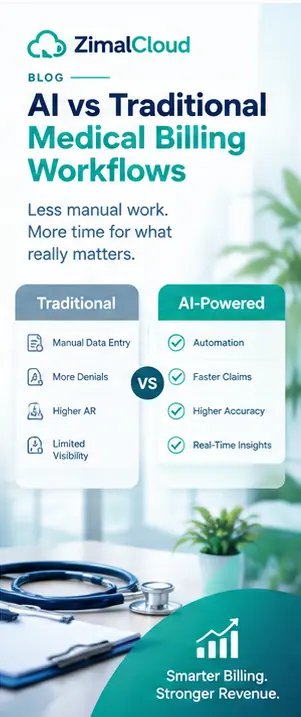
AI does not necessarily eliminate the need for billing professionals. Instead, it can change where their time is spent.
1. Data Entry
Traditional Approach
Traditional billing workflows often require staff to enter information from clinical documentation, charge sheets, superbills, payer documents, and other sources.
Repeated data entry can create opportunities for:
- Typing errors
- Missing information
- Duplicate entry
- Inconsistent records
- Delays
AI-Assisted Approach
AI and automation can help extract relevant information from structured or supported documentation and reduce repetitive entry.
For example, an intelligent billing workflow may identify relevant clinical information and assist with coding or charge capture.
Result: Staff can spend less time transferring information manually and more time reviewing the information for accuracy.
2. Medical Coding
Coding is an important part of the revenue cycle because diagnoses and procedures need to be represented accurately on claims.
Traditional Coding Workflow
A traditional process may require a coder to:
- Review documentation
- Identify diagnoses
- Identify procedures
- Select appropriate codes
- Review supporting documentation
- Enter codes into the billing system
AI-Assisted Coding
AI can analyze supported documentation and provide coding suggestions or identify potential coding issues.
A billing professional can then review the suggestions before final submission.
This creates a workflow such as:
Documentation → AI assistance → Coder review → Final coding → Claim
The human review remains important because AI-generated suggestions should not automatically be treated as correct simply because they were generated by software.
3. Claim Scrubbing and Validation
Traditional Workflow
In a manual workflow, billing staff may review claims for missing or inconsistent information before submission.
Depending on the practice, this can involve checking:
- Patient information
- Insurance details
- Diagnosis codes
- Procedure codes
- Modifiers
- Provider information
- Required claim fields
AI-Assisted Workflow
Automated validation can check claims before submission and flag potential problems.
An intelligent system may help identify patterns associated with:
- Missing information
- Coding inconsistencies
- Potential claim errors
- Payer-specific requirements
- Other validation issues
The earlier an issue is identified, the better the opportunity to correct it before it creates a downstream problem.
4. Denial Management
Denials can consume significant billing resources.
Traditional Denial Workflow
A traditional process may look like:
Denial received → Staff opens claim → Reviews payer explanation → Investigates issue → Determines action → Corrects claim → Resubmits
This process can require substantial manual effort.
AI-Assisted Denial Workflow
An AI-enabled system can help identify denial patterns and prioritize claims for review.
For example:
Denial received → Reason identified → Pattern analyzed → Priority assigned → Staff reviews → Corrective action
AI can help billing teams identify recurring problems instead of treating every denial as an isolated event.
5. Payment Posting
Payment posting is another area where automation can provide significant value.
Traditional payment posting may require staff to manually enter:
- Insurance payments
- Adjustments
- Patient responsibility
- Payment references
- Claim balances
With 835 ERA integration, electronic remittance information can be processed automatically.
A connected workflow can look like:
835 ERA received → Claim matched → Payment posted → Adjustments applied → Patient responsibility updated → Exceptions flagged
This can reduce repetitive data entry and help billing teams focus on transactions that require investigation.
6. Accounts Receivable Management
Traditional AR Management
Traditional AR management often relies on reports and staff experience.
Employees may manually sort outstanding claims by:
- Age
- Payer
- Balance
- Patient
- Claim status
They then determine which accounts should receive attention.
AI-Assisted AR Management
AI and analytics can help identify patterns in outstanding accounts and prioritize work.
For example, a system may help identify:
- High-value outstanding claims
- Aging accounts
- Repeated payer issues
- Claims requiring follow-up
- Accounts with unusual payment patterns
This can help teams move from working every account equally toward prioritizing accounts based on available data.
7. Reporting and Revenue-Cycle Visibility
Traditional billing environments may require staff to collect information from multiple systems before producing a complete report.
This can make it harder to see the full revenue-cycle picture.
AI-powered and integrated systems can bring information together and provide more centralized visibility into:
- Claims
- Payments
- Denials
- Adjustments
- AR
- Patient balances
- Payer performance
- Billing activity
Better visibility can help practice managers make more informed operational decisions.
8. Staff Productivity
One of the biggest differences between traditional and AI-assisted billing is how staff time is used.
Traditional model
More manual work → More staff time spent on repetitive tasks
AI-assisted model
More automation → Staff focus on exceptions, review, and decision-making
This does not mean every billing employee becomes unnecessary.
Instead, their role can shift toward activities that require:
- Judgment
- Investigation
- Communication
- Exception handling
- Compliance oversight
- Payer follow-up
- Revenue-cycle analysis
Does AI Replace Medical Billers?
Not necessarily.
AI is best viewed as a tool that can assist billing professionals rather than an automatic replacement for human expertise.
Medical billing involves many situations where human judgment matters.
For example:
- A claim may require clinical context.
- A payer may provide ambiguous information.
- Documentation may need interpretation.
- A denial may require communication with a payer.
- A coding recommendation may need professional review.
- A financial discrepancy may require investigation.
A strong workflow combines automation with human oversight.
The software handles repetitive tasks.
The billing professional handles decisions and exceptions.
Benefits of AI-Assisted Medical Billing
Faster Processing
Automation can process repetitive billing tasks more quickly than manual workflows.
Reduced Repetitive Work
Staff spend less time entering the same information into multiple systems.
Better Error Detection
Automated validation can help identify potential problems earlier.
Improved Denial Visibility
AI and analytics can help identify recurring denial patterns.
Better Payment Reconciliation
ERA and payment automation can make it easier to connect payer payments with claims.
Improved Staff Productivity
Billing professionals can spend more time on complex work.
Better Revenue-Cycle Visibility
Integrated data can provide a clearer view of claims, payments, denials, and AR.
Limitations of AI Medical Billing
AI is not a magic solution.
Implementation still requires:
- Accurate data
- Appropriate workflows
- Human oversight
- Proper configuration
- Staff training
- Security controls
- Compliance processes
- Ongoing monitoring
AI-generated coding or billing recommendations should be reviewed according to the organization's policies and applicable requirements.
Automation can also produce incorrect results if the underlying data is incomplete or the system is poorly configured.
The objective should therefore be responsible automation, not automation at any cost.
When Should a Medical Practice Consider AI Billing Automation?
AI and automation may be particularly useful when a practice experiences:
- High claim volumes
- Repetitive manual data entry
- Large AR workloads
- Frequent claim denials
- Slow payment posting
- Multiple disconnected billing systems
- Limited billing staff
- Difficulty tracking claim status
- Time-consuming reporting
- Manual reconciliation processes
The larger the volume of repetitive work, the greater the potential value of automation.
How to Transition From Traditional to AI-Assisted Billing
Practices do not necessarily need to automate everything at once.
A practical transition can start with high-volume repetitive workflows.
Step 1: Identify repetitive tasks
Find processes that consume significant staff time.
Step 2: Measure the current workflow
Track processing time, error rates, denial rates, and outstanding AR.
Step 3: Start with automation opportunities
Payment posting, claim validation, eligibility workflows, and reporting can be potential starting points.
Step 4: Keep humans in the loop
Define which activities can be automated and which require human approval.
Step 5: Monitor results
Compare performance before and after implementation.
Step 6: Expand gradually
Once the initial workflow is stable, additional billing processes can be automated.
AI vs Traditional Billing: Which Is Better?
There is no single answer for every medical practice.
Traditional workflows may continue to work for organizations with low claim volumes and simple billing requirements.
However, practices dealing with increasing claim volumes, complex revenue-cycle operations, multiple payers, and growing administrative workloads may benefit from AI-assisted automation.
The strongest approach is often not:
Traditional vs AI
but:
Human expertise + intelligent automation
Technology can handle repetitive processes while experienced billing professionals remain responsible for review, exceptions, and important decisions.
The Future of Medical Billing
Healthcare revenue cycle management is moving toward increasingly connected workflows.
Instead of separate systems for:
Documentation → Coding → Claims → Payments → Denials → AR → Reporting
modern platforms can connect these processes into a more unified workflow.
AI can add another layer by helping analyze information, identify patterns, assist with decisions, and automate repetitive tasks.
The future of medical billing is therefore less about replacing billing teams and more about giving billing teams better tools.
Conclusion
Traditional medical billing workflows depend heavily on manual processes, while AI-assisted workflows use automation, intelligent analysis, and connected systems to reduce repetitive work.
AI can assist with coding, claim validation, payment posting, denial identification, AR prioritization, and reporting. However, human oversight remains essential for accuracy, judgment, compliance, and exception management.
For medical practices, the most effective strategy is to identify repetitive billing tasks, automate appropriate processes, and allow skilled professionals to focus on the work that requires human expertise.
The future of medical billing isn't humans versus AI. It's humans working with AI to build a faster, smarter, and more connected revenue cycle.
FAQ
Frequently asked questions
What is AI medical billing?
AI medical billing uses artificial intelligence, automation, and data-driven workflows to assist with tasks such as coding, claim validation, payment posting, denial identification, accounts receivable prioritization, and revenue-cycle reporting.
What is traditional medical billing?
Traditional medical billing relies heavily on manual processes, including data entry, claim review, coding, payer portal checks, payment posting, denial follow-up, reconciliation, and reporting.
What is the difference between AI and traditional medical billing?
Traditional medical billing depends primarily on manual staff-driven processes, while AI-assisted billing uses automation and intelligent analysis to reduce repetitive work, identify potential issues, prioritize tasks, and provide billing teams with better workflow visibility.
Can AI automate medical billing?
AI and automation can automate or assist with many medical billing activities, including claim validation, coding assistance, payment posting, ERA processing, denial identification, accounts receivable prioritization, and reporting. Human review remains important for complex cases and final decisions.
Can AI replace medical billers?
AI does not necessarily replace medical billers. Instead, it can reduce repetitive administrative work and allow billing professionals to focus more on exceptions, denial management, payer follow-up, compliance, complex claims, and revenue-cycle decisions.
How can AI improve medical billing workflows?
AI can improve medical billing workflows by reducing repetitive data entry, assisting with coding, identifying potential claim problems, analyzing denial patterns, automating payment-related processes, prioritizing accounts receivable, and providing more centralized revenue-cycle insights.
Can AI help reduce medical billing errors?
AI and automated validation can help identify missing information, inconsistencies, and potential billing issues before they create downstream problems. However, AI outputs should be appropriately reviewed and validated by qualified billing or coding professionals.
Can AI help with medical billing denials?
Yes. AI and analytics can help identify denial patterns, categorize issues, prioritize claims for follow-up, and provide billing teams with information that can support corrective action and denial management.
Can AI automate medical payment posting?
Yes. With electronic remittance workflows such as 835 ERA integration, payment information can be electronically processed, matched to claims, and used to post payments and adjustments while flagging transactions that require staff review.
Is AI medical billing suitable for small medical practices?
AI-assisted medical billing can be useful for practices of different sizes, particularly when they experience repetitive manual work, increasing claim volumes, billing delays, denial management challenges, or limited administrative resources.
What are the benefits of AI-powered medical billing?
Potential benefits include reduced repetitive data entry, faster processing, improved error detection, better denial visibility, more efficient payment reconciliation, improved staff productivity, and greater visibility into the revenue cycle.
Should medical practices completely automate their billing workflow?
Complete automation is not always appropriate. A practical approach is to automate repetitive, rules-based activities while keeping qualified professionals involved in coding review, exceptions, denials, complex claims, compliance, and other decisions requiring human judgment.