What Is Healthcare Interoperability?
Healthcare interoperability enables different healthcare systems, EHRs, providers, laboratories, pharmacies, and other organizations to securely exchange and use patient information. By using standards such as FHIR, HL7, and USCDI, interoperability reduces data silos, minimizes duplicate work, improves care coordination, and supports more connected, efficient, patient-centered healthcare.
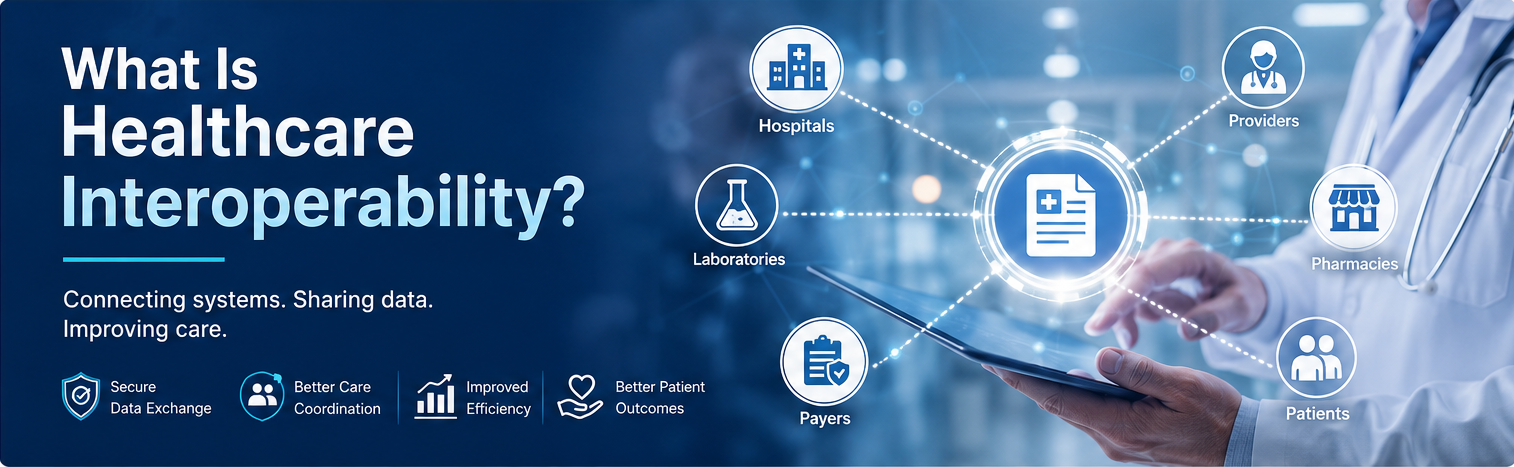
Table of contents
- Why Is Healthcare Interoperability Important?
- How Does Healthcare Interoperability Work?
- The Four Levels of Interoperability
- Healthcare Interoperability Example
- Benefits of Healthcare Interoperability
- Interoperability and EHR Systems
- Challenges of Healthcare Interoperability
- The Future of Healthcare Interoperability
- Conclusion
Healthcare interoperability is the ability of different healthcare systems, applications, providers, and organizations to securely exchange, access, and use health information in a consistent and meaningful way.
In a modern healthcare environment, patient information may exist across EHRs, hospitals, laboratories, pharmacies, health information exchanges, insurance systems, and specialty practices. Without interoperability, providers may struggle to access complete and timely patient information, resulting in duplicate tests, manual data entry, delays, and fragmented care.
Why Is Healthcare Interoperability Important?
Interoperability connects healthcare systems so that the right information can reach the right person at the right time.
For example, when a patient visits a specialist, an interoperable system can allow authorized providers to access relevant information such as:
- Patient demographics
- Medical history
- Allergies
- Medications
- Lab results
- Diagnoses
- Procedures
- Clinical notes
- Care plans
- Claims and insurance information
This reduces the need for patients and staff to repeatedly enter or transfer the same information.
How Does Healthcare Interoperability Work?
Healthcare interoperability depends on common data standards, APIs, security protocols, and healthcare information models.
Common technologies and standards include:
FHIR (Fast Healthcare Interoperability Resources)
FHIR provides a modern, API-based approach for exchanging healthcare information. It represents information as standardized resources such as Patient, Encounter, Observation, Medication, and Procedure.
HL7
HL7 standards support the exchange of clinical and administrative information between healthcare applications.
USCDI
The United States Core Data for Interoperability defines a standardized set of health data elements that can be exchanged across systems.
SMART on FHIR
SMART on FHIR enables healthcare applications to securely integrate with EHR platforms using standardized APIs and authorization mechanisms.
The Four Levels of Interoperability
Healthcare interoperability can generally be understood through four levels:
1. Foundational Interoperability
Systems can send data from one system to another, but the receiving system may not necessarily understand the information.
2. Structural Interoperability
Data follows a defined structure and format, allowing the receiving system to process the information consistently.
3. Semantic Interoperability
Systems understand the meaning of exchanged information. Standardized vocabularies such as SNOMED CT, LOINC, ICD-10, and RxNorm help maintain consistent meaning.
4. Organizational Interoperability
This goes beyond technology. Organizations establish policies, workflows, governance, security practices, and agreements that allow information to be exchanged and used effectively.
Healthcare Interoperability Example
Consider a patient who receives care from a primary care provider, gastroenterologist, laboratory, and pharmacy.
Without interoperability, each organization may maintain separate information. The patient may need to carry reports, provide medication details, or complete the same forms repeatedly.
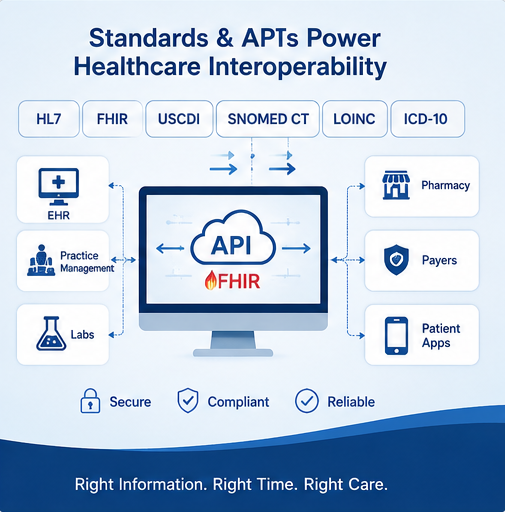
With interoperability:
Primary Care EHR
↓
Patient Health Information
↓
FHIR / HL7 APIs
↓
Specialist EHR
↓
Laboratory Results
↓
Medication / Pharmacy Information
↓
Updated Patient Record
Authorized providers can obtain relevant information without relying entirely on fax, paper records, or manual data entry.
Benefits of Healthcare Interoperability
Better Patient Care
Providers can access more complete patient information, supporting better-informed clinical decisions.
Reduced Duplicate Testing
When previous laboratory and diagnostic results are available, unnecessary repeat testing can potentially be avoided.
Improved Care Coordination
Primary care providers, specialists, hospitals, behavioral health teams, and other care professionals can coordinate treatment more effectively.
Greater Efficiency
Automated data exchange reduces manual entry, scanning, faxing, and administrative work.
Improved Patient Experience
Patients spend less time repeating their medical history and transferring records between providers.
Better Population Health Management
Organizations can aggregate and analyze information to identify care gaps, high-risk populations, and trends.
Interoperability and EHR Systems
For modern EHR and healthcare applications, interoperability should be considered part of the platform architecture rather than an afterthought.
A well-designed EHR may integrate with:
- Hospitals and health systems
- Other EHR platforms
- Health information exchanges
- Laboratories
- Pharmacies
- Clearinghouses
- Payers
- Patient-facing applications
- Remote monitoring devices
- Telehealth platforms
- Government healthcare services
APIs can allow authorized systems to exchange information while authentication, authorization, encryption, auditing, and access controls help protect sensitive health data.
Challenges of Healthcare Interoperability
Although interoperability provides significant benefits, implementation can be challenging.
Common challenges include:
- Different systems using different data formats
- Legacy healthcare applications
- Inconsistent terminology
- Data quality problems
- Patient matching
- Privacy and security requirements
- Complex integration workflows
- Vendor-specific APIs
- Different organizational policies
- Implementation and maintenance costs
Successful interoperability therefore requires more than simply connecting two APIs. Systems must also agree on what data means, how it is structured, who can access it, and how it should be used.
The Future of Healthcare Interoperability
Healthcare is increasingly moving toward API-driven, standards-based data exchange. FHIR, SMART on FHIR, standardized clinical terminology, and cloud-based architectures are helping healthcare organizations build more connected systems.
For EHR and healthcare technology providers, interoperability can create a foundation for connected services such as care coordination, behavioral health integration, chronic care management, remote patient monitoring, gastroenterology workflows, patient engagement, and healthcare revenue cycle management.
Conclusion
Healthcare interoperability enables healthcare systems to exchange and use information securely and meaningfully. By connecting EHRs, providers, laboratories, pharmacies, payers, and other healthcare applications, interoperability can reduce information silos, improve care coordination, increase operational efficiency, and support better patient experiences.
As healthcare continues to become more digital, interoperability will remain an essential component of connected and patient-centered healthcare.