How Behavioral Health Integration Works in Primary Care
Behavioral health integration brings mental health and primary care together so patients can receive more coordinated, whole-person care. By combining screening, care coordination, behavioral interventions, and follow-up within primary care, healthcare teams can identify concerns earlier, improve treatment outcomes, and make behavioral healthcare easier to access.
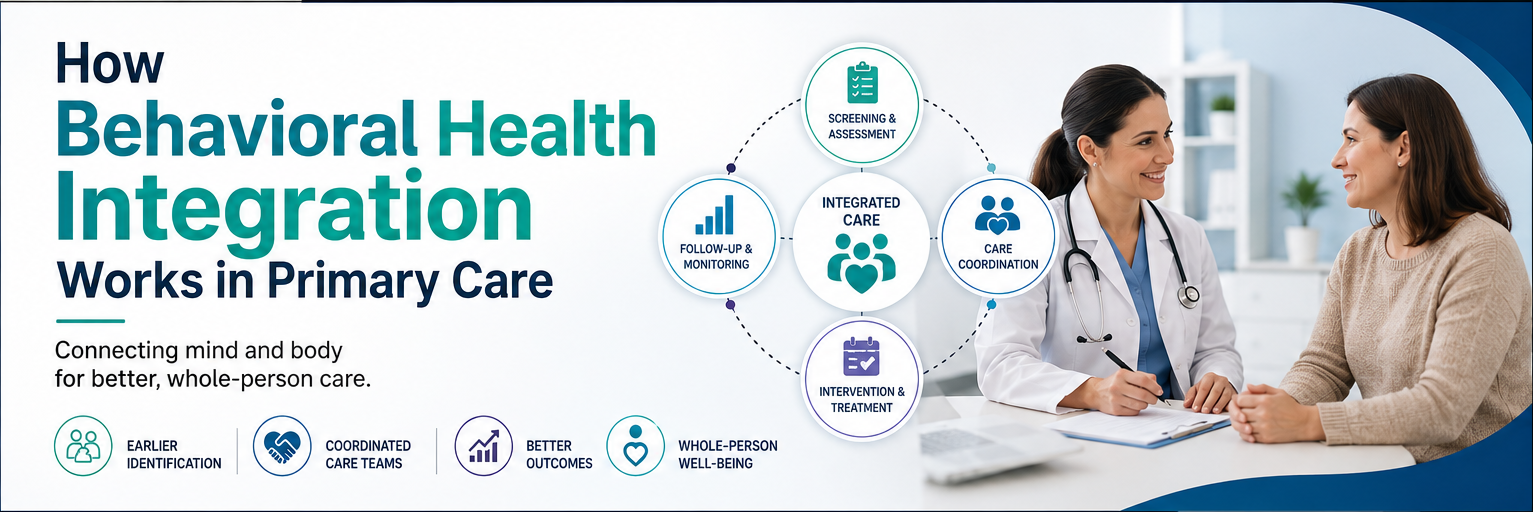
Table of contents
- What Is Behavioral Health Integration?
- Why Behavioral Health Belongs in Primary Care
- How the Behavioral Health Integration Process Works
- 1. Screening Identifies Potential Concerns
- 2. Primary Care Providers Review the Results
- 3. Behavioral Health Professionals Become Part of the Care Team
- 4. A Coordinated Care Plan Is Created
- 5. Progress Is Monitored
- The Role of Technology in Behavioral Health Integration
- What Patients Gain From Integrated Care
- Challenges Healthcare Organizations Need to Consider
- The Future of Integrated Primary Care
Healthcare is increasingly recognizing an important reality: physical health and behavioral health cannot always be treated separately.
A patient visiting a primary care clinic for headaches, fatigue, chronic pain, diabetes, or high blood pressure may also be experiencing anxiety, depression, stress, substance use concerns, or other behavioral health challenges.
When these needs go unnoticed, they can affect treatment adherence, quality of life, and overall health outcomes.
Behavioral Health Integration (BHI) addresses this gap by bringing behavioral health services into the primary care environment. Instead of sending patients through disconnected systems, primary care and behavioral health professionals work together as part of a coordinated care process.
What Is Behavioral Health Integration?
Behavioral Health Integration is an approach that connects primary medical care with behavioral health services.
Rather than treating mental and physical health as completely separate areas, an integrated model allows healthcare teams to identify behavioral health needs, provide appropriate interventions, coordinate treatment, and monitor progress within or alongside primary care.
The goal is simple:
Treat the whole person, not just the condition that brought them into the clinic.
Depending on the practice, integration may involve primary care physicians, behavioral health specialists, care managers, social workers, psychiatrists, nurses, and other members of the healthcare team.
Why Behavioral Health Belongs in Primary Care
Primary care is often where patients have their most frequent interactions with the healthcare system. This makes it an important setting for identifying behavioral health concerns early.
For example, a patient with uncontrolled diabetes may be struggling with depression that makes it difficult to follow a treatment plan. Another patient with recurring physical symptoms may have an underlying anxiety disorder.
If these issues are addressed together, providers can build a more complete picture of the patient's health.
Integrated care can help:
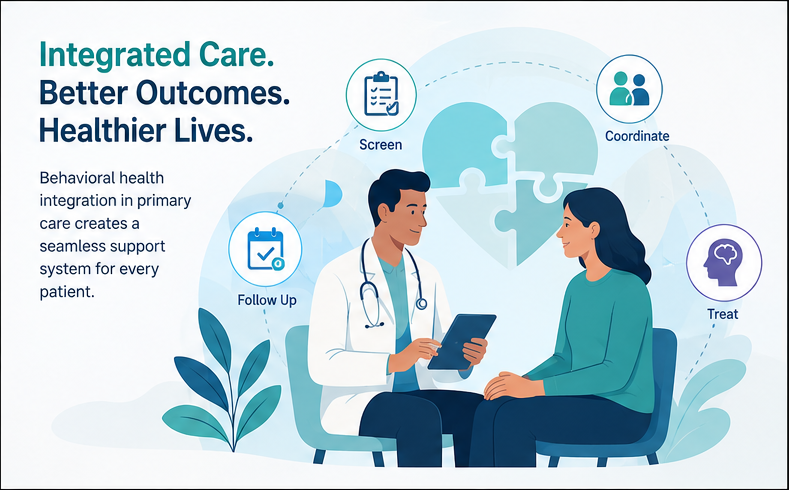
- Identify behavioral health concerns earlier
- Improve communication between care professionals
- Support treatment adherence
- Reduce gaps between physical and mental healthcare
- Make behavioral health services easier to access
- Provide more consistent patient follow-up
- Encourage a more patient-centered approach to care
How the Behavioral Health Integration Process Works
Although workflows differ between healthcare organizations, an integrated model commonly follows several connected steps.
1. Screening Identifies Potential Concerns
The process may begin during a routine primary care visit.
Patients can be screened for concerns such as depression, anxiety, substance use, or other behavioral health needs using appropriate clinical assessment tools.
Screening does not automatically mean that a patient has a behavioral health condition. Instead, it helps providers determine whether further assessment or support may be appropriate.
This creates an opportunity to identify concerns that might otherwise remain hidden.
2. Primary Care Providers Review the Results
The primary care team considers screening results alongside the patient's medical history, symptoms, medications, lifestyle, and other factors.
This broader view is important because behavioral and physical health can influence one another.
For example, chronic illness can contribute to emotional distress, while untreated behavioral health concerns may make it harder for a patient to manage a chronic condition.
3. Behavioral Health Professionals Become Part of the Care Team
When additional support is needed, a behavioral health professional can become involved.
Depending on the practice model, this might include:
- Behavioral health consultants
- Clinical social workers
- Psychologists
- Psychiatrists
- Care managers
- Counselors
Instead of operating independently, these professionals communicate with the primary care team and contribute to a shared care plan.
4. A Coordinated Care Plan Is Created
The team develops a plan based on the patient's needs.
This may include behavioral interventions, counseling, medication management, lifestyle changes, referrals, self-management support, or additional medical care.
The important difference is coordination.
Rather than asking the patient to manage multiple disconnected services alone, the healthcare team works toward common goals.
5. Progress Is Monitored
Integration does not end when the initial intervention is completed.
Care teams can monitor symptoms, treatment adherence, clinical indicators, and patient progress over time.
If the patient is not improving, the team can reassess the care plan and determine whether additional services are needed.
This creates a continuous feedback loop rather than a one-time intervention.
The Role of Technology in Behavioral Health Integration
Technology can make integrated care easier to coordinate, especially when multiple professionals are involved.
Electronic health records can help authorized members of the care team access relevant patient information, while digital screening tools can support standardized assessments.
Healthcare platforms can also help teams manage:
- Patient assessments
- Care plans
- Follow-up schedules
- Referrals
- Secure communication
- Patient engagement
- Progress tracking
- Clinical documentation
When designed appropriately, technology can reduce information gaps and help care teams stay aligned.
What Patients Gain From Integrated Care
From the patient's perspective, behavioral health integration can make healthcare feel more connected.
Instead of visiting one provider for physical symptoms and another for emotional concerns—with little communication between them—the patient can receive more coordinated support.
Potential benefits include:
Better access: Behavioral health support can become part of a familiar primary care setting.
Earlier identification: Concerns can be recognized before they become more difficult to manage.
Improved coordination: Different members of the care team can work toward shared goals.
Whole-person care: Physical, emotional, and behavioral needs can be considered together.
Greater continuity: Follow-up can become part of an ongoing care relationship.
Challenges Healthcare Organizations Need to Consider
Implementing behavioral health integration is not simply a matter of adding another professional to a clinic.
Organizations may need to address staffing, reimbursement, workflows, privacy requirements, technology infrastructure, training, and communication processes.
Successful integration requires clearly defined responsibilities.
Healthcare teams should understand:
- Who performs screening?
- Who reviews results?
- When should a behavioral health professional become involved?
- How are referrals handled?
- Who follows up with the patient?
- How is progress documented?
- How is information shared appropriately?
Clear workflows can prevent patients from falling through the cracks.
The Future of Integrated Primary Care
Behavioral health integration represents a shift away from fragmented healthcare toward a whole-person model.
As healthcare organizations increasingly focus on prevention, chronic disease management, patient experience, and coordinated care, integrating behavioral health into primary care can become an important part of delivering comprehensive services.
The ultimate goal isn't simply to place more services in the same location.
It is to create a healthcare experience where medical and behavioral needs are recognized, connected, and managed as part of the same patient journey.