BHI vs Mental Health Services: What's the Difference?
BHI and Mental Health Services are related but different. Mental Health focuses on diagnosing and treating psychiatric or behavioral conditions, while BHI integrates behavioral healthcare into primary care through assessment, care planning, monitoring, care coordination, and team-based support. BHI can complement—not replace—specialized mental health services.
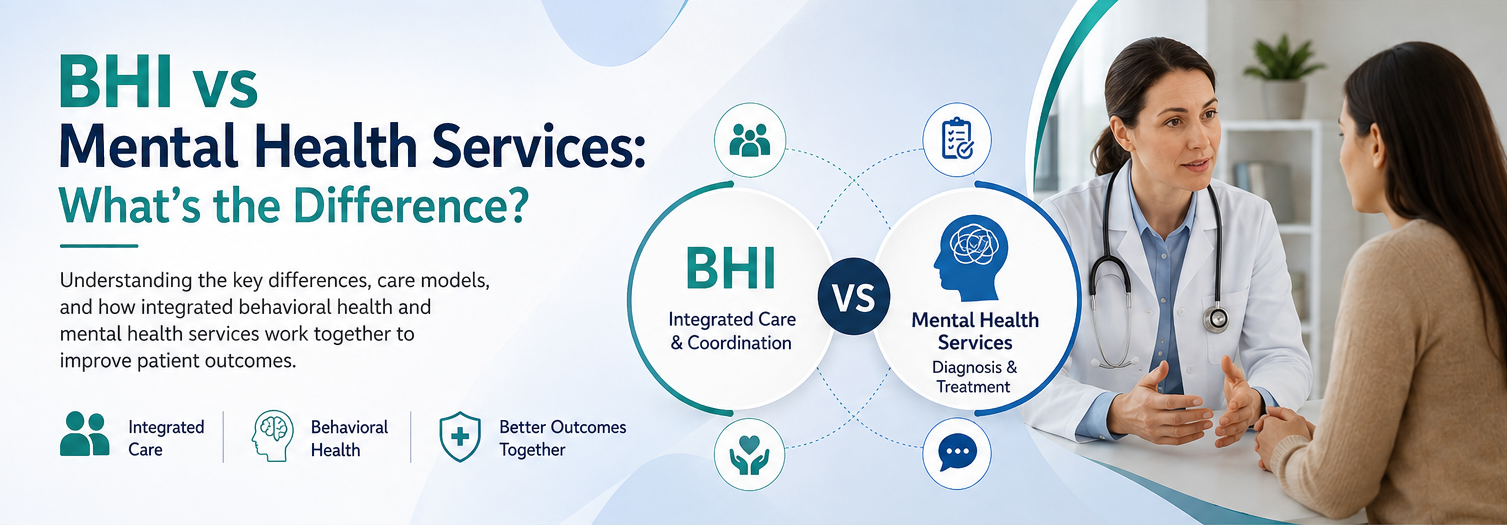
Table of contents
- Introduction
- What Are Mental Health Services?
- What Is Behavioral Health Integration (BHI)?
- BHI vs Mental Health Services: Key Differences
- The Biggest Difference: Integration vs Treatment
- Mental Health
- BHI
- BHI Is Not a Replacement for Mental Health Care
- How CoCM Fits Into BHI
- When Should a Practice Consider BHI?
- When Are Traditional Mental Health Services More Appropriate?
- BHI and Mental Health Can Work Together
- What This Means for EHR and Healthcare Practices
- BHI module
- Mental Health module
- Final Takeaway
Introduction
Mental health is an increasingly important part of healthcare, but many practices still struggle to understand the difference between Mental Health (MH) Services and Behavioral Health Integration (BHI).
Although both can address conditions such as depression, anxiety, and other behavioral health concerns, they are not the same type of service.
The simplest way to understand the difference is:
Mental Health Services focus primarily on treating the patient's behavioral or psychiatric condition, while BHI focuses on integrating behavioral healthcare into the patient's broader medical care.
BHI is particularly relevant in primary care, where physical and behavioral health needs often overlap. CMS describes BHI as a care-management approach that can include assessment, care planning, interventions, ongoing monitoring, and coordination by a healthcare team.
What Are Mental Health Services?
Mental Health Services are clinical services designed specifically to assess, diagnose, treat, and manage mental, emotional, and behavioral conditions.
These services may be provided by professionals such as:
- Psychiatrists
- Psychologists
- Licensed clinical social workers
- Licensed professional counselors
- Psychiatric nurse practitioners
- Other qualified behavioral health professionals
Common conditions treated through mental health services include:
- Depression
- Anxiety disorders
- Bipolar disorder
- PTSD
- ADHD
- Substance use disorders
- Serious mental illness
- Other behavioral or psychiatric conditions
Treatment may involve:
- Psychiatric evaluation
- Psychotherapy
- Medication management
- Behavioral interventions
- Psychological assessment
- Crisis intervention
- Individual or family therapy
- Ongoing psychiatric follow-up
In other words, mental health services are generally centered around the patient's behavioral or psychiatric diagnosis and treatment.
What Is Behavioral Health Integration (BHI)?
Behavioral Health Integration (BHI) brings behavioral healthcare into the patient's broader healthcare workflow.
Instead of treating mental health as something completely separate from physical healthcare, BHI connects behavioral health needs with primary and medical care.
CMS describes BHI as a monthly, time-based care-management service for patients with identified mental, behavioral, or psychiatric health conditions. BHI can involve assessment, behavioral health care planning, interventions, and members of a care team working under the direction of the billing practitioner.
For example, consider a patient with:
Diabetes + Depression
A traditional approach might treat these as two separate problems.
With BHI, the care team can coordinate:
Primary Care
↓
Behavioral Health Assessment
↓
Care Plan
↓
Behavioral Health Care Manager
↓
Psychiatric Consultation
↓
Ongoing Monitoring
↓
Primary Care Follow-Up
The objective is to provide more coordinated, whole-person care.
BHI vs Mental Health Services: Key Differences
| Area | BHI | Mental Health Services |
|---|---|---|
| Primary focus | Integration of behavioral and physical healthcare | Diagnosis and treatment of mental/behavioral conditions |
| Typical setting | Primary care or integrated care environment | Mental health or behavioral health practice |
| Main objective | Coordinated, whole-person care | Direct psychiatric/behavioral treatment |
| Care model | Team-based and coordinated | Often clinician-to-patient |
| Primary care involvement | Usually central to the model | May be limited or separate |
| Behavioral health care manager | May be part of the care team | Not necessarily |
| Psychiatric consultant | Common in CoCM | Treating psychiatrist may directly manage the patient |
| Care coordination | Core component | May or may not be included |
| Physical health integration | Major component | Not necessarily part of treatment |
| Billing approach | Often monthly care-management services | Depends on the specific service provided |
| Examples | General BHI, CoCM | Psychotherapy, psychiatric evaluation, medication management |
CMS recognizes both general BHI and the Psychiatric Collaborative Care Model (CoCM) as integrated behavioral health approaches.
The Biggest Difference: Integration vs Treatment
The most important distinction is what the care model is designed to accomplish.
Mental Health
The central question is:
“How do we diagnose and treat this patient's mental health condition?”
For example:
A patient has major depression.
A psychiatrist may:
- Evaluate the patient
- Establish a diagnosis
- Prescribe medication
- Monitor symptoms
- Adjust treatment
- Provide psychiatric follow-up
This is direct mental health treatment.
BHI
The central question is:
“How do we integrate behavioral healthcare into this patient's overall medical care?”
For example:
A primary care patient has diabetes and depression.
The BHI team may:
- Screen the patient
- Assess behavioral health needs
- Create a behavioral health care plan
- Monitor symptoms
- Coordinate with the primary care provider
- Involve a behavioral health care manager
- Obtain psychiatric consultation when appropriate
- Track progress over time
- Coordinate additional services when needed
This creates a connected care model rather than an isolated behavioral health service.
BHI Is Not a Replacement for Mental Health Care
One common misconception is that BHI replaces psychiatry or psychotherapy.
It does not.
Instead, BHI can complement traditional mental health services.
A patient may receive BHI while also being referred to a psychiatrist, therapist, psychologist, substance-use specialist, or other behavioral health provider when clinically appropriate.
For example:
Primary Care
+
BHI Care Management
+
Psychiatric Consultation
+
Therapy
+
Medication Management
can work together as part of a coordinated care strategy.
CMS's current BHI guidance specifically describes care-team involvement and notes that BHI may address identified mental, behavioral, or psychiatric conditions.
How CoCM Fits Into BHI
The Psychiatric Collaborative Care Model (CoCM) is one important form of BHI.
A typical CoCM team includes:
Primary Care Provider
↓
Behavioral Health Care Manager
↓
Psychiatric Consultant
The primary care provider remains involved in the patient's overall care, while the behavioral health care manager coordinates behavioral health activities and the psychiatric consultant provides specialist input.
CMS identifies specific CoCM services and billing codes, including 99492, 99493, 99494, and G2214, subject to applicable requirements.
This makes CoCM different from a traditional standalone psychiatric visit because the emphasis is on systematic collaboration and ongoing care management.
When Should a Practice Consider BHI?
BHI can be particularly valuable for primary care practices managing patients who have both physical and behavioral health needs.
Examples include patients with:
- Diabetes and depression
- Cardiovascular disease and anxiety
- Chronic pain and depression
- COPD and behavioral health conditions
- Multiple chronic conditions and mental health needs
- Substance use concerns alongside medical conditions
The broader goal is to prevent behavioral health needs from becoming disconnected from physical healthcare.
AHRQ describes integrated behavioral health as a team-based approach in which primary care and behavioral health clinicians work together with patients and families to provide patient-centered care.
When Are Traditional Mental Health Services More Appropriate?
Traditional mental health services remain essential when the patient requires specialized behavioral or psychiatric treatment.
Examples may include:
- Comprehensive psychiatric evaluation
- Psychotherapy
- Medication management
- Intensive psychiatric treatment
- Specialized psychological assessment
- Treatment of serious mental illness
- Crisis services
- Specialty substance-use treatment
In these situations, a dedicated mental health provider may be the appropriate primary source of treatment.
BHI and Mental Health Can Work Together
The choice does not always have to be BHI vs Mental Health.
In many healthcare environments, the better approach is:
Primary Care
↕
BHI
↕
Mental Health Specialists
This allows primary care teams to identify behavioral health needs earlier while maintaining access to specialized mental health treatment.
CMS's broader behavioral health strategy emphasizes connecting physical and behavioral health, prevention, integrated care, care coordination, and evidence-based treatment.
What This Means for EHR and Healthcare Practices
For an EHR or practice-management platform, BHI and Mental Health should generally be modeled as related but distinct care programs.
BHI module
A BHI workflow may include:
Patient Identification
→ Screening
→ Assessment
→ BHI Eligibility
→ Care Plan
→ Care Manager Activities
→ Psychiatric Consultation
→ Monthly Monitoring
→ Care Coordination
→ Billing
Mental Health module
A mental health workflow may include:
Referral / Appointment
→ Psychiatric Evaluation
→ Diagnosis
→ Treatment Plan
→ Therapy / Medication Management
→ Progress Notes
→ Follow-Up
→ Billing
Keeping these workflows separate but connected can help practices manage clinical documentation, care coordination, reporting, and billing more effectively.
Final Takeaway
BHI and Mental Health Services address overlapping behavioral health needs, but they serve different purposes.
Mental Health Services primarily focus on the direct assessment, diagnosis, and treatment of behavioral and psychiatric conditions.
BHI focuses on integrating behavioral health into broader medical care through coordinated, team-based care management.
The two approaches are therefore not competitors. A well-designed healthcare system can use BHI to connect behavioral health with primary care while using specialized mental health services when patients need direct psychiatric or therapeutic treatment.