AI in Medical Billing: Opportunities and Challenges
AI is transforming medical billing by automating repetitive tasks, supporting coding, improving claims accuracy, predicting denials, and streamlining revenue cycle workflows. While these benefits can improve efficiency and reduce administrative costs, healthcare organizations must address privacy, compliance, integration, accuracy, and human oversight to use AI responsibly and effectively.
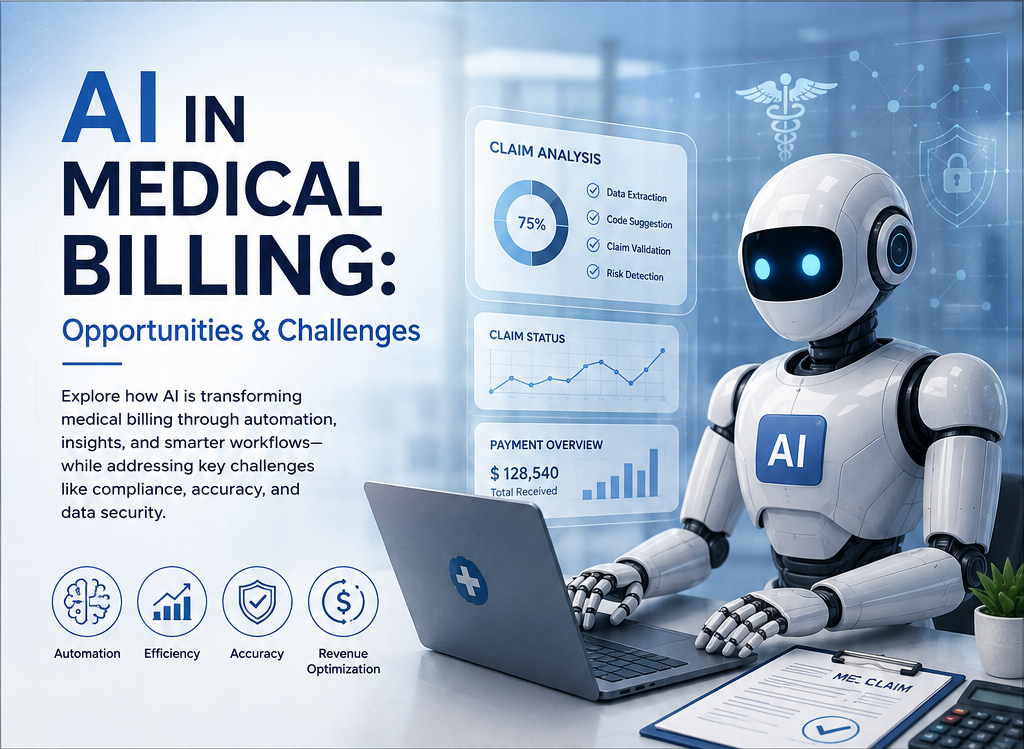
Table of contents
- Introduction
- What Is AI in Medical Billing?
- How AI Is Transforming Medical Billing
- 1. Automated Medical Coding
- 2. Faster Claims Processing
- 3. Predicting and Preventing Claim Denials
- 4. Intelligent Accounts Receivable Management
- 5. Reducing Manual Administrative Work
- Key Opportunities of AI in Medical Billing
- Improved Efficiency
- Better Accuracy
- Reduced Operational Costs
- Improved Revenue Cycle Performance
- Actionable Insights
- Challenges of Using AI in Medical Billing
- 1. Data Privacy and Security
- 2. Accuracy and Reliability
- 3. Regulatory and Compliance Requirements
- 4. Integration With Existing Systems
- 5. Staff Training and Adoption
- AI Should Assist, Not Replace, Billing Professionals
- Best Practices for Implementing AI in Medical Billing
- Start With a Specific Problem
- Evaluate the Technology
- Keep Humans in the Loop
- Monitor Performance
- Protect Patient Data
- The Future of AI in Medical Billing
- Conclusion
Introduction
Medical billing is one of the most detail-oriented and time-consuming processes in healthcare. From reviewing documentation and selecting appropriate codes to submitting claims and following up on denials, billing teams manage a complex workflow where small errors can lead to payment delays or lost revenue.
Artificial intelligence (AI) is changing how healthcare organizations approach these challenges. By analyzing large amounts of clinical and financial data, AI-powered billing solutions can automate repetitive tasks, identify potential errors, improve claims management, and help billing teams work more efficiently.
However, AI is not a replacement for experienced billing professionals. Healthcare organizations must consider data privacy, accuracy, regulatory requirements, system integration, and human oversight when implementing AI.
What Is AI in Medical Billing?
AI in medical billing refers to the use of artificial intelligence technologies—including machine learning, natural language processing (NLP), and intelligent automation—to support billing and revenue cycle management.
Depending on the solution, AI can help with tasks such as:
- Extracting information from clinical documentation
- Suggesting medical billing codes
- Checking claims for potential errors
- Identifying missing information
- Predicting claim denials
- Automating repetitive administrative work
- Monitoring payment patterns
- Supporting accounts receivable follow-up
- Identifying unusual billing activity
The goal is to make billing workflows faster, more consistent, and less dependent on manual data entry.
How AI Is Transforming Medical Billing
1. Automated Medical Coding
Coding requires careful review of clinical documentation and knowledge of applicable coding rules. AI can analyze documentation and suggest relevant codes based on the information available.
For example, NLP technology can review clinical notes and identify diagnoses, procedures, and other relevant details that may support coding.
Important: AI-generated coding recommendations should still be reviewed by qualified professionals, particularly when documentation is complex or ambiguous.
2. Faster Claims Processing
Traditional claims workflows often involve repetitive data entry and manual verification. AI can automate parts of this process by extracting information, checking fields, and identifying potential issues before submission.
This can help organizations:
- Reduce manual workload
- Accelerate claim preparation
- Improve consistency
- Reduce avoidable submission errors
Faster processing can ultimately contribute to a more efficient revenue cycle.
3. Predicting and Preventing Claim Denials
Claim denials are a major concern for healthcare organizations. AI can analyze historical claims and identify patterns associated with rejected or denied claims.
An AI system might flag issues such as:
- Missing documentation
- Incorrect or inconsistent information
- Coding mismatches
- Eligibility-related concerns
- Authorization requirements
- Potential payer-specific issues
Instead of discovering problems after a claim is rejected, billing teams can address potential issues before submission.
4. Intelligent Accounts Receivable Management
AI can also support accounts receivable workflows by analyzing unpaid claims and helping prioritize follow-up activities.
For example, systems can identify claims that may require immediate attention based on factors such as:
- Age of the claim
- Payer behavior
- Claim value
- Previous payment patterns
- Likelihood of successful recovery
This allows staff to spend more time on higher-value or more complex cases.
5. Reducing Manual Administrative Work
Medical billing teams often spend significant time performing repetitive tasks. AI-powered automation can help handle routine activities such as data extraction, claim checks, status monitoring, and workflow routing.
Reducing repetitive work allows staff to focus on tasks that require judgment, communication, and problem-solving.
Key Opportunities of AI in Medical Billing
Improved Efficiency
AI can process large volumes of information quickly and consistently. This can help billing departments handle growing workloads without increasing manual effort at the same rate.
Better Accuracy
Automated checks can identify inconsistencies and missing information that may be overlooked during manual processing.
Reduced Operational Costs
By automating repetitive processes, healthcare organizations may reduce administrative workload and use staff resources more strategically.
Improved Revenue Cycle Performance
Better claim preparation, denial prevention, and follow-up prioritization can contribute to stronger revenue cycle management.
Actionable Insights
AI can analyze historical billing data to identify trends and patterns that may not be obvious through manual review.
Challenges of Using AI in Medical Billing
Despite its potential, AI introduces important challenges that healthcare organizations need to address.
1. Data Privacy and Security
Medical billing involves sensitive patient and financial information. Organizations must ensure that AI systems are implemented with appropriate privacy and security controls.
Healthcare providers should carefully evaluate:
- Data storage
- Access controls
- Encryption
- Vendor security practices
- Audit capabilities
- Data retention policies
- Regulatory obligations
AI should strengthen operational efficiency without compromising patient privacy.
2. Accuracy and Reliability
AI systems can make mistakes. An incorrect coding suggestion or inaccurate interpretation of documentation can result in billing errors or compliance concerns.
For this reason, organizations should establish appropriate human review processes rather than treating AI output as automatically correct.
3. Regulatory and Compliance Requirements
Medical billing operates within a highly regulated environment. AI implementation must align with applicable healthcare, privacy, coding, reimbursement, and payer requirements.
Organizations should regularly evaluate whether AI-supported workflows remain compliant as regulations and payer policies evolve.
4. Integration With Existing Systems
Many healthcare organizations already use EHRs, practice management systems, clearinghouses, and revenue cycle platforms.
An AI billing solution needs to integrate effectively with these systems. Poor integration can create duplicate work, data inconsistencies, or workflow disruptions.
5. Staff Training and Adoption
Introducing AI changes established workflows. Billing professionals need to understand what the technology does, how to interpret its recommendations, and when human intervention is required.
Successful implementation is therefore not simply a technology project—it is also a people and process initiative.
AI Should Assist, Not Replace, Billing Professionals
One of the most important considerations is finding the right balance between automation and human expertise.
AI is particularly effective at processing large volumes of structured and unstructured data, identifying patterns, and performing repetitive checks. Human professionals remain essential for complex cases, clinical context, judgment, communication, and compliance decisions.
A strong model is:
AI identifies → AI recommends → Human reviews → Organization acts
This approach combines the speed of automation with the expertise of experienced healthcare professionals.
Best Practices for Implementing AI in Medical Billing
Healthcare organizations considering AI should take a gradual and measurable approach.
Start With a Specific Problem
Instead of implementing AI across the entire billing operation at once, begin with a clearly defined challenge such as denial prediction, coding assistance, or claims quality checks.
Evaluate the Technology
Assess the solution's accuracy, integration capabilities, security controls, scalability, reporting features, and vendor support.
Keep Humans in the Loop
Define which tasks AI can automate and which decisions require professional review.
Monitor Performance
Track metrics such as:
- Claim denial rates
- Clean claim rates
- Days in accounts receivable
- Coding accuracy
- Staff productivity
- Claim turnaround time
- Revenue recovery
Protect Patient Data
Make privacy and security requirements part of the technology evaluation from the beginning—not an afterthought.
The Future of AI in Medical Billing
AI is likely to become increasingly embedded in revenue cycle management. Future systems may provide more sophisticated automation across coding, claims, denial management, payment analysis, and financial forecasting.
Rather than eliminating the role of billing professionals, AI is more likely to change what those professionals spend their time doing. Routine tasks can increasingly be automated while employees focus on complex claims, exceptions, payer communication, compliance, and revenue strategy.
The organizations that benefit most will be those that treat AI as a tool for improving processes—not simply as a way to reduce headcount.
Conclusion
AI presents significant opportunities for improving medical billing. From automated coding and claims review to denial prediction and accounts receivable management, intelligent technologies can reduce repetitive work and help healthcare organizations build more efficient revenue cycles.
At the same time, successful AI adoption requires careful attention to accuracy, privacy, compliance, integration, and human oversight.
The future of medical billing is not simply automated billing—it is a smarter collaboration between AI technology and skilled healthcare professionals.