Who Qualifies for Principal Care Management?
Principal Care Management (PCM) supports patients with a significant chronic condition requiring focused, ongoing management. Learn who may qualify, what clinical and documentation requirements apply, how PCM differs from CCM, and how providers can build care plans, document monthly activities, and prepare accurate claims while following applicable Medicare and payer rules.

Table of contents
- Who Qualifies for Principal Care Management?
- What Is Principal Care Management?
- Who May Qualify for PCM?
- 1. The Patient Has a Significant Chronic Condition
- 2. The Patient Has One Principal Condition Requiring Focused Management
- 3. The Condition Requires Significant Management
- 4. The Patient Has an Established Relationship With the Billing Provider
- 5. A Comprehensive Care Plan Is Created
- 6. The Patient Gives the Required Consent
- 7. The Required Monthly Services Are Performed and Documented
- Who Does Not Automatically Qualify?
- PCM vs. CCM: What Is the Difference?
- Examples of Patients Who May Be Appropriate for PCM
- Example 1: Complex COPD
- Example 2: Complex Heart Failure
- Example 3: Stable Chronic Condition
- PCM Eligibility Checklist
- How PCM Can Fit Into an EHR or Practice Management System
- What Should Providers Document?
- Final Takeaway
Who Qualifies for Principal Care Management?
Principal Care Management (PCM) is a care-management service designed for patients with a single complex or high-risk chronic condition that requires focused, ongoing management. PCM helps healthcare providers coordinate care, monitor the patient's condition, manage treatment, and reduce the risk of complications.
Understanding who qualifies for Principal Care Management is important for providers, care teams, and medical billing staff because PCM has specific clinical, documentation, consent, and billing requirements.
What Is Principal Care Management?
Principal Care Management is a monthly care-management service focused on one principal chronic condition.
Unlike programs that may address multiple chronic conditions, PCM concentrates on the condition that is primarily responsible for the patient's significant health needs.
Examples may include:
- Heart failure
- Chronic obstructive pulmonary disease (COPD)
- Diabetes with significant complications
- Asthma
- Hypertension with complications
- Complex neurological conditions
- Other serious chronic conditions requiring focused management
The condition must be sufficiently complex or high-risk to justify ongoing care-management services.
Who May Qualify for PCM?
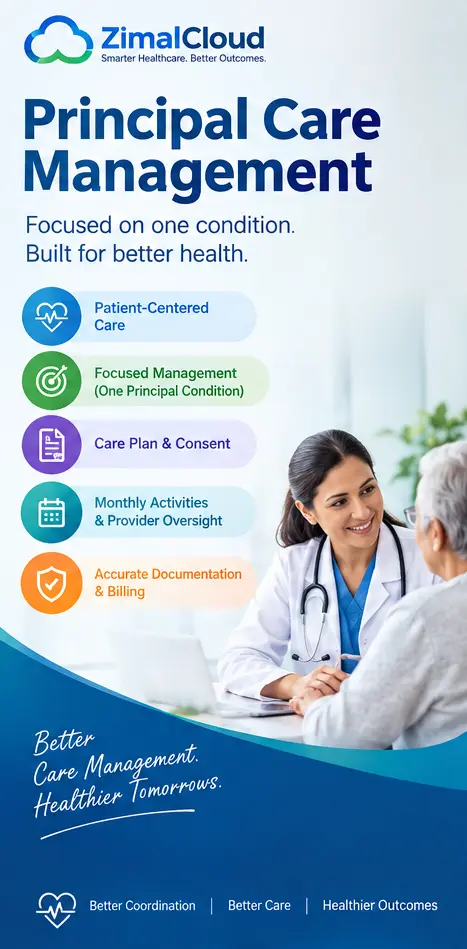
A patient may be appropriate for PCM when the following circumstances apply.
1. The Patient Has a Significant Chronic Condition
The patient should have a chronic condition that requires ongoing management rather than a short-term or temporary problem.
The condition may require:
- Regular monitoring
- Medication management
- Treatment adjustments
- Care coordination
- Communication with healthcare professionals
- Follow-up after changes in treatment
- Monitoring for worsening symptoms
2. The Patient Has One Principal Condition Requiring Focused Management
PCM is designed around one principal chronic condition.
The provider should identify the condition that requires the primary focus of the care-management service.
For example, a patient may have diabetes, hypertension, and COPD. If COPD is the condition requiring intensive ongoing management, the PCM care plan may focus specifically on COPD.
Other conditions can remain documented in the patient's medical record, but PCM should have a clearly defined principal condition and purpose.
3. The Condition Requires Significant Management
Having a chronic disease alone does not automatically mean a patient qualifies for PCM.
The condition should require ongoing, active management by the healthcare team.
Examples of management activities may include:
- Reviewing symptoms and clinical status
- Monitoring treatment response
- Managing medications
- Communicating with the patient
- Coordinating with specialists
- Updating the care plan
- Following up on treatment recommendations
- Addressing changes in the patient's condition
The medical record should demonstrate why ongoing care management is medically necessary.
4. The Patient Has an Established Relationship With the Billing Provider
PCM is generally provided within an established clinician-patient relationship.
The clinician should understand the patient's condition, treatment needs, and overall clinical situation before developing the PCM plan of care.
5. A Comprehensive Care Plan Is Created
A PCM program should have a documented care plan addressing the patient's principal condition.
Depending on the patient's needs, the care plan may include:
- Clinical goals
- Treatment objectives
- Medication management
- Monitoring requirements
- Patient education
- Follow-up activities
- Care coordination
- Provider oversight
- Escalation instructions when the patient's condition worsens
The care plan should be individualized rather than simply copied from a standard template.
6. The Patient Gives the Required Consent
Patient consent is an important part of care-management services.
The practice should follow applicable Medicare and payer requirements for obtaining and documenting consent.
The patient should understand what the service involves and any applicable cost-sharing or billing considerations.
7. The Required Monthly Services Are Performed and Documented
PCM is not simply a diagnosis added to a patient's chart.
The care team must perform qualifying care-management activities and maintain appropriate documentation.
Documentation can include:
- Date and type of activity
- Time spent when time-based requirements apply
- Clinical issue addressed
- Medication or treatment discussion
- Communication with the patient or caregiver
- Care coordination
- Updates to the care plan
- Provider involvement and oversight
The exact documentation and coding requirements depend on the applicable CPT code and payer rules.
Who Does Not Automatically Qualify?
A patient does not automatically qualify for PCM simply because they:
- Have a chronic disease
- Take several medications
- Visit a physician regularly
- Have multiple diagnoses
- Are elderly
- Have recently been hospitalized
- Need occasional follow-up
The provider must determine whether the patient's condition and care needs meet the applicable PCM requirements.
PCM vs. CCM: What Is the Difference?
One of the easiest ways to understand PCM is to compare it with Chronic Care Management (CCM).
| PCM | CCM |
|---|---|
| Focuses on one principal chronic condition | Generally addresses multiple chronic conditions |
| Provides focused management for that condition | Coordinates care across multiple chronic conditions |
| Uses a condition-specific care plan | Uses a broader comprehensive care plan |
| Appropriate when one condition requires significant management | Appropriate when multiple chronic conditions require ongoing management |
A patient may have several chronic conditions, but the practice must evaluate whether PCM, CCM, or another care-management service is appropriate based on the patient's circumstances and applicable billing rules.
Examples of Patients Who May Be Appropriate for PCM
Example 1: Complex COPD
A patient has COPD with frequent exacerbations, medication changes, and ongoing monitoring needs.
The provider determines that COPD is the principal condition requiring focused care management.
The care team creates a COPD-focused care plan, monitors symptoms, manages medications, and coordinates follow-up.
This patient may be an appropriate candidate for PCM if all applicable requirements are satisfied.
Example 2: Complex Heart Failure
A patient has chronic heart failure and requires ongoing medication management, symptom monitoring, and coordination with a cardiologist.
If heart failure is the principal condition requiring significant management, PCM may be appropriate when the applicable requirements are met.
Example 3: Stable Chronic Condition
A patient has a chronic condition but requires only routine visits and occasional medication refills.
If there is no significant ongoing management need, simply having the diagnosis may not justify PCM.
PCM Eligibility Checklist
Before enrolling a patient in PCM, a practice can evaluate:
☐ Does the patient have a significant chronic condition?
☐ Is there one principal condition requiring focused management?
☐ Is ongoing care management medically necessary?
☐ Is there an established clinician-patient relationship?
☐ Has an individualized care plan been created?
☐ Has required patient consent been obtained and documented?
☐ Will the care team perform qualifying monthly services?
☐ Can the practice document the services performed?
☐ Does the selected CPT code match the service actually provided?
☐ Are applicable Medicare and payer requirements satisfied?
How PCM Can Fit Into an EHR or Practice Management System
A well-designed healthcare management system can keep PCM information connected to the patient's overall record.
For example:
Patient → Principal Condition → PCM Enrollment → Care Plan → Monthly Activities → Provider Oversight → Documentation → Coding → Claim → ERA/Payment
This allows the clinical and billing teams to work from the same patient record while maintaining a clear separation between clinical documentation and billing activities.
A PCM dashboard can also help staff identify:
- Patients currently enrolled in PCM
- Principal conditions
- Care-plan status
- Monthly activity status
- Documentation completion
- Provider review requirements
- Coding readiness
- Claims waiting for submission
What Should Providers Document?
Good documentation should explain why the patient needs PCM and what the care team actually did.
The record should make it possible for an auditor or payer to understand:
- What principal condition is being managed?
- Why does the condition require ongoing management?
- What goals were established?
- What care-management activities were performed?
- How did those activities support the patient's treatment?
- What provider oversight occurred?
- What time or other requirements apply to the billed service?
- Which code accurately represents the service?
Avoid documenting generic statements that do not demonstrate actual care-management work.
Final Takeaway
Who qualifies for Principal Care Management? Generally, PCM is intended for patients with a significant chronic condition that requires focused, ongoing management of one principal condition.
A qualifying PCM workflow should connect the patient's clinical condition to a personalized care plan, ongoing care-management activities, provider oversight, documentation, appropriate coding, and billing.
Because Medicare and payer requirements can change, healthcare organizations should verify the current CPT, Medicare, and payer-specific requirements before implementing or billing PCM.
For healthcare practices, integrating PCM into the same patient record as CCM, RPM, BHI, GI, and Practice Management can provide a more complete view of the patient's care while keeping each service's documentation and billing workflow clearly defined.