RPM CPT Codes and Billing: A Practical Guide
Remote Patient Monitoring (RPM) helps healthcare practices monitor patients using connected medical devices while supporting ongoing clinical management. This practical guide explains 2026 RPM CPT codes, including 99453, 99445, 99454, 99470, 99457, and 99458, along with documentation, billing workflow, transmission requirements, common mistakes, and EHR automation.
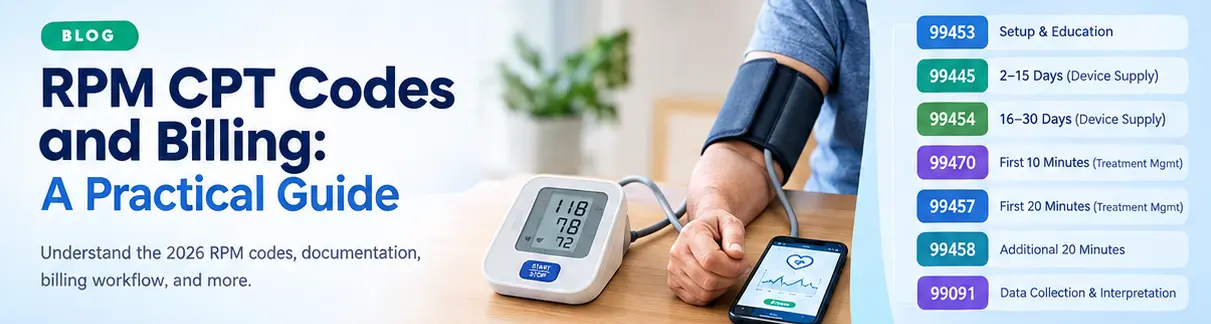
Table of contents
- RPM CPT Codes and Billing: A Practical Guide
- Introduction
- What Is Remote Patient Monitoring?
- RPM CPT Codes: 2026 Overview
- 1. CPT 99453 — Initial Setup and Patient Education
- 2. CPT 99445 — RPM Device Supply for 2–15 Days
- Example
- 3. CPT 99454 — RPM Device Supply for 16–30 Days
- Practical documentation
- 4. CPT 99470 — RPM Treatment Management: First 10 Minutes
- Example
- 5. CPT 99457 — First 20 Minutes of RPM Treatment Management
- 6. CPT 99458 — Additional 20 Minutes
- 7. CPT 99091 — Data Collection and Interpretation
- RPM Billing Workflow
- Step 1: Identify an Appropriate Patient
- Step 2: Obtain and Document Consent
- Step 3: Assign the Connected Device
- Step 4: Educate the Patient
- Step 5: Collect and Transmit Data
- Step 6: Review the Data
- Step 7: Communicate With the Patient
- Step 8: Document Clinical Management
- Step 9: Perform Billing Review
- RPM Documentation Checklist
- RPM Billing: Common Mistakes
- 1. Billing Without Proper Device Data
- 2. Missing Transmission-Day Requirements
- 3. Poor Time Documentation
- 4. Missing Interactive Communication
- 5. Treating RPM as Only Device Monitoring
- RPM Software: What Should Be Automated?
- Recommended RPM dashboard
- RPM and EHR Integration
- RPM vs RTM
- RPM Billing in 2026: What Changed?
- Previously
- 2026
- Practical RPM Example
- During the month:
- Key Takeaways
RPM CPT Codes and Billing: A Practical Guide
Introduction
Remote Patient Monitoring (RPM) has become an important part of modern healthcare. It allows healthcare providers to monitor patients outside the traditional office setting using connected medical devices such as blood pressure monitors, weight scales, pulse oximeters, and glucose-monitoring devices.
For medical practices, RPM can improve continuity of care while creating a structured, billable workflow. However, successful RPM billing requires more than simply giving a patient a device. The practice must document medical necessity, device setup, data transmission, clinical review, patient communication, treatment management, and other applicable requirements.
The 2026 CPT updates also changed the RPM landscape by introducing shorter-duration billing options, making it important for practices and billing teams to understand the current code structure.
What Is Remote Patient Monitoring?
Remote Patient Monitoring is the collection and transmission of a patient's physiologic data from a connected medical device to a healthcare provider.
Common RPM data includes:
- Blood pressure
- Weight
- Pulse rate
- Oxygen saturation
- Blood glucose
- Respiratory measurements
- Other physiologic parameters
The provider or care team uses this information to monitor the patient's condition and make appropriate treatment decisions.
For Medicare RPM, CMS describes three major components:
- Patient education and device setup
- Connected device supply and data transmission
- Clinical treatment and management
These components are represented by different billing codes.
RPM CPT Codes: 2026 Overview
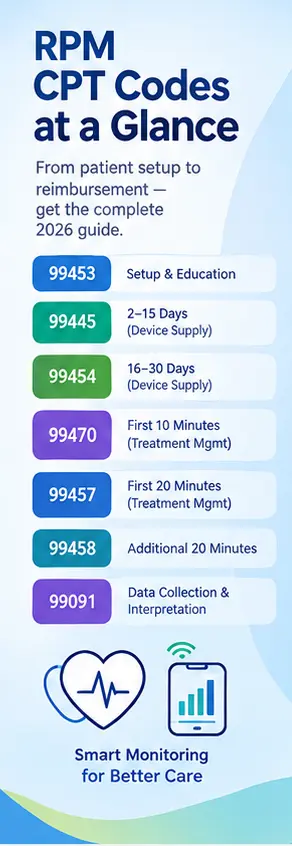
The primary RPM CPT codes used in 2026 include:
| CPT Code | Purpose | Key Requirement |
|---|---|---|
| 99453 | Initial setup and patient education | Initial RPM setup and education |
| 99445 | Device supply/data transmission | 2–15 days of data in a 30-day period |
| 99454 | Device supply/data transmission | 16–30 days of data in a 30-day period |
| 99470 | RPM treatment management | First 10 minutes of qualifying monthly management |
| 99457 | RPM treatment management | First 20 minutes of qualifying monthly management |
| 99458 | Additional RPM management | Each additional 20 minutes |
| 99091 | Collection and interpretation of physiologic data | Physician/QHP time-based data review |
The 2026 CPT update introduced 99445 for shorter monitoring periods and 99470 for shorter treatment-management time.
1. CPT 99453 — Initial Setup and Patient Education
CPT 99453 represents the initial setup of RPM equipment and patient education.
The practice may provide education regarding:
- How to use the device
- How measurements are obtained
- How data is transmitted
- When the patient should take readings
- What to do if the device does not work
- How the patient should contact the care team
The documentation should demonstrate that the patient actually received the necessary setup and education.
A patient with hypertension receives a connected blood-pressure monitor. A member of the care team explains how to use the device and confirms that the device can transmit readings to the practice.
The setup and education activity may support 99453, when all applicable requirements are met.
2. CPT 99445 — RPM Device Supply for 2–15 Days
One of the important 2026 changes is CPT 99445.
This code provides a billing pathway when qualifying RPM data is transmitted on 2–15 days within a 30-day period.
Previously, practices generally faced a 16-day threshold for the device-supply code. The 2026 update introduced a shorter-duration option.
Example
A patient uses a connected blood-pressure device and transmits qualifying data on 10 separate days during a 30-day monitoring period.
If all other requirements are satisfied, the device-supply portion may support 99445 rather than 99454.
Important: 99445 and 99454 represent different monitoring-duration ranges and should not both be reported for the same monitoring period.
3. CPT 99454 — RPM Device Supply for 16–30 Days
CPT 99454 represents the supply of the connected device and transmission of physiologic data when the patient has qualifying data transmission on 16–30 days within the 30-day period.
Examples of connected devices include:
- Blood pressure monitors
- Connected weight scales
- Pulse oximeters
- Glucose-monitoring devices
CMS states that the device used for RPM must meet the applicable definition of a medical device and electronically transmit the physiologic information.
Practical documentation
The RPM system should be able to show:
- Patient
- Device assigned
- Device type
- Monitoring period
- Dates data was transmitted
- Number of qualifying transmission days
- Data received
- Device status
4. CPT 99470 — RPM Treatment Management: First 10 Minutes
CPT 99470 is another important 2026 addition.
It provides a pathway for RPM treatment-management services when the qualifying monthly management time reaches the applicable shorter threshold.
The code represents the first 10 minutes of RPM treatment-management services during a calendar month and requires real-time interactive communication with the patient or caregiver.
Example
A care team reviews a patient's RPM information, determines that intervention is appropriate, communicates with the patient in real time, and documents 10–19 minutes of qualifying treatment-management activity during the month.
When all applicable requirements are met, 99470 may be appropriate.
5. CPT 99457 — First 20 Minutes of RPM Treatment Management
CPT 99457 covers the first 20 minutes of RPM treatment-management services during a calendar month.
The service involves clinical management based on the patient's RPM data and requires interactive communication with the patient or caregiver. CMS identifies 99457 as part of the RPM treatment-management code family.
Examples of management activities can include:
- Reviewing abnormal readings
- Assessing patient status
- Discussing readings with the patient
- Providing clinical instructions
- Adjusting the treatment plan
- Coordinating follow-up
- Escalating concerning findings to the provider
The medical record should demonstrate that the time was actually spent on qualifying RPM treatment-management activities.
6. CPT 99458 — Additional 20 Minutes
CPT 99458 is an add-on code for additional RPM treatment-management time.
It is used when the practice provides additional qualifying management time beyond the base RPM management service.
The record should contain sufficient time documentation to support the reported service.
7. CPT 99091 — Data Collection and Interpretation
CPT 99091 represents collection and interpretation of physiologic data that is digitally stored and/or transmitted by the patient or caregiver.
CMS describes this service as involving 30 minutes of physician or qualified healthcare professional time.
This code is distinct from the newer RPM treatment-management structure, so practices should carefully evaluate whether services meet the requirements of 99091 versus 99457/99458.
For example, CMS notes that 99457 may not be billed together with 99091 for the same billing period and beneficiary.
RPM Billing Workflow
A well-designed RPM workflow can be divided into several stages.
Step 1: Identify an Appropriate Patient
The provider determines that remote physiologic monitoring is medically necessary for an acute or chronic condition.
Examples may include:
- Hypertension
- Diabetes
- Heart failure
- COPD
- Weight-related monitoring
- Other conditions requiring physiologic monitoring
CMS states that Medicare RPM can apply to patients with acute or chronic conditions when the applicable requirements are satisfied.
Step 2: Obtain and Document Consent
The patient should provide the applicable consent to participate in RPM.
The EHR should store:
- Consent date
- Consent status
- Patient/caregiver
- Program
- Provider
- Relevant documentation
Step 3: Assign the Connected Device
The practice assigns an appropriate connected medical device.
The system should record:
- Device type
- Device identifier
- Patient
- Assignment date
- Activation status
- Transmission status
Step 4: Educate the Patient
The care team explains how to use the device and confirms that the patient understands the monitoring process.
This activity can support 99453 when applicable requirements are met.
Step 5: Collect and Transmit Data
The device automatically collects and transmits physiologic information.
The RPM platform should track the patient's transmission activity throughout the monitoring period.
Step 6: Review the Data
The care team monitors incoming readings and identifies:
- Normal readings
- Abnormal readings
- Alerts
- Trends
- Missing data
- Potential clinical concerns
Step 7: Communicate With the Patient
When treatment-management requirements are met, the provider or qualified care team member communicates with the patient or caregiver.
Communication may involve:
- Telephone interaction
- Other qualifying real-time communication
- Treatment instructions
- Medication-related discussion
- Follow-up planning
Step 8: Document Clinical Management
The record should demonstrate what happened as a result of the RPM data.
For example:
Blood pressure readings reviewed. Persistent elevated readings identified. Patient contacted and instructed regarding treatment plan and follow-up.
The documentation should support the medical necessity and billed service.
Step 9: Perform Billing Review
Before claim submission, the billing team should verify:
- Correct CPT code
- Monitoring period
- Transmission-day count
- Treatment-management time
- Required interactive communication
- Consent
- Medical necessity
- Provider eligibility
- Payer-specific requirements
- Potential code conflicts
RPM Documentation Checklist
A strong RPM workflow should capture the following information:
| Documentation Area | What to Store |
|---|---|
| Patient eligibility | Condition and clinical need |
| Medical necessity | Reason RPM is appropriate |
| Consent | Date and consent documentation |
| Device | Device type and identifier |
| Setup | Setup date and education |
| Transmission | Dates and data received |
| Alerts | Alerts generated and reviewed |
| Clinical review | Data/trends reviewed |
| Communication | Date, participants, method |
| Treatment management | Clinical action taken |
| Time | Qualifying management time |
| Provider | Rendering/supervising provider |
| Billing | CPT, date/period, claim status |
RPM Billing: Common Mistakes
1. Billing Without Proper Device Data
RPM should involve an appropriate connected medical device and electronically transmitted physiologic data. Simply asking patients to manually text or report readings may not satisfy the requirements for standard RPM device-supply billing.
2. Missing Transmission-Day Requirements
Practices should track qualifying transmission days rather than simply counting the number of readings.
For 2026, the device-supply pathway distinguishes between:
- 99445: 2–15 days
- 99454: 16–30 days
3. Poor Time Documentation
Treatment-management codes are time-based. If the practice cannot demonstrate the qualifying time, the claim may be difficult to support during an audit.
4. Missing Interactive Communication
Treatment-management services such as 99457 require interactive communication with the patient or caregiver during the month.
5. Treating RPM as Only Device Monitoring
RPM is not simply a device-distribution program.
A compliant workflow should connect:
Patient → Device → Data → Clinical Review → Communication → Treatment Management → Documentation → Billing
RPM Software: What Should Be Automated?
An RPM-capable EHR or practice-management system should make billing compliance easier by automatically tracking important events.
Recommended RPM dashboard
Patient
→ Enrollment
→ Consent
→ Device
→ Data Transmission
→ Alerts
→ Clinical Review
→ Communication
→ Treatment Management
→ Time Tracking
→ Billing Eligibility
→ Claim
The system can then provide billing alerts such as:
- 99453 eligible
- 99445 eligible
- 99454 eligible
- 99470 threshold reached
- 99457 threshold reached
- 99458 additional time available
- Missing transmission
- Missing communication
- Missing documentation
This reduces manual work and helps prevent missed billing opportunities.
RPM and EHR Integration
For an EHR or Practice Management system, RPM should not operate as an isolated module.
A better architecture connects RPM with:
- Patient demographics
- Problem list
- Diagnoses
- Care plans
- Medication management
- Provider tasks
- Device management
- Vital signs
- Clinical alerts
- Communication logs
- Time tracking
- CPT coding
- Claims
- ERA/payment posting
This creates a complete workflow from clinical monitoring to reimbursement.
RPM vs RTM
RPM and Remote Therapeutic Monitoring (RTM) are related but different.
RPM primarily focuses on physiologic data such as:
- Blood pressure
- Weight
- Pulse
- Oxygen saturation
- Glucose
RTM generally focuses on data related to therapeutic responses, adherence, or other non-physiologic aspects of treatment.
Practices should not automatically use RPM codes simply because monitoring occurs remotely. The nature of the data and service must match the applicable coding framework.
RPM Billing in 2026: What Changed?
The most important 2026 changes are the introduction of shorter-duration RPM pathways.
Previously
Practices generally had to reach the established monitoring threshold before reporting the device-supply component.
2026
The CPT structure now provides:
2–15 transmission days → 99445
16–30 transmission days → 99454
And for treatment management:
Shorter qualifying management period → 99470
20-minute base management service → 99457
Additional 20-minute increments → 99458
The AMA announced the 2026 CPT code-set changes as effective January 1, 2026.
Practical RPM Example
Consider a patient with hypertension enrolled in RPM.
During the month:
- Patient receives a connected blood-pressure monitor.
- Patient receives device education.
- Data is automatically transmitted.
- Data is transmitted on 18 separate days.
- Care team reviews the readings.
- Provider/care team communicates with the patient.
- Treatment-management time reaches the applicable threshold.
Potential RPM billing could include:
99453 → Initial setup and education
99454 → 16–30 days of device data transmission
99457 → First 20 minutes of qualifying treatment management
99458 → Additional qualifying 20-minute blocks, when applicable
The exact claim depends on the patient's circumstances, payer rules, provider qualifications, documentation, and other applicable requirements.
Key Takeaways
RPM billing becomes much easier when the clinical workflow and billing workflow are designed together.
The most important principles are:
- Confirm medical necessity.
- Obtain and document consent.
- Use an appropriate connected medical device.
- Document device setup and patient education.
- Track actual transmission days.
- Review and act on physiologic data.
- Document qualifying patient communication.
- Track treatment-management time accurately.
- Match the CPT code to the service actually performed.
- Maintain complete documentation for audit purposes.
The 2026 CPT changes make RPM more flexible by introducing 99445 for 2–15 days of device data and 99470 for the shorter treatment-management threshold. Practices should update their EHR, RPM platform, billing rules, and claim-validation logic accordingly.
Important: CPT coding and Medicare billing requirements can change, and commercial payers may apply different policies. Practices should verify current payer-specific coverage, reimbursement, modifier, and documentation requirements before submitting claims. CMS's current RPM guidance should be used alongside the applicable CPT code set and payer policies.