PCM vs CCM: What's the Difference?
PCM and CCM are Medicare care-management services designed to support patients with chronic conditions, but they serve different clinical needs. CCM generally coordinates care for patients with two or more chronic conditions, while PCM focuses on one complex, high-risk chronic condition. Understanding the difference helps practices choose appropriate workflows, documentation, and billing process.
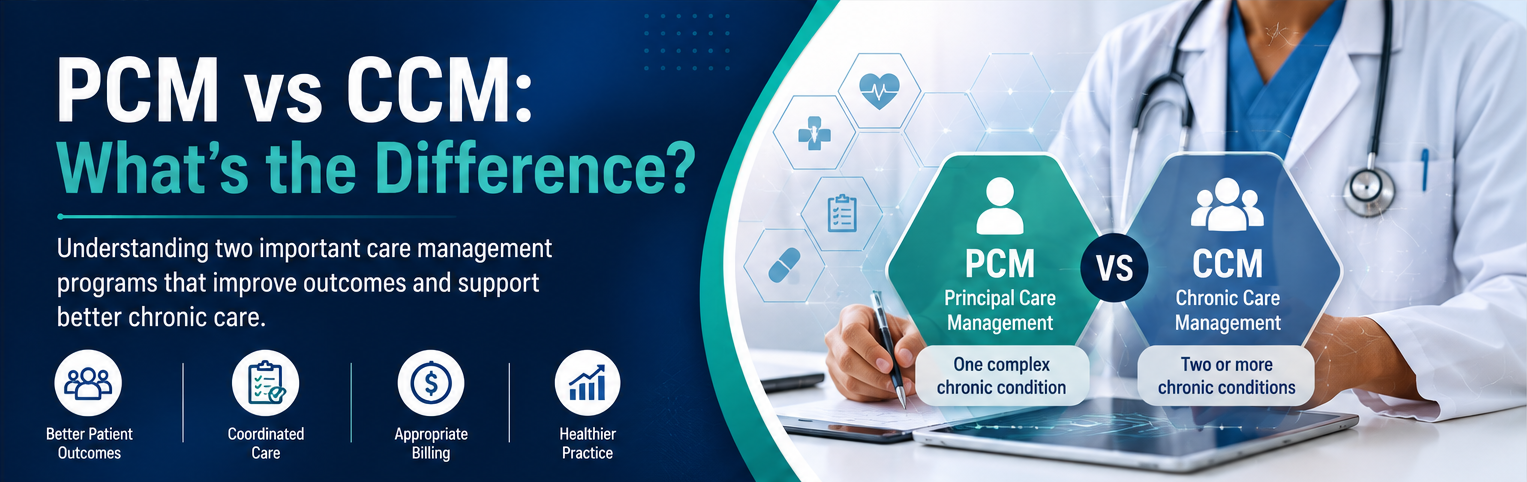
Table of contents
- What Is Chronic Care Management (CCM)?
- What Is Principal Care Management (PCM)?
- PCM vs CCM: Quick Comparison
- The Biggest Difference: One Condition vs. Multiple Conditions
- PCM
- CCM
- Example: GI Patient Under PCM
- Example: GI Patient Under CCM
- PCM and CCM in a GI Practice
- Potential PCM candidates
- Potential CCM candidates
- What Does a PCM Care Plan Include?
- 1. Problem Identification
- 2. Treatment Goals
- 3. Medication Management
- 4. Monitoring
- 5. Patient Education
- 6. Care Coordination
- 7. Follow-Up
- What Does a CCM Care Plan Include?
- PCM vs CCM Billing Codes
- Documentation: PCM vs CCM
- PCM Documentation
- CCM Documentation
- PCM vs CCM: Workflow Difference
- PCM Workflow
- CCM Workflow
- Which Is Better: PCM or CCM?
- PCM may be appropriate when:
- CCM may be appropriate when:
- Can PCM and CCM Be Used Together?
- How Software Can Support PCM and CCM
- Patient Eligibility
- Care Plan
- Monthly Activities
- Billing
- PCM vs CCM: Key Takeaways
- Final Thought
Managing chronic conditions requires more than an occasional office visit. Many patients need ongoing monitoring, medication management, care coordination, education, and communication between appointments.
Two important Medicare care-management models are Chronic Care Management (CCM) and Principal Care Management (PCM).
Although both programs involve ongoing care management, they are designed for different patient situations.
The simplest distinction is:
CCM generally addresses multiple chronic conditions, while PCM focuses on one serious or complex chronic condition.
Understanding this difference is important for providers, care managers, billers, and healthcare organizations because eligibility, documentation, workflows, and billing requirements must align with the service being provided.
What Is Chronic Care Management (CCM)?
Chronic Care Management (CCM) is designed for eligible patients who have two or more chronic conditions expected to last at least 12 months, or until the patient's death, and that place the patient at significant risk of death, acute exacerbation/decompensation, or functional decline.
CCM takes a comprehensive, multi-condition approach.
For example, a patient may have:
- Diabetes
- Hypertension
- Chronic kidney disease
- COPD
- Heart disease
- Depression
The goal is to coordinate care across the patient's different chronic conditions rather than concentrating on only one disease.
What Is Principal Care Management (PCM)?
Principal Care Management (PCM) focuses on managing one complex chronic condition that requires significant ongoing management.
The condition may place the patient at risk for serious deterioration, hospitalization, or other significant health consequences.
For example, a patient may have one primary condition such as:
- Crohn's disease
- Ulcerative colitis
- Severe GERD
- Chronic liver disease
- Heart failure
- COPD
- Diabetes with significant complications
The key idea is that PCM is disease-specific, whereas CCM is designed around the patient's broader chronic-care needs.
CMS describes PCM as disease-specific care management for a single complex chronic condition.
PCM vs CCM: Quick Comparison
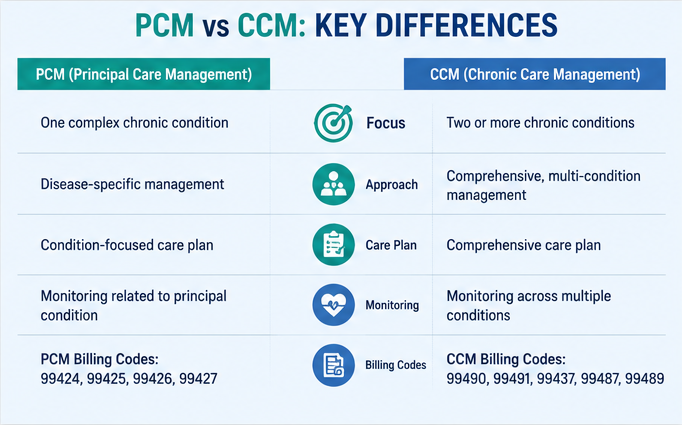
| Feature | PCM | CCM |
|---|---|---|
| Full Name | Principal Care Management | Chronic Care Management |
| Primary Focus | One complex chronic condition | Multiple chronic conditions |
| Conditions | Generally one | Two or more |
| Care Approach | Disease-specific | Comprehensive/multi-condition |
| Care Coordination | Focused around principal condition | Across chronic conditions |
| Care Plan | Condition-specific | Comprehensive chronic-care plan |
| Monitoring | Focused on principal disease | Multiple chronic conditions |
| Medication Management | Related to principal condition | Across patient's chronic conditions |
| Best Fit | Complex disease requiring focused management | Patient with multiple chronic conditions |
| Billing | PCM-specific codes | CCM-specific codes |
The Biggest Difference: One Condition vs. Multiple Conditions
The easiest way to understand PCM versus CCM is to look at the number and focus of chronic conditions.
PCM
One complex chronic condition
↓
Focused care management
↓
Disease-specific monitoring and treatment
CCM
Two or more chronic conditions
↓
Comprehensive care management
↓
Coordination across multiple conditions
This distinction should be reflected in the patient's clinical documentation and care-management workflow.
Example: GI Patient Under PCM
Consider a patient with severe Crohn's disease requiring ongoing management.
The gastroenterology practice may need to monitor:
- Disease activity
- Symptoms
- Medication response
- Medication adherence
- Laboratory results
- Treatment changes
- Specialist coordination
- Patient education
- Follow-up requirements
If the care-management service is appropriately furnished and all applicable requirements are met, this type of disease-focused management may align with the purpose of PCM.
The emphasis is the single principal GI condition.
Example: GI Patient Under CCM
Now consider another GI patient who has:
- Crohn's disease
- Diabetes
- Hypertension
- Chronic kidney disease
This patient's care may involve multiple providers and multiple interacting chronic conditions.
The practice may need to coordinate:
- GI treatment
- Diabetes management
- Blood pressure management
- Medication reconciliation
- Laboratory monitoring
- Specialist communication
- Preventive care
- Patient education
This broader, multi-condition approach is more consistent with the purpose of CCM when the applicable requirements are satisfied.
PCM and CCM in a GI Practice
Both programs can be valuable for gastroenterology practices because GI patients frequently require long-term management.
Potential PCM candidates
A GI practice may encounter patients requiring focused management of conditions such as:
- Inflammatory bowel disease
- Complex liver disease
- Chronic GI disorders
- Severe gastrointestinal conditions
- Other high-risk chronic GI conditions
Potential CCM candidates
GI patients may also have multiple chronic conditions, such as:
GI condition + Diabetes + Hypertension + CKD
or
Liver disease + Cardiovascular disease + Diabetes
In these cases, the patient's care-management needs extend beyond one disease.
What Does a PCM Care Plan Include?
A structured PCM care plan should support the ongoing management of the principal condition.
Depending on the patient's clinical needs and applicable requirements, a workflow can include:
1. Problem Identification
Document the principal chronic condition.
2. Treatment Goals
Define measurable clinical goals.
3. Medication Management
Track medications, adherence, effectiveness, and clinically appropriate changes.
4. Monitoring
Track symptoms, laboratory results, clinical indicators, and other relevant information.
5. Patient Education
Provide condition-specific education and self-management guidance.
6. Care Coordination
Coordinate with other healthcare professionals when necessary.
7. Follow-Up
Document ongoing monitoring and follow-up activities.
What Does a CCM Care Plan Include?
CCM requires a broader approach because multiple chronic conditions are being managed.
A comprehensive care plan may include:
- Problem list
- Treatment goals
- Symptom management
- Medication management
- Preventive care
- Patient education
- Care coordination
- Referrals
- Communication with other providers
- Monitoring
- Periodic review
CMS describes comprehensive care planning and coordination as important elements of CCM.
PCM vs CCM Billing Codes
For Medicare, the current PCM code family includes:
- 99424
- 99425
- 99426
- 99427
CMS lists these as Principal Care Management services.
The CCM family includes codes such as:
- 99490
- 99439
- 99491
- 99437
- 99487
- 99489
CMS's CCM guidance identifies these codes and distinguishes services based on the practitioner/staff type, complexity, and applicable time requirements.
Important: Billing codes and requirements can change. Practices should verify current CMS guidance, CPT requirements, payer policies, and applicable documentation requirements before submitting claims.
Documentation: PCM vs CCM
Documentation is one of the most important parts of both programs.
PCM Documentation
The record should clearly demonstrate:
One principal chronic condition
↓
Clinical risk/complexity
↓
Care-management activities
↓
Condition-specific care plan
↓
Ongoing monitoring and management
CCM Documentation
The record should demonstrate:
Two or more qualifying chronic conditions
↓
Comprehensive care plan
↓
Ongoing care-management activities
↓
Coordination across conditions/providers
↓
Required monthly service elements
Good documentation not only supports patient care but also helps the practice demonstrate that billed services were actually performed.
PCM vs CCM: Workflow Difference
PCM Workflow
Patient Identification
↓
Identify Principal Condition
↓
Eligibility Review
↓
Care Plan
↓
Condition-Specific Management
↓
Monitoring
↓
Medication Management
↓
Care Coordination
↓
Monthly Documentation
↓
Claim Submission
CCM Workflow
Patient Identification
↓
Identify 2+ Chronic Conditions
↓
Eligibility Review
↓
Comprehensive Care Plan
↓
Multi-Condition Management
↓
Care Coordination
↓
Medication Management
↓
Monitoring
↓
Monthly Documentation
↓
Claim Submission
Which Is Better: PCM or CCM?
There is no universally "better" program.
The appropriate service depends on the patient's clinical situation and applicable billing requirements.
PCM may be appropriate when:
- One complex chronic condition is the primary focus.
- The condition requires significant ongoing management.
- Care is primarily disease-specific.
- The patient's needs fit the applicable PCM requirements.
CCM may be appropriate when:
- The patient has two or more qualifying chronic conditions.
- Multiple conditions require ongoing management.
- The patient's care requires broader coordination.
- The patient's needs fit the applicable CCM requirements.
The decision should be based on the patient's clinical needs and the applicable Medicare/payer rules—not simply on which service generates greater reimbursement.
Can PCM and CCM Be Used Together?
This is an area where practices should be particularly careful.
Because PCM and CCM can overlap in their care-management activities, practices should not assume that both services can simply be billed for the same patient or the same work.
Before billing, verify:
- Patient eligibility
- Payer rules
- Practitioner requirements
- Service requirements
- Time requirements where applicable
- Consent requirements
- Documentation
- Whether services overlap with another billed care-management service
CMS maintains separate guidance for care-management services, and requirements should be checked against the current Medicare rules.
How Software Can Support PCM and CCM
A modern care-management platform can help practices manage both programs through structured workflows.
Patient Eligibility
Patient → Conditions → Eligibility → Program
Care Plan
Problems → Goals → Interventions → Monitoring → Review
Monthly Activities
Track:
- Phone calls
- Patient communication
- Medication review
- Care coordination
- Referrals
- Education
- Monitoring
- Provider review
Billing
Care Activity → Documentation → Time/Service Validation → Claim → ERA → Payment
This creates an auditable connection between clinical activity and billing.
PCM vs CCM: Key Takeaways
The difference can be summarized in one sentence:
CCM manages multiple chronic conditions, while PCM concentrates on one complex chronic condition.
For healthcare organizations, the important considerations are:
PCM
- One principal condition
- Disease-specific management
- Focused care plan
- Condition-centered monitoring
CCM
- Two or more chronic conditions
- Comprehensive care management
- Multi-condition care plan
- Broader coordination
For GI practices, understanding this distinction can help create clearer workflows, improve documentation, support appropriate billing, and make care-management programs easier for providers and staff to manage.
Final Thought
The goal of PCM and CCM is not simply to create another billing opportunity. Properly implemented, these programs provide a structured way to maintain contact with patients between office visits, coordinate care, manage medications, monitor chronic conditions, and support better long-term outcomes.
For practices implementing these programs, clinical appropriateness, accurate documentation, clear workflows, and payer compliance should remain the foundation of the billing process.