PCM Billing: CPT Codes and Requirements
PCM Billing: CPT Codes and Requirements Learn how Principal Care Management (PCM) works, including CPT codes 99424–99427, patient eligibility, care-plan requirements, time tracking, documentation, consent, and billing workflows. This practical guide helps medical practices understand PCM requirements and build accurate, compliant care-management processes.
Table of contents
- What Is Principal Care Management (PCM)?
- Example
- PCM CPT Codes
- 99424 and 99425
- 99426 and 99427
- What Does PCM Include?
- 1. Care Plan Development
- 2. Medication Management
- 3. Monitoring the Condition
- 4. Care Coordination
- 5. Patient Communication
- 6. Follow-Up
- PCM Eligibility Requirements
- One Complex Chronic Condition
- Condition Expected to Last
- Significant Risk
- Ongoing Management
- PCM Care Plan Requirements
- PCM Time Requirements
- Example
- PCM Documentation Requirements
- Patient Eligibility
- Medical Necessity
- Care Plan
- Services Performed
- Time
- Communication
- Clinical Updates
- Patient Consent
- Who Can Perform PCM?
- Physician / Qualified Healthcare Professional
- Clinical Staff
- PCM Billing Workflow
- PCM vs. CCM
- Common PCM Billing Mistakes
- 1. Billing Without Confirming Eligibility
- 2. Missing the Principal Condition
- 3. Incomplete Care Plan
- 4. Unsupported Time
- 5. Copy-and-Paste Documentation
- 6. Poor Activity Tracking
- 7. Ignoring Payer Rules
- How Software Can Simplify PCM Billing
- Example PCM Dashboard
- PCM Billing Documentation Checklist
- Conclusion
Principal Care Management (PCM) is a Medicare care-management service designed for patients who have a single complex chronic condition that requires ongoing management and coordination.
PCM allows eligible healthcare professionals to provide structured, continuous care outside of traditional office visits. When the required services, time, documentation, and patient eligibility criteria are met, providers may bill Medicare using specific CPT codes.
Understanding PCM billing requirements is important because care-management claims depend heavily on patient eligibility, clinical necessity, documented time, care planning, communication, and proper billing practices.
What Is Principal Care Management (PCM)?
Principal Care Management is a care-management program focused on one serious or complex chronic condition that is expected to last at least three months.
The condition should generally:
- Require ongoing medical management
- Create a significant risk of hospitalization or acute deterioration
- Require frequent adjustments or monitoring
- Need a focused care-management approach
- Be addressed through a documented treatment and management plan
Unlike Chronic Care Management (CCM), which generally focuses on patients with multiple chronic conditions, PCM is centered on one complex chronic condition.
Example
A patient may have several health problems, but one condition—such as severe COPD, heart failure, diabetes with complications, or another complex chronic disease—may require the primary focus of ongoing care management.
The PCM service should be connected to that specific condition and the clinical work required to manage it.
PCM CPT Codes
PCM billing primarily uses CPT codes 99424–99427.
| CPT Code | Service | Typical Time Requirement | Provider |
|---|---|---|---|
| 99424 | PCM, first 30 minutes in a calendar month | 30 min | Physician or other qualified health professional |
| 99425 | PCM, each additional 30 minutes | +30 min | Physician or other qualified health professional |
| 99426 | PCM, first 30 minutes in a calendar month | 30 min | Clinical staff under physician/QHP direction |
| 99427 | PCM, each additional 30 minutes | +30 min | Clinical staff under physician/QHP direction |
99424 and 99425
These codes are used when the PCM service is personally performed by a physician or other qualified healthcare professional.
- 99424: First 30 minutes
- 99425: Each additional 30 minutes
99426 and 99427
These codes are used when the PCM service is provided by clinical staff under the direction of a physician or other qualified healthcare professional.
- 99426: First 30 minutes
- 99427: Each additional 30 minutes
The exact billing requirements and payer policies should always be verified against current Medicare guidance and the applicable payer rules.
What Does PCM Include?
PCM is more than simply making a monthly phone call. The service involves ongoing management of the patient's principal chronic condition.
Depending on the patient's needs, PCM activities can include:
1. Care Plan Development
A comprehensive care plan should identify the patient's principal chronic condition, treatment objectives, interventions, monitoring requirements, and follow-up strategy.
2. Medication Management
The care team may:
- Review medications
- Monitor adherence
- Identify potential medication-related issues
- Coordinate medication changes
- Communicate relevant concerns to the treating provider
3. Monitoring the Condition
The care team may monitor:
- Symptoms
- Clinical changes
- Treatment response
- Patient-reported information
- Relevant measurements
- Warning signs requiring escalation
4. Care Coordination
PCM may involve coordination among:
- Primary care providers
- Specialists
- Hospitals
- Pharmacies
- Other healthcare professionals
5. Patient Communication
Depending on the service and patient's needs, communication may occur through appropriate methods such as:
- Telephone
- Secure electronic communication
- Other permitted communication methods
6. Follow-Up
The care team should follow up on the patient's condition and document clinically relevant activities performed during the month.
PCM Eligibility Requirements
Before billing PCM, the practice should establish that the patient meets the applicable eligibility requirements.
Important considerations include:
One Complex Chronic Condition
PCM is intended to manage one complex chronic condition that requires substantial ongoing management.
Condition Expected to Last
The condition should generally be expected to last for at least three months, or until the condition is resolved.
Significant Risk
The condition should place the patient at significant risk of:
- Hospitalization
- Acute exacerbation
- Functional decline
- Other serious complications
Ongoing Management
The patient should require ongoing medical management rather than a one-time intervention.
PCM Care Plan Requirements
A documented care plan is an important part of PCM.
A practical PCM care plan can include:
| Care Plan Section | What to Document |
|---|---|
| Principal Condition | The chronic condition being managed |
| Clinical Assessment | Current status and relevant findings |
| Treatment Goals | Desired clinical outcomes |
| Interventions | Planned management activities |
| Medication Plan | Current medications and management needs |
| Monitoring | What will be monitored and how often |
| Patient Education | Education provided to support self-management |
| Care Coordination | Specialists and other healthcare resources |
| Follow-Up | Planned follow-up and escalation strategy |
| Review | Updates made to the plan based on patient progress |
The care plan should be individualized to the patient rather than being a generic template.
PCM Time Requirements
Time is an important component of PCM billing.
The practice should track the actual qualifying time spent performing PCM services during the calendar month.
For example:
99424 / 99426
→ First 30 minutes of qualifying PCM service during the month.
99425 / 99427
→ Additional 30-minute increments when the applicable requirements are satisfied.
Example
Suppose qualifying PCM activities total:
- Care coordination: 10 minutes
- Medication review: 8 minutes
- Patient communication: 7 minutes
- Care-plan management: 5 minutes
Total = 30 minutes
The practice may have met the time component for the applicable first-30-minute PCM code, assuming all other billing requirements are satisfied.
Time should not be artificially rounded or manufactured. The medical record should support the services and time reported.
PCM Documentation Requirements
Good documentation is essential for PCM billing and audit readiness.
A PCM record should clearly establish:
Patient Eligibility
Document why the patient qualifies for PCM and identify the principal chronic condition being managed.
Medical Necessity
Explain why ongoing care management is clinically necessary.
Care Plan
Maintain an individualized plan addressing the patient's condition and management needs.
Services Performed
Document the actual activities performed during the month.
Time
Record qualifying time in a manner that supports the billed CPT code.
Communication
Document relevant communication with the patient, caregivers, providers, specialists, or other healthcare professionals when applicable.
Clinical Updates
Record meaningful changes in the patient's condition, treatment, medications, or care plan.
Patient Consent
Patient consent requirements should be addressed before providing and billing applicable care-management services.
The practice should maintain documentation showing that the patient was informed about:
- The nature of the PCM service
- The purpose of the service
- Applicable cost-sharing
- Relevant billing considerations
- The patient's ability to discontinue the service
Practices should follow the current Medicare and payer-specific consent requirements rather than relying on an outdated workflow.
Who Can Perform PCM?
PCM can involve different members of the healthcare team depending on the CPT code and applicable rules.
Physician / Qualified Healthcare Professional
Certain PCM services may be personally performed by the physician or other qualified healthcare professional.
Clinical Staff
Other PCM services may be performed by clinical staff under the direction of the physician or qualified healthcare professional.
A practice-management system should therefore identify:
Who performed the activity → What was performed → When it was performed → How much qualifying time was spent → Which provider supervised or directed the service when required.
PCM Billing Workflow
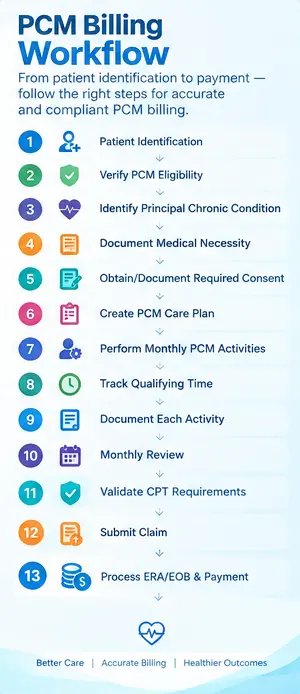
A well-designed PCM workflow can follow this sequence:
Patient Identification
↓
Verify PCM Eligibility
↓
Identify Principal Chronic Condition
↓
Document Medical Necessity
↓
Obtain/Document Required Consent
↓
Create PCM Care Plan
↓
Perform Monthly PCM Activities
↓
Track Qualifying Time
↓
Document Each Activity
↓
Monthly Review
↓
Validate CPT Requirements
↓
Submit Claim
↓
Process ERA/EOB & Payment
This workflow helps connect clinical documentation with billing requirements.
PCM vs. CCM
PCM and CCM are related care-management services, but they are not identical.
| Feature | PCM | CCM |
|---|---|---|
| Primary focus | One complex chronic condition | Multiple chronic conditions |
| CPT range | 99424–99427 | 99490, 99439 and other applicable codes |
| Care plan | Required | Required |
| Monthly time | Based on applicable CPT | Based on applicable CPT |
| Care coordination | Yes | Yes |
| Patient monitoring | Yes | Yes |
| Main purpose | Focused management of one principal condition | Comprehensive management of multiple chronic conditions |
The correct program should be selected based on the patient's clinical situation and the applicable billing rules.
Common PCM Billing Mistakes
Practices should avoid the following problems:
1. Billing Without Confirming Eligibility
Do not assume every patient with a chronic condition automatically qualifies for PCM.
2. Missing the Principal Condition
The documentation should clearly identify the one complex chronic condition being managed.
3. Incomplete Care Plan
A generic or incomplete care plan may create documentation problems.
4. Unsupported Time
The documented time should support the billed service.
5. Copy-and-Paste Documentation
Repeated identical notes may fail to demonstrate meaningful ongoing care.
6. Poor Activity Tracking
If the system does not capture who performed an activity, when it occurred, and what was done, billing validation becomes difficult.
7. Ignoring Payer Rules
Medicare requirements can differ from commercial payer policies. Practices should verify applicable payer rules before submitting claims.
How Software Can Simplify PCM Billing
A modern EHR or practice-management system can automate much of the PCM workflow.
Useful PCM features include:
- PCM eligibility checklist
- Principal-condition selection
- Care-plan templates
- Consent tracking
- Monthly activity tracking
- Automatic time accumulation
- Provider/staff attribution
- Monthly review
- CPT eligibility alerts
- Documentation validation
- Claim generation
- Billing-status tracking
- ERA/EOB integration
- Audit-ready activity history
Example PCM Dashboard
A PCM dashboard could display:
Patient: John Doe
Principal Condition: Complex Chronic Condition
Monthly Time: 24 / 30 minutes
Care Plan: Active
Consent: Documented
Medication Review: Completed
Care Coordination: 2 activities
Patient Contact: Completed
Monthly Review: Pending
Billing Status: Not Ready
This gives the care team and billing department a clear view of what remains before the claim is submitted.
PCM Billing Documentation Checklist
Before submitting a PCM claim, verify:
☑ Eligible patient
☑ One principal complex chronic condition identified
☑ Medical necessity documented
☑ Required consent documented
☑ Individualized care plan established
☑ Qualifying services performed
☑ Actual qualifying time documented
☑ Provider/staff identity recorded
☑ Monthly activities documented
☑ CPT requirements validated
☑ Payer-specific requirements checked
☑ Claim reviewed before submission
Conclusion
Principal Care Management (PCM) provides a structured way to manage patients with a single complex chronic condition through ongoing monitoring, care coordination, treatment management, and patient engagement.
For successful PCM billing, practices should focus on four core areas:
Eligibility + Care Plan + Qualifying Services/Time + Complete Documentation
Using a well-designed EHR and billing workflow can make it easier to track monthly activities, validate CPT requirements, reduce documentation gaps, and maintain an audit-ready record.
Important: CPT codes, Medicare rules, coverage policies, and payer requirements can change. Practices should verify current CMS and payer guidance before billing.