Which Patients Qualify for CCM? A Practical Guide for Providers
Which patients qualify for Chronic Care Management (CCM)? Learn the key Medicare eligibility criteria, including having two or more qualifying chronic conditions expected to last at least 12 months and creating a comprehensive care plan. This practical guide also explains consent, initiating visits, care coordination, documentation, and important considerations for providers.
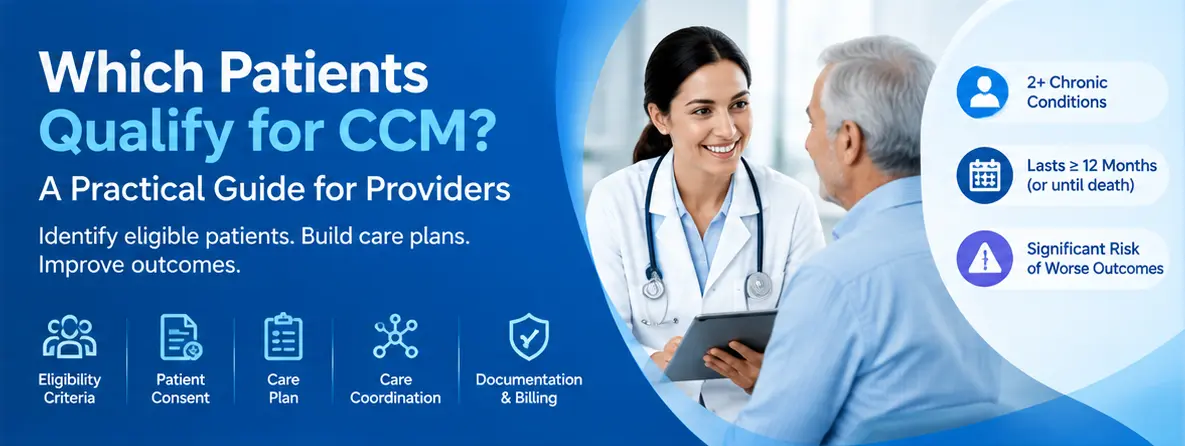
Table of contents
- Which Patients Qualify for CCM? A Practical Guide for Providers
- What Is Chronic Care Management?
- Which Patients Qualify for CCM?
- What Counts as a Chronic Condition?
- A Simple CCM Eligibility Example
- Does Having Two Chronic Conditions Automatically Qualify a Patient?
- What Other Requirements Apply Before CCM Begins?
- 1. Patient Consent
- 2. Initiating Visit
- 3. Comprehensive Care Plan
- 4. Ongoing Care Management
- Which Patients May Benefit From CCM?
- Common Conditions Seen in CCM
- Diabetes + Hypertension
- COPD + Cardiovascular Disease
- Diabetes + Chronic Kidney Disease
- Dementia + Multiple Chronic Conditions
- CCM Eligibility Checklist for Providers
- Common CCM Eligibility Mistakes
- Mistake 1: Counting Diagnoses Without Assessing Risk
- Mistake 2: Treating the Diagnosis List as the Care Plan
- Mistake 3: Forgetting Patient Consent
- Mistake 4: Missing the Initiating Visit Requirement
- Mistake 5: Assuming Every Chronic-Disease Patient Needs CCM
- How Practices Can Improve CCM Patient Identification
- Step 1: Review the Patient Population
- Step 2: Confirm Clinical Criteria
- Step 3: Assess Care Complexity
- Step 4: Verify Applicable Medicare Requirements
- Step 5: Discuss CCM With the Patient
- Step 6: Document Appropriately
- CCM vs. Other Care Management Services
- Why Accurate CCM Eligibility Matters
- Final Thoughts
Which Patients Qualify for CCM? A Practical Guide for Providers
Chronic Care Management (CCM) can help healthcare practices coordinate care for patients who are managing multiple long-term health conditions.
For providers, identifying appropriate CCM patients begins with understanding the Medicare eligibility requirements and documenting the necessary elements of the service.
According to the Centers for Medicare & Medicaid Services (CMS), Medicare covers CCM for patients with two or more chronic conditions that are expected to last at least 12 months—or until the patient's death—and that place the patient at significant risk of death, acute exacerbation or decompensation, or functional decline.
This guide explains the key criteria providers should understand when evaluating patients for CCM.
What Is Chronic Care Management?
Chronic Care Management (CCM) is a Medicare-covered care management service designed for eligible patients with multiple chronic conditions.
CCM focuses on ongoing coordination and management rather than a single office visit. Depending on the patient's needs, care management can involve coordination among the primary care practice, specialists, pharmacies, testing facilities, hospitals, and other relevant healthcare resources.
The objective is to create a coordinated approach to managing a patient's ongoing health needs.
Which Patients Qualify for CCM?
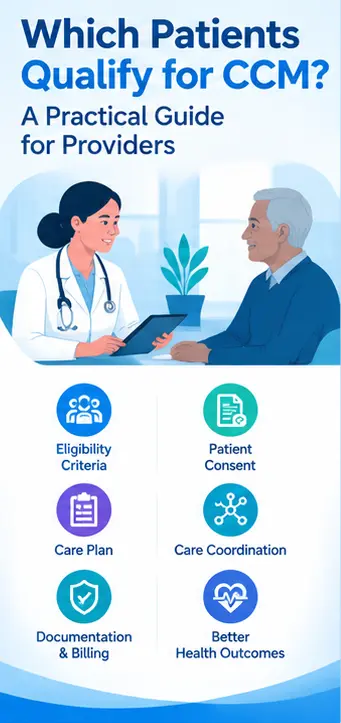
For Medicare CCM, the core patient eligibility criteria are:
- The patient has two or more chronic conditions.
- The conditions are expected to last at least 12 months or until the patient's death.
- The conditions place the patient at significant risk of:
- Death
- Acute exacerbation or decompensation
- Functional decline
CMS states that these are the diagnostic criteria for separately payable CCM services.
Having two diagnoses alone does not automatically mean a patient should be enrolled. Providers should assess whether the patient's conditions meet the applicable CCM requirements and whether ongoing care management is appropriate.
What Counts as a Chronic Condition?
CMS does not limit CCM eligibility to a short list of diagnoses.
Examples of chronic conditions CMS identifies include:
- Alzheimer's disease and related dementia
- Arthritis
- Asthma
- Atrial fibrillation
- Cancer
- Cardiovascular disease
- Chronic obstructive pulmonary disease (COPD)
- Depression
- Diabetes
- Glaucoma
- HIV/AIDS
- Hypertension
- Substance use disorders
This list is not exhaustive. The patient's conditions must still satisfy the applicable CCM eligibility requirements.
A Simple CCM Eligibility Example
Consider a Medicare patient who has:
- Type 2 diabetes
- Hypertension
- COPD
If these conditions are expected to continue for at least 12 months and place the patient at significant risk of adverse outcomes, the patient may meet the core clinical eligibility criteria for CCM.
However, the provider must also satisfy the applicable service, consent, documentation, and billing requirements before CCM can be billed.
Does Having Two Chronic Conditions Automatically Qualify a Patient?
No.
The number of conditions is an important starting point, but it is not the only consideration.
The chronic conditions must also:
- Be expected to last at least 12 months or until death, and
- Place the patient at significant risk of death, acute exacerbation/decompensation, or functional decline.
Providers should therefore evaluate the patient's overall clinical situation rather than simply counting diagnoses.
What Other Requirements Apply Before CCM Begins?
Meeting the clinical eligibility criteria is only one part of CCM.
Several additional requirements apply.
1. Patient Consent
Providers must obtain the patient's written or verbal consent before billing CCM services.
The patient should be informed about:
- The availability of CCM services
- Potential cost-sharing responsibilities
- The fact that only one practitioner can provide and bill CCM for the patient during a calendar month
- The patient's right to stop CCM services at any time, effective at the end of the calendar month
The consent and required information should be documented in the patient's medical record.
2. Initiating Visit
For a new patient—or a patient whom the billing practitioner has not seen within the previous year—CMS requires an initiating visit before CCM services begin.
The initiating visit can occur during:
- A comprehensive face-to-face E/M visit
- An Annual Wellness Visit (AWV)
- An Initial Preventive Physical Examination (IPPE)
CMS notes that the initiating visit is separately billable and is not itself part of the CCM service.
3. Comprehensive Care Plan
An eligible CCM patient needs a patient-centered comprehensive care plan.
The care plan should be developed, revised, and monitored as appropriate and should address the patient's individual needs.
CMS describes potential care-plan elements such as:
- Problem list
- Expected outcomes and prognosis
- Measurable treatment goals
- Symptom management
- Planned interventions
- Medication management
- Cognitive and functional assessment
- Environmental assessment
- Caregiver assessment
- Coordination with outside providers and resources
- Periodic review
The care plan should support coordinated management rather than simply serving as a documentation form.
4. Ongoing Care Management
CCM is designed around ongoing management and coordination.
Depending on the patient's needs, activities can include coordinating with:
- Primary care providers
- Specialists
- Pharmacies
- Hospitals
- Laboratories
- Diagnostic facilities
- Community resources
- Caregivers
The purpose is to help connect the different elements of the patient's care.
Which Patients May Benefit From CCM?
In addition to reviewing formal eligibility requirements, providers may identify patients who have complex ongoing care needs.
Potential indicators include patients who have:
- Multiple chronic illnesses
- Multiple medications
- Frequent healthcare encounters
- Repeated hospitalizations
- Emergency department visits
- Multiple specialists
- Complex care coordination needs
- Difficulty managing multiple treatment plans
CMS notes that CPT guidance may be used to help identify patients who require CCM, including factors such as the number of illnesses, medications, repeat admissions, or emergency department visits.
These indicators can help practices identify patients for review, but they do not replace the actual Medicare eligibility requirements.
Common Conditions Seen in CCM
CCM may be relevant for patients managing combinations such as:
Diabetes + Hypertension
A patient may require ongoing monitoring, medication management, preventive care, and coordination across providers.
COPD + Cardiovascular Disease
These conditions may require ongoing treatment coordination and monitoring.
Diabetes + Chronic Kidney Disease
Patients may require coordinated management involving primary care, medication management, laboratory monitoring, and specialty care.
Dementia + Multiple Chronic Conditions
Patients with cognitive impairment and multiple chronic diseases may require coordination involving clinicians, caregivers, and community resources.
The specific diagnosis combination is not what determines eligibility by itself. The patient's conditions must satisfy the applicable CCM criteria.
CCM Eligibility Checklist for Providers
A practice can use the following as a starting point when reviewing potential CCM candidates:
| Eligibility consideration | What to check |
|---|---|
| Medicare coverage | Confirm applicable Medicare eligibility |
| Chronic conditions | Patient has 2 or more chronic conditions |
| Duration | Conditions expected to last at least 12 months or until death |
| Risk | Conditions create significant risk of death, exacerbation/decompensation, or functional decline |
| Initiating visit | Required visit completed when applicable |
| Consent | Patient consent obtained and documented |
| Care plan | Comprehensive, patient-centered care plan established |
| Coordination | Ongoing care-management needs identified |
| Documentation | Required CCM activities appropriately documented |
CMS's provider checklist specifically recommends identifying eligibility, completing the required initiating visit when applicable, obtaining informed consent, and documenting these elements.
Common CCM Eligibility Mistakes
Mistake 1: Counting Diagnoses Without Assessing Risk
Having two chronic diagnoses does not, by itself, establish CCM eligibility. The conditions must also meet the duration and risk requirements.
Mistake 2: Treating the Diagnosis List as the Care Plan
A list of diagnoses is not the same as a comprehensive care plan. The plan should address goals, interventions, monitoring, and coordination appropriate to the patient.
Mistake 3: Forgetting Patient Consent
Required consent and patient notification should be completed and documented before billing CCM.
Mistake 4: Missing the Initiating Visit Requirement
For applicable new patients or patients not seen by the billing practitioner within the preceding year, the required initiating visit must occur before CCM begins.
Mistake 5: Assuming Every Chronic-Disease Patient Needs CCM
CCM should be considered based on the patient's clinical circumstances and applicable Medicare requirements, not simply because a chronic diagnosis appears in the medical record.
How Practices Can Improve CCM Patient Identification
A structured workflow can make patient identification more consistent.
Step 1: Review the Patient Population
Use the EHR to identify patients with multiple chronic conditions.
Step 2: Confirm Clinical Criteria
Review the duration and risk associated with the patient's chronic conditions.
Step 3: Assess Care Complexity
Look for medication burden, multiple providers, recent hospital or emergency visits, and coordination needs.
Step 4: Verify Applicable Medicare Requirements
Confirm coverage and current CCM requirements before enrollment and billing.
Step 5: Discuss CCM With the Patient
Explain the service, potential cost-sharing, and the patient's right to discontinue it.
Step 6: Document Appropriately
Maintain the required consent, care plan, initiating visit, and ongoing care-management documentation.
CCM vs. Other Care Management Services
Medical practices should also distinguish CCM from other Medicare care-management programs.
CMS offers several care-management services, and eligibility and billing requirements can differ between programs. For example, Medicare's Advanced Primary Care Management (APCM) services have their own requirements and code structure.
Therefore, practices should not assume that criteria for one care-management service automatically apply to another.
Why Accurate CCM Eligibility Matters
Correct patient identification can help practices:
- Focus care-management resources on appropriate patients
- Build more meaningful care plans
- Improve coordination between providers
- Maintain appropriate documentation
- Reduce billing errors
- Support consistent workflows
Most importantly, eligibility review should remain connected to the patient's actual healthcare needs.
Final Thoughts
Determining which patients qualify for CCM starts with three core clinical questions:
Does the patient have at least two chronic conditions?
Are those conditions expected to last at least 12 months or until death?
Do those conditions place the patient at significant risk of death, acute exacerbation/decompensation, or functional decline?
If the clinical criteria are met, practices must still complete the applicable CCM requirements, including the initiating visit when required, informed patient consent, comprehensive care planning, and appropriate documentation.
Because Medicare rules and billing requirements can change, providers should verify current CMS guidance before implementing or billing CCM workflows.
Note: This article is educational and is not a substitute for official Medicare billing guidance or professional compliance advice.