How to Build an Effective CCM Care Plan
Learn how to build an effective CCM care plan that supports coordinated chronic care, clear team responsibilities, patient-centered goals, monitoring, follow-up, documentation, and billing readiness. This guide covers the essential components of a strong CCM care plan, common workflow mistakes, and practical ways medical practices can improve care-management efficiency.
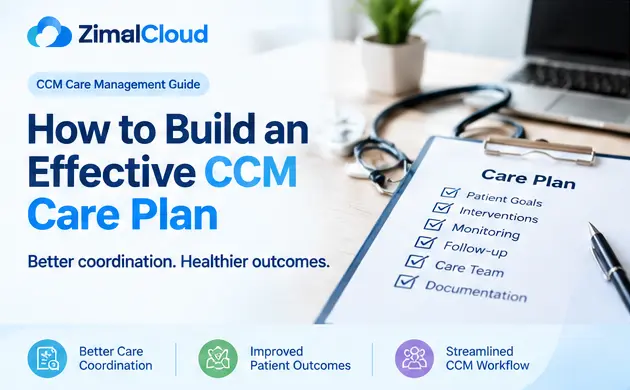
Table of contents
- What Is a CCM Care Plan?
- Why Is an Effective CCM Care Plan Important?
- What Should a CCM Care Plan Include?
- 1. Patient and Clinical Overview
- 2. Identify the Chronic Conditions Being Managed
- 3. Establish Patient-Centered Goals
- 4. Document Interventions
- 5. Define Care-Team Responsibilities
- 6. Include Medication Management
- 7. Include Specialist and Referral Coordination
- 8. Add Monitoring and Follow-Up Requirements
- 9. Document Patient Education and Self-Management Support
- 10. Create an Escalation Plan
- How to Build a CCM Care Plan Step by Step
- Step 1: Review the Patient's Clinical Information
- Step 2: Identify Priority Conditions
- Step 3: Define Patient Goals
- Step 4: Select Appropriate Interventions
- Step 5: Assign Responsibilities
- Step 6: Establish Monitoring and Follow-Up
- Step 7: Add Coordination Requirements
- Step 8: Establish Escalation Rules
- Step 9: Review and Update the Plan
- Common CCM Care Plan Mistakes
- Mistake 1: Using the Same Plan for Every Patient
- Mistake 2: Setting Vague Goals
- Mistake 3: Not Assigning Ownership
- Mistake 4: Failing to Update the Plan
- Mistake 5: Treating Documentation as an Afterthought
- Mistake 6: Disconnecting the Care Plan From Daily Work
- How Technology Can Improve CCM Care-Plan Workflows
- How Practices Can Make CCM More Efficient
- Final Thoughts
Chronic Care Management (CCM) can help practices coordinate ongoing care for patients with multiple chronic conditions, but an effective CCM program depends on more than identifying eligible patients. A well-structured CCM care plan gives the care team a clear roadmap for managing conditions, coordinating services, tracking progress, and documenting ongoing care.
For medical practices, the goal is to create a care plan that is patient-centered, clinically useful, easy for the care team to follow, and integrated into the practice workflow.
In this guide, we'll explain what a CCM care plan is, what it should include, how to build one, and how practices can make the process more efficient.
What Is a CCM Care Plan?
A CCM care plan is a structured document that outlines how a patient's chronic conditions will be managed over time.
It brings important information together so that physicians, care managers, clinical staff, and other members of the care team can work toward shared goals.
A strong care plan can include:
- Active chronic conditions
- Patient-specific health goals
- Treatment and medication information
- Recommended interventions
- Care-team responsibilities
- Follow-up requirements
- Monitoring needs
- Coordination with specialists
- Patient education and self-management support
- Progress toward goals
The care plan should be individualized rather than simply copied from a standard template.
Why Is an Effective CCM Care Plan Important?
Patients with multiple chronic conditions often interact with different providers, specialists, facilities, and healthcare services.
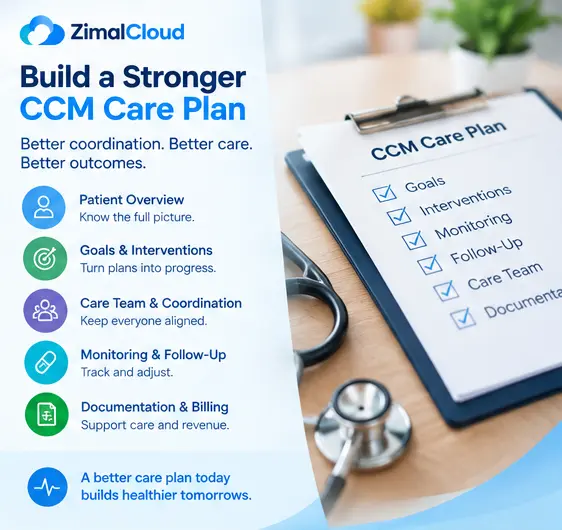
Without a clear plan, important information can become fragmented.
A structured CCM care plan can help practices:
- Improve care coordination
- Give care managers clear direction
- Keep providers informed
- Track patient goals and progress
- Organize follow-up activities
- Reduce communication gaps
- Support continuity of care
- Improve documentation consistency
- Create a more repeatable CCM workflow
For practice leaders, the care plan also provides a framework for organizing ongoing CCM activities.
What Should a CCM Care Plan Include?
A useful care plan should contain enough information to guide ongoing care without becoming unnecessarily complicated.
Here are the key components to consider.
1. Patient and Clinical Overview
Start with the information the care team needs to understand the patient's current situation.
Depending on the practice workflow, this may include:
- Relevant chronic conditions
- Current health concerns
- Important medical history
- Current medications
- Allergies
- Recent clinical findings
- Relevant risk factors
- Care-team information
The goal is to give authorized members of the care team a concise clinical picture.
2. Identify the Chronic Conditions Being Managed
Clearly identify the chronic conditions included in the patient's CCM plan.
For each condition, consider documenting:
- Current status
- Relevant symptoms
- Risk factors
- Treatment approach
- Monitoring requirements
- Current challenges
- Planned interventions
This helps the care team understand what needs attention and why.
3. Establish Patient-Centered Goals
Effective care plans should focus on meaningful, measurable goals.
Goals may relate to areas such as:
- Medication adherence
- Disease management
- Monitoring health measurements
- Nutrition
- Physical activity
- Follow-up appointments
- Symptom management
- Self-management skills
- Preventive care
Whenever possible, make goals specific and realistic.
Instead of documenting a broad goal such as "improve health," a care plan could define a more specific objective appropriate to the patient's condition and treatment plan.
4. Document Interventions
After establishing goals, identify the actions the care team will take to support them.
Interventions may include:
- Medication management
- Patient education
- Care coordination
- Follow-up communication
- Monitoring
- Referrals
- Specialist coordination
- Lifestyle counseling
- Preventive-care activities
Each intervention should have a clear purpose and connection to the patient's care goals.
5. Define Care-Team Responsibilities
One common CCM workflow problem is unclear ownership.
A care plan should make it clear who is responsible for different activities.
Depending on the practice, responsibilities may involve:
- Primary-care physicians
- Care managers
- Nurses
- Medical assistants
- Behavioral health professionals
- Specialists
- Pharmacists
- Other members of the care team
Clearly defined responsibilities can reduce duplicated work and prevent important tasks from being overlooked.
6. Include Medication Management
Medication information is an important part of many chronic-care workflows.
The care team may need to monitor:
- Current medications
- Medication changes
- Potential adherence concerns
- Patient questions
- Reported side effects
- Medication-related follow-up
- Communication with prescribing providers
Medication information should be reviewed and updated when clinically appropriate.
7. Include Specialist and Referral Coordination
Many patients with chronic conditions receive care from multiple providers.
The CCM care plan should help the primary-care team understand:
- Which specialists are involved
- Why the patient was referred
- Upcoming specialist appointments
- Relevant recommendations
- Follow-up responsibilities
- Communication requirements
This can help create a more connected workflow between primary care and specialty care.
8. Add Monitoring and Follow-Up Requirements
A care plan should explain what needs to be monitored and when follow-up should occur.
Depending on the patient's conditions, monitoring may include:
- Symptoms
- Vital signs
- Laboratory results
- Medication response
- Treatment adherence
- Disease-specific measurements
- Appointment completion
- Patient-reported concerns
The exact monitoring approach should be based on the patient's clinical needs and the treating clinician's plan.
9. Document Patient Education and Self-Management Support
Patients often need practical guidance to participate in managing chronic conditions.
The care plan can identify education needs such as:
- Understanding medications
- Recognizing concerning symptoms
- Following treatment recommendations
- Managing lifestyle factors
- Understanding when to contact the practice
- Preparing for appointments
- Using monitoring equipment when applicable
Education should be appropriate to the patient's needs, abilities, and preferences.
10. Create an Escalation Plan
The care team should understand what happens when a patient's condition changes or a concern is identified.
An escalation workflow can define:
- Which issues require provider review
- When the care manager should contact the physician
- When a specialist should be involved
- What information should be documented
- When urgent evaluation may be appropriate
Clear escalation pathways can help care teams respond consistently.
How to Build a CCM Care Plan Step by Step
Creating a care plan does not have to be complicated. A standardized workflow can make the process easier for the entire practice.
Step 1: Review the Patient's Clinical Information
Begin with the patient's relevant medical information, chronic conditions, medications, recent clinical data, and current concerns.
Step 2: Identify Priority Conditions
Determine which chronic conditions require ongoing management and coordination.
Step 3: Define Patient Goals
Work with the patient and care team to establish realistic and meaningful goals.
Step 4: Select Appropriate Interventions
Determine what actions the care team will take to support those goals.
Step 5: Assign Responsibilities
Identify who will perform each major care-management activity.
Step 6: Establish Monitoring and Follow-Up
Define what should be monitored and when the care team should follow up.
Step 7: Add Coordination Requirements
Document specialist involvement, referrals, medication coordination, and other relevant services.
Step 8: Establish Escalation Rules
Define how clinical concerns should move from the care manager to the appropriate provider or specialist.
Step 9: Review and Update the Plan
The care plan should be reviewed and updated when the patient's clinical circumstances or treatment needs change.
Common CCM Care Plan Mistakes
Even practices with established CCM programs can encounter workflow problems.
Mistake 1: Using the Same Plan for Every Patient
Templates can improve efficiency, but a care plan should still reflect the individual's conditions, goals, and care needs.
Mistake 2: Setting Vague Goals
Goals such as "improve health" provide limited direction.
Make goals specific enough that the care team can determine whether progress is occurring.
Mistake 3: Not Assigning Ownership
If nobody knows who is responsible for a task, follow-up can be delayed.
Mistake 4: Failing to Update the Plan
A care plan that no longer reflects the patient's current situation can become less useful to the care team.
Mistake 5: Treating Documentation as an Afterthought
Documentation should be incorporated into the workflow rather than reconstructed at the end of the month.
Mistake 6: Disconnecting the Care Plan From Daily Work
A care plan should guide actual care-management activities.
If the plan exists only as a document and isn't connected to follow-up, communication, and monitoring workflows, its operational value is limited.
How Technology Can Improve CCM Care-Plan Workflows
Technology can help practices organize CCM activities and reduce manual administrative work.
A healthcare technology platform can potentially help teams:
- Centralize care-plan information
- Track assigned tasks
- Organize follow-ups
- Monitor workflow status
- Improve communication between team members
- Maintain documentation
- Identify outstanding activities
- Improve operational visibility
The objective should not be to add another system for staff to manage. Instead, technology should help connect the activities the practice is already performing.
How Practices Can Make CCM More Efficient
An effective CCM program requires more than a good care plan. The surrounding workflow also matters.
Practice leaders should consider standardizing:
Eligibility → Enrollment → Assessment → Care Plan → Care Activities → Documentation → Review → Billing
When these steps are connected, the care team has a clearer understanding of what needs to happen and when.
The practice can also monitor workflow metrics such as:
- Eligible patients identified
- Patients enrolled
- Care plans completed
- Follow-ups completed
- Outstanding activities
- Documentation completion
- Provider escalations
- Billing readiness
These metrics can help practice leaders identify bottlenecks and improve the CCM process over time.
Final Thoughts
A strong CCM care plan gives healthcare teams a practical roadmap for managing chronic conditions and coordinating ongoing care.
The most effective approach combines patient-specific goals, clear interventions, defined responsibilities, consistent monitoring, coordinated follow-up, and reliable documentation.
For medical practices, the next step is to connect the care plan to the broader CCM workflow. When eligibility, enrollment, care planning, daily activities, documentation, and billing operate as one connected process, practices can reduce administrative friction and improve visibility across their care-management operations.
FAQ
Frequently asked questions
What is the purpose of a CCM care plan?
A CCM care plan provides a structured framework for managing a patient's chronic conditions, goals, interventions, monitoring, follow-up, and care coordination.
Who creates a CCM care plan?
The care plan is developed and maintained by the healthcare team as part of the patient's ongoing care. The treating clinician and other appropriate team members contribute based on their roles and the patient's needs.
How often should a CCM care plan be updated?
The plan should be reviewed and updated when the patient's condition, treatment, goals, or care needs change. Practices should follow applicable clinical, documentation, and billing requirements.
Can a CCM care plan use a template?
Yes. Templates can help standardize workflows and reduce administrative effort, but the care plan should be individualized to the patient's clinical needs and goals.
What makes a CCM care plan effective?
An effective care plan is specific, patient-centered, actionable, current, and accessible to the appropriate members of the care team.