Endoscopy Documentation: What Should a Modern System Capture?
Endoscopy documentation should capture more than procedure notes. A modern system connects patient details, findings, anatomy, interventions, images, pathology, medications, complications, recommendations, coding support, and follow-up in one workflow—helping providers document efficiently while creating a complete, structured, and actionable clinical record.
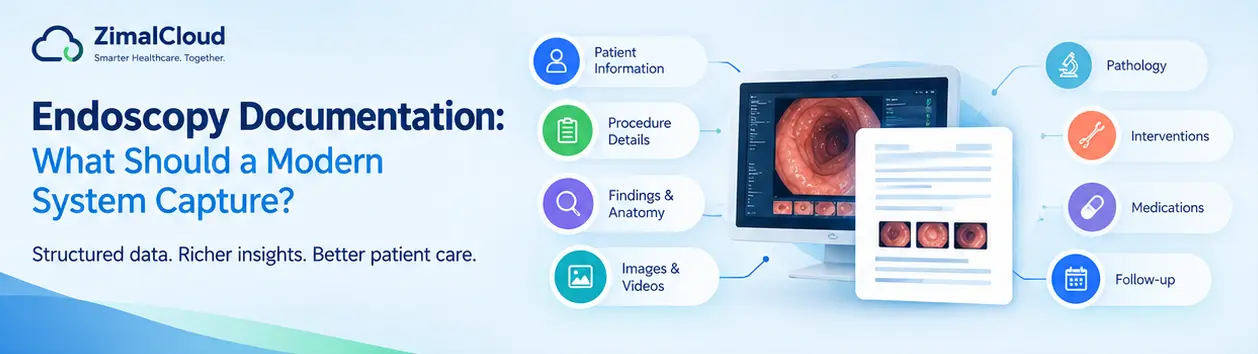
Table of contents
- Endoscopy Documentation: What Should a Modern System Capture?
- What Is Endoscopy Documentation?
- Why Modern Endoscopy Documentation Matters
- 1. Patient and Procedure Information
- 2. Pre-Procedure Assessment
- 3. Procedure Details
- 4. Anatomical Findings
- 5. Findings With Specific Characteristics
- 6. Procedures and Interventions
- 7. Specimen and Pathology Information
- 8. Images and Videos
- 9. Medications and Sedation
- 10. Complications and Safety Events
- 11. Physician Impression
- 12. Recommendations and Follow-Up
- 13. Coding and Billing Support
- 14. AI-Assisted Documentation
- 15. Interoperability With Other Healthcare Systems
- What Should a Modern Endoscopy System Capture?
- The Ideal Endoscopy Documentation Workflow
- What Makes Endoscopy Documentation "Modern"?
- Structured
- Connected
- Intelligent
- Visual
- Efficient
- Interoperable
- Patient-Centered
- Final Thoughts
Endoscopy Documentation: What Should a Modern System Capture?
Endoscopy documentation is more than recording what happened during a procedure. A modern endoscopy system should capture the clinical details, findings, images, procedures, medications, pathology information, and follow-up requirements needed to create a complete and useful patient record.
For endoscopy practices, better documentation can improve clinical communication, reduce repetitive data entry, support coding and billing, and make reports easier to review.
But what exactly should a modern endoscopy documentation system capture?
What Is Endoscopy Documentation?
Endoscopy documentation is the structured record created before, during, and after an endoscopic procedure.
It may include information about:
- The patient's indication for the procedure
- Pre-procedure assessment
- Procedure type
- Anatomic locations examined
- Findings and abnormalities
- Biopsies or specimens collected
- Images and videos
- Medications and sedation
- Complications
- Physician assessment
- Recommendations and follow-up
Traditionally, much of this information may be entered manually into separate fields or systems. A modern platform should bring these elements together into one connected workflow.
Why Modern Endoscopy Documentation Matters
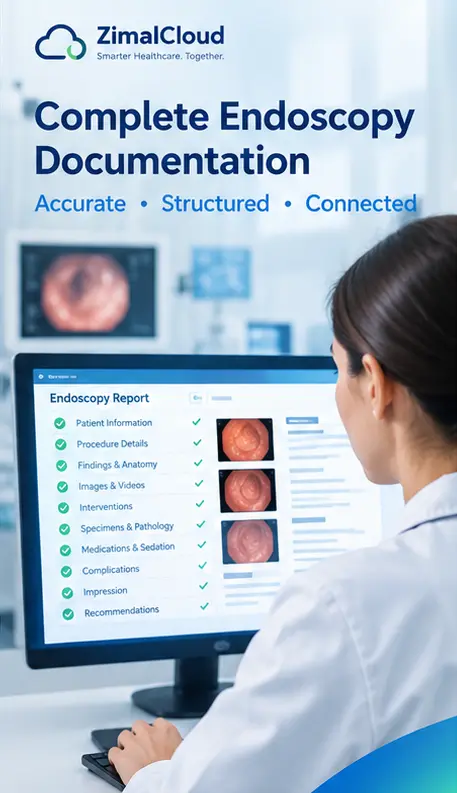
Endoscopy generates a large amount of clinical information. If documentation is fragmented, providers may spend unnecessary time searching for information, entering the same details repeatedly, or preparing reports manually.
A modern documentation system can help by providing:
Structured documentation
Important clinical information can be captured in standardized fields rather than relying entirely on free-text notes.
Faster reporting
Reusable templates and automated workflows can reduce the time required to complete procedure reports.
Better clinical continuity
Complete documentation helps other providers understand what was performed, what was found, and what should happen next.
Improved coding and billing workflows
Accurate procedure and finding information can support downstream coding, charge capture, and claims processes.
Better data accessibility
Structured information can be easier to search, analyze, exchange, and incorporate into the patient's longitudinal record.
1. Patient and Procedure Information
The system should begin by capturing basic information that establishes who the patient is and what procedure is being performed.
Important information can include:
- Patient demographics
- Medical record number
- Procedure date and time
- Procedure type
- Indication
- Referring provider
- Performing provider
- Location or procedure room
- Relevant pre-procedure diagnosis
This information creates the foundation for the rest of the procedure record.
2. Pre-Procedure Assessment
Documentation should not start when the scope enters the patient.
A modern system should capture relevant pre-procedure information, such as:
- Clinical history
- Relevant medications
- Allergies
- Previous procedures
- Relevant risk factors
- Pre-procedure diagnosis
- Consent status
- Sedation assessment
- Preparation quality when applicable
Capturing this information electronically can help ensure that important clinical details are available before the procedure begins.
3. Procedure Details
The system should clearly document what was actually performed.
Depending on the procedure, this may include:
- Procedure type
- Scope type
- Scope identification
- Extent of examination
- Anatomic landmarks
- Insertion and withdrawal information
- Procedure duration
- Technical difficulty
- Completion status
- Quality of examination
For example, a colonoscopy record may need to identify how far the examination progressed and whether visualization was adequate.
4. Anatomical Findings
One of the most important parts of endoscopy documentation is recording what the provider observed.
A modern system should make it easy to document findings by anatomical location.
These may include:
- Lesions
- Polyps
- Ulcers
- Inflammation
- Bleeding
- Strictures
- Masses
- Diverticula
- Normal findings
- Other abnormalities
Instead of requiring physicians to repeatedly type common findings, structured selections can make documentation faster while still allowing additional free-text details when necessary.
5. Findings With Specific Characteristics
Simply documenting "polyp found" may not provide enough information.
Depending on the procedure and clinical situation, the system may need to capture characteristics such as:
- Location
- Size
- Shape
- Number
- Appearance
- Morphology
- Severity
- Distribution
- Estimated depth
- Relationship to surrounding anatomy
Structured fields can help ensure that important characteristics aren't accidentally omitted.
6. Procedures and Interventions
A modern system should document not only what was seen but also what was done.
For example:
- Biopsy
- Polypectomy
- Snare removal
- Hemostasis
- Dilation
- Injection
- Foreign-body removal
- Ablation
- Stent placement
- Other therapeutic interventions
Each intervention should be associated with the relevant finding or anatomical location whenever appropriate.
This creates a clearer connection between:
Finding → Intervention → Specimen → Recommendation
7. Specimen and Pathology Information
When tissue or other specimens are collected, documentation should follow them through the workflow.
The system may capture:
- Specimen type
- Specimen location
- Number of specimens
- Collection details
- Specimen labeling
- Pathology destination
- Pathology order or reference
- Relevant clinical notes
Connecting procedure documentation with pathology information can reduce the risk of disconnected records and make follow-up easier.
8. Images and Videos
Endoscopy is highly visual, so modern documentation should integrate procedure images and video into the clinical record.
The system should ideally support:
- Image capture
- Video capture
- Image association with findings
- Anatomical labeling
- Procedure timestamps
- Multiple images per finding
- Image review
- Secure storage
- Easy retrieval
For example, an image of a lesion should ideally be connected to the corresponding finding in the procedure report.
This creates a more complete clinical record than storing images separately from the written documentation.
9. Medications and Sedation
Medication documentation is another important component of the procedure record.
Depending on the workflow, the system may capture:
- Sedation medications
- Dosage
- Administration time
- Route
- Anesthesia information
- Monitoring information
- Recovery status
Accurate medication documentation supports both patient safety and complete procedure records.
10. Complications and Safety Events
The documentation system should provide a clear way to record complications or unexpected events.
Examples may include:
- Bleeding
- Perforation
- Hypotension
- Hypoxia
- Adverse medication reaction
- Incomplete procedure
- Other procedural complications
The system should also distinguish between no complications and an undocumented complication.
A clearly documented "no immediate complications" statement can be valuable when appropriate.
11. Physician Impression
After documenting the findings, the system should help the provider summarize the overall clinical impression.
The impression may include:
- Major findings
- Diagnoses
- Procedure outcome
- Clinical interpretation
- Relevant concerns
This section should remain concise and clinically meaningful rather than simply repeating every detail from the procedure.
12. Recommendations and Follow-Up
A modern endoscopy system should also capture what happens next.
Recommendations may include:
- Follow-up appointments
- Repeat endoscopy
- Pathology follow-up
- Medication recommendations
- Surveillance intervals
- Referrals
- Additional testing
- Patient instructions
This turns documentation from a static procedure report into part of an ongoing care workflow.
13. Coding and Billing Support
Endoscopy documentation can also support downstream revenue-cycle workflows.
A modern system should capture structured information that may be useful for:
- CPT coding
- ICD-10-CM diagnosis coding
- Modifier determination
- Procedure documentation
- Charge capture
- Claim preparation
- Audit support
The goal should not be to replace appropriate coding review, but to ensure that the clinical documentation contains the information needed for accurate downstream processes.
14. AI-Assisted Documentation
Artificial intelligence can further improve endoscopy documentation when implemented responsibly.
For example, AI can assist with:
- Suggesting structured findings
- Identifying missing documentation elements
- Converting dictated information into structured fields
- Generating draft procedure reports
- Suggesting relevant CPT or ICD codes for review
- Organizing findings by anatomical location
- Creating preliminary summaries
The provider should remain responsible for reviewing and approving the final documentation.
A useful principle is:
AI should reduce documentation work—not reduce clinical oversight.
15. Interoperability With Other Healthcare Systems
Endoscopy documentation should not exist in isolation.
A modern system should ideally connect with systems such as:
EHR → Endoscopy System → Pathology → Billing → Patient Record
Interoperability can help information move between clinical and administrative workflows without requiring staff to repeatedly re-enter the same data.
Standards such as HL7 and FHIR can also support healthcare data exchange when appropriately implemented.
What Should a Modern Endoscopy System Capture?
At a high level, the documentation workflow should capture:
| Documentation Area | Examples |
|---|---|
| Patient information | Demographics, MRN |
| Procedure | Type, date, provider |
| Indication | Reason for procedure |
| Pre-procedure | History, consent, assessment |
| Anatomy | Locations examined |
| Findings | Lesions, polyps, inflammation |
| Characteristics | Size, shape, severity |
| Interventions | Biopsy, removal, hemostasis |
| Specimens | Type, location, pathology |
| Images | Photos, videos, timestamps |
| Medications | Sedation, dosage, administration |
| Complications | Events and outcomes |
| Impression | Clinical interpretation |
| Recommendations | Follow-up and surveillance |
| Coding support | Procedure and diagnosis details |
| Interoperability | EHR, pathology, billing |
The Ideal Endoscopy Documentation Workflow
A well-designed system should connect the entire process:
Patient Preparation
↓
Pre-Procedure Assessment
↓
Procedure Documentation
↓
Findings & Anatomy
↓
Images & Videos
↓
Interventions & Specimens
↓
AI-Assisted Report Drafting
↓
Provider Review & Sign-Off
↓
Coding & Billing
↓
Follow-Up & Surveillance
This connected approach reduces duplicate documentation and helps ensure that information captured during the procedure remains useful throughout the patient's care journey.
What Makes Endoscopy Documentation "Modern"?
A modern system isn't simply an electronic version of a paper procedure note.
It should be:
Structured
Important clinical information should be captured in consistent, searchable formats.
Connected
Procedure data, images, pathology, EHR information, and billing workflows should work together.
Intelligent
AI and automation can reduce repetitive documentation tasks while keeping clinicians in control.
Visual
Images and videos should be connected directly to relevant findings.
Efficient
Providers should be able to document common findings quickly without sacrificing completeness.
Interoperable
Information should be capable of moving securely between appropriate healthcare systems.
Patient-Centered
The final record should support not only the procedure itself but also follow-up care and long-term surveillance.
Final Thoughts
Endoscopy documentation should capture more than a narrative description of a procedure. A modern system should connect patient information, procedure details, anatomical findings, interventions, images, pathology, medications, complications, recommendations, and downstream workflows into one complete record.
The goal is simple: capture the right information once, structure it intelligently, and make it useful throughout the patient's care journey.
For endoscopy practices, this can mean less repetitive documentation, more consistent reporting, better information flow, and a stronger foundation for clinical, operational, and billing workflows.