CCM vs RPM: What’s the Difference?
CCM and RPM both support patients beyond traditional office visits, but they serve different purposes. CCM focuses on comprehensive chronic care coordination, while RPM uses connected devices to collect and monitor physiological data remotely. Understanding their differences—and how they can work together—can help practices build more connected and effective chronic care programs.
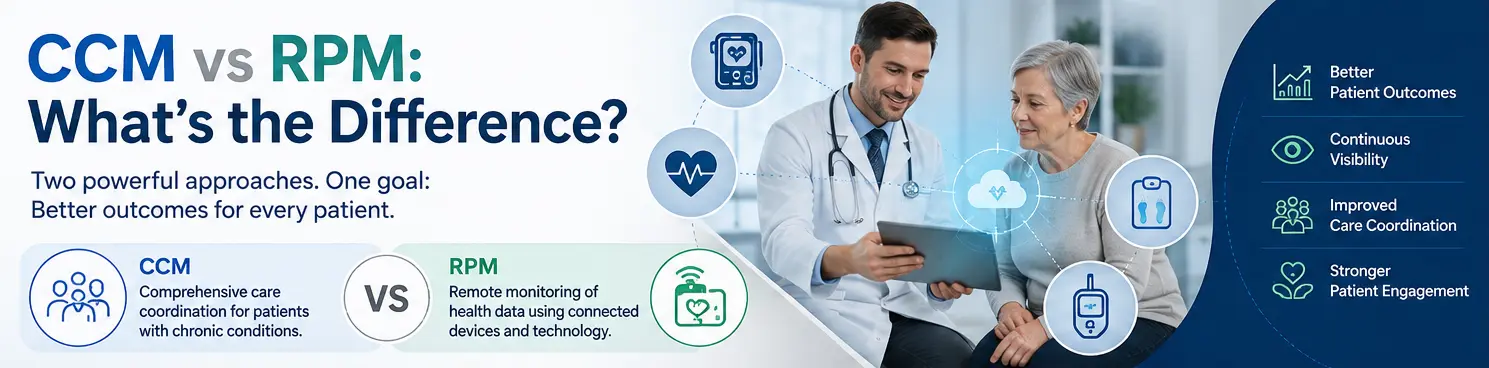
Table of contents
- Introduction
- What Is Chronic Care Management (CCM)?
- What Is Remote Patient Monitoring (RPM)?
- CCM vs RPM: The Key Difference
- CCM vs RPM Comparison
- How CCM and RPM Work Together
- When Should a Practice Consider CCM?
- When Should a Practice Consider RPM?
- CCM and RPM: Technology's Role
- Benefits of Combining CCM and RPM
- 1. More Continuous Patient Engagement
- 2. Better Visibility Into Patient Health
- 3. Improved Care Coordination
- 4. Earlier Identification of Changes
- 5. More Connected Workflows
- What About Billing?
- Which Is Better: CCM or RPM?
- Final Thoughts
Introduction
Healthcare is increasingly moving beyond the traditional office visit. Providers now have more ways to support patients between appointments, especially those living with chronic conditions. Two important approaches are Chronic Care Management (CCM) and Remote Patient Monitoring (RPM).
Although both programs help improve ongoing patient care, they work in different ways. CCM focuses on coordinating and managing a patient’s overall chronic care, while RPM focuses on collecting and reviewing patient health data remotely through connected devices.
Understanding the difference between CCM and RPM can help healthcare organizations determine which program—or combination of programs—best supports their patients and care teams.
What Is Chronic Care Management (CCM)?
Chronic Care Management (CCM) is a care coordination service designed for patients with two or more chronic conditions expected to last at least 12 months or until the patient's death.
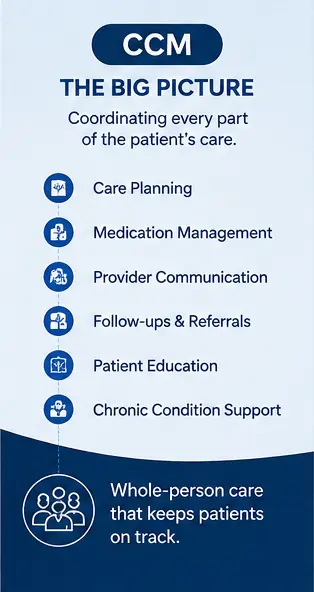
The goal of CCM is to ensure that a patient's care remains organized and consistent across providers, medications, treatments, and healthcare settings.
CCM may include:
- Developing and maintaining a comprehensive care plan
- Coordinating care between providers
- Medication management
- Monitoring the patient's health status
- Following up with patients between visits
- Helping patients manage chronic conditions
- Coordinating referrals and appointments
- Supporting transitions between healthcare settings
- Providing patient education and self-management support
In simple terms, CCM is about managing the patient's overall care journey.
What Is Remote Patient Monitoring (RPM)?
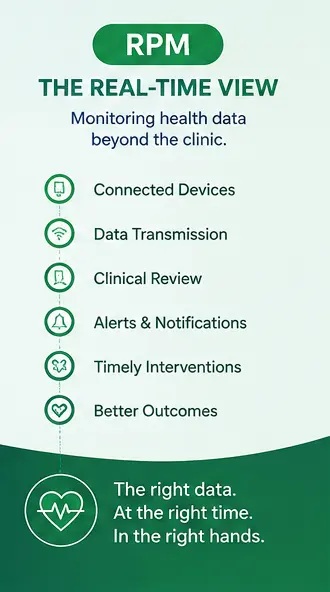
Remote Patient Monitoring (RPM) uses connected medical devices to collect health information from patients outside the traditional clinical setting.
Depending on the patient's condition, devices may measure:
- Blood pressure
- Blood glucose
- Weight
- Oxygen saturation
- Heart rate
- Other relevant physiological measurements
The information is transmitted electronically to the healthcare team. Providers or clinical staff can then review the data, identify concerning trends, communicate with patients, and make appropriate care decisions.
RPM is particularly useful for patients who need regular monitoring but do not necessarily need to visit a healthcare facility for every measurement.
In simple terms, RPM is about continuously bringing relevant patient health data into the care team's workflow.
CCM vs RPM: The Key Difference
The biggest difference is their primary purpose.
CCM focuses on care coordination and comprehensive chronic disease management.
RPM focuses on collecting and monitoring physiological data remotely.
For example, consider a patient with hypertension and diabetes.
A CCM program might help coordinate the patient's medications, appointments, care plan, specialist communication, and education.
An RPM program might provide the patient with a connected blood pressure monitor and glucose-monitoring device, allowing the care team to receive and review measurements remotely.
Together, these services can provide a more complete picture of the patient's needs.
CCM vs RPM Comparison
| Feature | CCM | RPM |
|---|---|---|
| Primary focus | Care coordination and chronic disease management | Remote collection and monitoring of health data |
| Typical patient | Patients with multiple chronic conditions | Patients who need ongoing physiological monitoring |
| Patient data | Care plans, medications, clinical information, communication, and care activities | Physiological measurements from connected devices |
| Technology requirement | Technology can support the workflow but is not the defining feature | Connected monitoring devices and data transmission are central |
| Care team role | Coordinate, educate, manage, and follow up | Review data, identify trends, and respond to clinically relevant readings |
| Patient interaction | Ongoing communication and care coordination | Device use, data transmission, monitoring, and clinical follow-up |
| Main objective | Improve coordination and management of chronic conditions | Detect changes and support timely intervention |
| Can they complement each other? | Yes | Yes |
How CCM and RPM Work Together
CCM and RPM don't necessarily have to operate as separate programs.
For eligible patients, they can work together as complementary components of a broader chronic care strategy.
Consider a patient with heart failure, hypertension, and diabetes.
The CCM program could coordinate:
- The patient's overall care plan
- Medication management
- Specialist communication
- Follow-up activities
- Patient education
- Referrals and appointments
RPM could provide:
- Daily or regular blood pressure measurements
- Weight measurements
- Heart-rate information
- Other relevant physiological data
The RPM data gives the care team timely information about the patient's condition, while CCM provides the broader coordination needed to manage the patient's care.
This combination can help providers move from simply reacting to office-visit information toward a more continuous and coordinated model of care.
When Should a Practice Consider CCM?
CCM may be appropriate when patients have multiple chronic conditions and need ongoing coordination.
Common situations include patients who:
- Have multiple chronic conditions
- Take several medications
- See multiple healthcare providers
- Require frequent care coordination
- Need help following a comprehensive care plan
- Have difficulty managing their conditions independently
- Need regular communication between healthcare professionals
The emphasis is on coordination, continuity, and comprehensive chronic care management.
When Should a Practice Consider RPM?
RPM may be useful when a patient's condition can benefit from regular measurement and remote review of physiological data.
Examples may include patients who need monitoring for:
- Hypertension
- Diabetes
- Heart failure
- Chronic respiratory conditions
- Other conditions where remote physiological measurements are clinically useful
RPM can help healthcare teams identify changes between traditional office visits and potentially respond earlier when readings indicate a concern.
CCM and RPM: Technology's Role
Technology plays an important role in both programs, but in different ways.
For CCM, healthcare technology can help teams manage:
- Patient care plans
- Tasks and reminders
- Patient communication
- Documentation
- Care coordination
- Provider workflows
- Billing-related information
For RPM, technology is more directly involved in:
- Device connectivity
- Patient measurements
- Data transmission
- Data dashboards
- Alerts and notifications
- Clinical review
- Documentation
A well-designed healthcare platform can bring these workflows together so care teams don't have to manage disconnected systems.
Benefits of Combining CCM and RPM
When appropriately integrated, CCM and RPM can provide several potential benefits.
1. More Continuous Patient Engagement
Patients can receive support between traditional appointments rather than interacting with the healthcare system only when they have a scheduled visit.
2. Better Visibility Into Patient Health
RPM can provide current physiological measurements, while CCM provides broader information about the patient's care, medications, and ongoing needs.
3. Improved Care Coordination
CCM can help connect primary care providers, specialists, care managers, and patients around a shared care plan.
4. Earlier Identification of Changes
Regular RPM measurements can help care teams recognize potentially important changes in a patient's condition sooner.
5. More Connected Workflows
Integrating CCM and RPM into one platform can reduce fragmented workflows and give care teams a more centralized view of patient activity.
What About Billing?
CCM and RPM are distinct Medicare care-management services with their own eligibility, documentation, time, and billing requirements.
Practices should not assume that a patient automatically qualifies for either program simply because they have a chronic condition.
Eligibility and billing requirements can also change, so organizations should verify current CMS guidance and applicable payer requirements before designing or billing these programs.
The operational workflow should account for:
- Patient eligibility
- Required consent
- Documentation
- Care-plan requirements
- Device requirements where applicable
- Clinical staff involvement
- Time and service requirements
- Appropriate coding and billing rules
Which Is Better: CCM or RPM?
There isn't a universal winner.
The right approach depends on the patient's needs.
Choose CCM when the primary need is comprehensive chronic care coordination.
Choose RPM when the primary need is ongoing remote collection and monitoring of physiological data.
Consider combining CCM and RPM when a patient needs both coordinated chronic care and continuous physiological monitoring.
The most effective strategy is not necessarily choosing one program over another. Instead, healthcare organizations should determine how each service can fit into the patient's overall care plan and clinical workflow.
Final Thoughts
CCM and RPM are both important tools for modern chronic care, but they solve different problems.
CCM focuses on the bigger picture—coordinating the patient's ongoing chronic care.
RPM focuses on the data—collecting and monitoring health measurements remotely.
When implemented thoughtfully, the two programs can complement one another. CCM can provide the coordination and patient engagement, while RPM can provide timely physiological information that helps care teams understand what is happening between visits.
For healthcare organizations building scalable care-management programs, integrating these capabilities into a connected technology platform can help create a more coordinated, data-driven, and patient-centered approach to chronic care.