CCM Billing: CPT Codes, Requirements, and Workflow
CCM billing helps healthcare practices receive reimbursement for coordinating care for eligible patients with multiple chronic conditions. This guide explains key CPT codes, patient eligibility, consent, care-plan and documentation requirements, monthly time thresholds, and a practical billing workflow. Learn how to build a consistent CCM process while supporting better care and accurate claims.
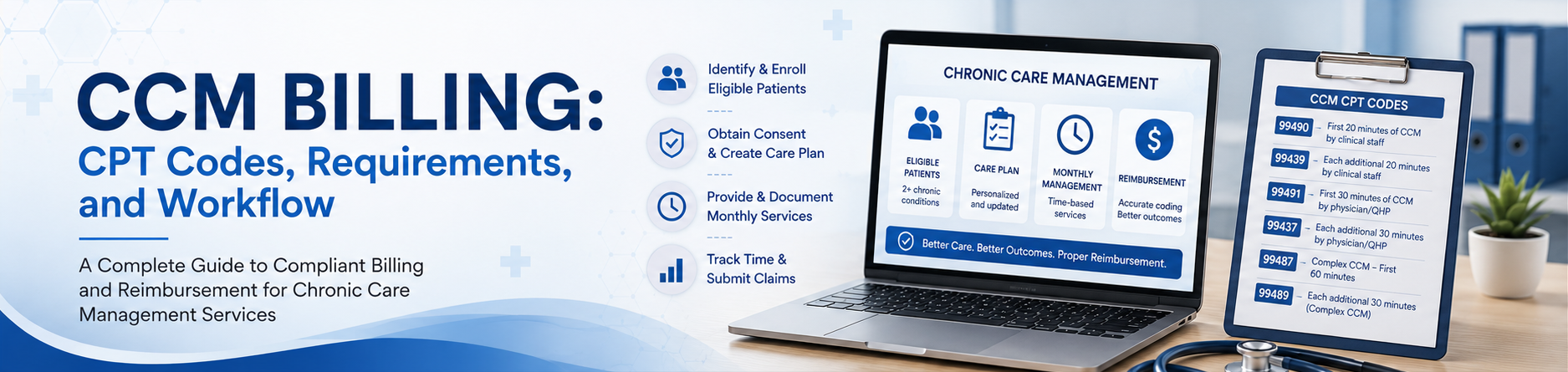
Table of contents
- What Is CCM Billing?
- Common CCM CPT Codes
- Key CCM Billing Requirements
- 1. Confirm Patient Eligibility
- 2. Obtain and Document Patient Consent
- 3. Complete an Initiating Visit When Required
- 4. Develop a Comprehensive Care Plan
- 5. Provide the Required Care-Management Services
- A Practical CCM Billing Workflow
- Common CCM Billing Mistakes to Avoid
- CCM vs. Advanced Primary Care Management
- Building a Sustainable CCM Program
- Final Takeaway
Chronic Care Management (CCM) billing allows eligible healthcare practices to receive Medicare reimbursement for providing ongoing, coordinated care to patients with multiple chronic conditions. When implemented correctly, CCM can support better patient outcomes while creating a structured, sustainable care-management workflow for practices.
Understanding the applicable CPT codes, patient eligibility requirements, documentation standards, and monthly workflow is essential for accurate CCM billing.
What Is CCM Billing?
Chronic Care Management is a Medicare-covered service designed for patients with two or more chronic conditions that are expected to last at least 12 months, or until the patient's death, and that place the patient at significant risk of death, acute exacerbation or decompensation, or functional decline.
CCM services may include medication management, care coordination, development and maintenance of a comprehensive care plan, communication with patients and caregivers, coordination with other healthcare professionals, and ongoing monitoring of the patient's needs.
Because CCM is generally billed as a monthly service, practices need a reliable process for tracking eligible patients, documenting time and services, and submitting claims at the appropriate time.
Common CCM CPT Codes
CMS identifies several CPT codes for CCM based on who provides the service, the level of complexity, and the amount of time spent during the calendar month.
| CPT Code | Service | Time |
|---|---|---|
| 99490 | CCM provided by clinical staff under the direction of a physician or other qualified healthcare professional | First 20 minutes |
| 99439 | Additional CCM time provided by clinical staff | Each additional 20 minutes |
| 99491 | CCM personally provided by a physician or other qualified healthcare professional | First 30 minutes |
| 99437 | Additional CCM time personally provided by the physician or other qualified healthcare professional | Each additional 30 minutes |
| 99487 | Complex CCM provided by clinical staff | First 60 minutes |
| 99489 | Additional complex CCM time | Each additional 30 minutes |
For codes such as 99490 and 99439, clinical staff time directed by the billing practitioner can count toward the applicable time threshold. Codes 99491 and 99437 require time personally spent by the billing physician or other qualified healthcare professional.
Practices should always verify the current CPT code descriptors, Medicare rules, and payer-specific policies before submitting claims.
Key CCM Billing Requirements
1. Confirm Patient Eligibility
Before enrolling a patient, confirm that the patient has at least two qualifying chronic conditions. The conditions should be expected to last at least 12 months, or until death, and must place the patient at significant risk of death, acute exacerbation or decompensation, or functional decline.
Examples of chronic conditions that may qualify include diabetes, hypertension, COPD, cardiovascular disease, asthma, cancer, arthritis, and dementia.
2. Obtain and Document Patient Consent
Patient consent is an important part of the CCM process. The practice should explain the CCM service, including that cost sharing may apply, and document the patient's consent in the medical record.
CMS has clarified that consent for CCM can be obtained in different ways, provided the applicable requirements are met and the consent is properly documented.
3. Complete an Initiating Visit When Required
For new patients, or patients who have not been seen by the practitioner within the previous year, CMS requires an initiating visit before CCM services begin. This may be conducted as part of a comprehensive face-to-face evaluation and management visit, Annual Wellness Visit (AWV), or Initial Preventive Physical Examination (IPPE).
The initiating visit is separately billable when its requirements are met.
4. Develop a Comprehensive Care Plan
A comprehensive, patient-centered care plan is a central component of CCM.
Depending on the patient's needs, the care plan may include:
- Problem list and treatment goals
- Expected outcomes and prognosis
- Medication management
- Symptom monitoring
- Preventive care needs
- Planned interventions
- Functional and cognitive considerations
- Caregiver needs
- Coordination with specialists and other providers
- Follow-up and ongoing monitoring
The plan should be accessible to members of the care team and updated as the patient's needs change.
5. Provide the Required Care-Management Services
CCM is more than simply making phone calls. The monthly service should involve meaningful care-management activities appropriate to the patient's needs.
These may include:
- Medication reconciliation and management
- Patient and caregiver communication
- Coordination with specialists
- Follow-up after healthcare encounters
- Monitoring treatment plans
- Supporting adherence
- Addressing gaps in care
- Coordinating referrals
- Updating the patient's care plan
Documentation should clearly demonstrate what was done, when it was done, and how the activity supported the patient's care.
A Practical CCM Billing Workflow
A standardized workflow can help practices reduce missed billing opportunities and documentation errors.
Step 1: Identify eligible patients
Review the patient population and identify individuals with two or more qualifying chronic conditions.
Step 2: Verify eligibility and payer requirements
Confirm Medicare eligibility, check for potential overlapping services, and review applicable payer policies.
Step 3: Conduct the initiating visit when required
Complete the required visit and establish the patient's care-management needs.
Step 4: Obtain and document consent
Explain CCM to the patient and document consent according to applicable requirements.
Step 5: Create the comprehensive care plan
Develop an individualized plan based on the patient's conditions, risks, medications, goals, and care needs.
Step 6: Deliver and document CCM services
Care-management staff perform appropriate activities throughout the month while maintaining accurate documentation and tracking applicable time.
Step 7: Review monthly requirements
Before billing, verify that the required service elements and time threshold for the selected code have been met.
Step 8: Submit the claim
Submit the appropriate CPT code at the conclusion of the service period after confirming documentation and billing requirements.
Step 9: Monitor claims and improve the workflow
Track denials, documentation issues, patient engagement, and billing performance to identify opportunities for improvement.
CMS notes that the CCM service period is a calendar month and that applicable claims may be reported at the conclusion of the service period.
Common CCM Billing Mistakes to Avoid
Even when a practice has a strong CCM program, billing errors can occur. Common issues include:
- Billing without properly documented patient consent
- Enrolling patients who do not meet eligibility requirements
- Failing to document the required care-management activities
- Insufficient time documentation for time-based codes
- Using the wrong CPT code
- Failing to maintain or update the care plan
- Overlooking potential overlapping or duplicative services
- Billing without confirming payer-specific requirements
- Treating CCM as a collection of isolated phone calls rather than an ongoing care-management service
A consistent checklist and monthly billing review can help reduce these problems.
CCM vs. Advanced Primary Care Management
Practices should also be aware that Medicare introduced Advanced Primary Care Management (APCM) services beginning in 2025. APCM codes incorporate elements of CCM, Principal Care Management, Transitional Care Management, and communication technology-based services into a monthly bundled approach. Unlike traditional time-based care-management codes, APCM codes do not use the same minute-by-minute billing thresholds.
This means practices should evaluate which care-management pathway best fits their patients, services, staffing model, and Medicare billing strategy.
Building a Sustainable CCM Program
Successful CCM billing depends on more than selecting the correct CPT code. Practices need a repeatable system that connects patient identification, consent, care planning, service delivery, documentation, time tracking, quality review, and claims submission.
Technology can help practices organize patient lists, automate reminders, document care activities, track time, maintain care plans, and identify patients who may benefit from ongoing care management.
Most importantly, CCM should remain focused on the patient. Accurate billing is the result of delivering meaningful, coordinated care and documenting that care appropriately.
Final Takeaway
CCM billing can provide healthcare practices with a structured way to support patients with multiple chronic conditions while receiving reimbursement for eligible care-management services. Understanding CPT codes such as 99490, 99439, 99491, 99437, 99487, and 99489, along with patient eligibility, consent, care-plan, documentation, and monthly workflow requirements, is essential for compliant billing.
Because Medicare policies and payer requirements can change, practices should verify current CMS guidance and payer-specific rules before billing.