How Healthcare Automation Can Reduce Claim Denials
Healthcare claim denials can increase administrative workload and delay reimbursement. Learn how healthcare automation can help practices identify eligibility issues, missing information, authorization gaps, documentation problems, and claim errors earlier—while improving denial management, follow-up, reporting, and revenue-cycle visibility.
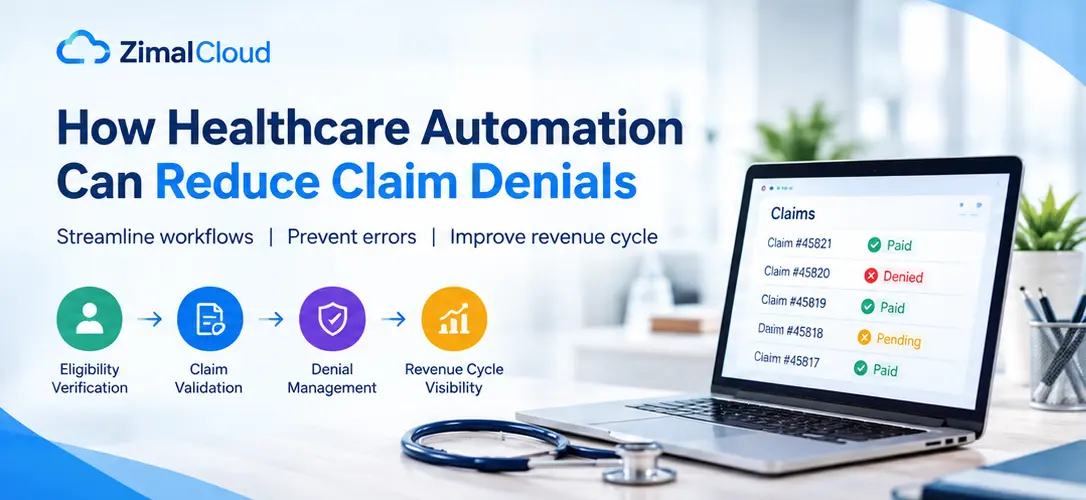
Table of contents
- How Healthcare Automation Can Reduce Claim Denials
- What Are Healthcare Claim Denials?
- Why Do Healthcare Claims Get Denied?
- How Healthcare Automation Can Reduce Claim Denials
- 1. Automate Insurance Eligibility Verification
- 2. Identify Missing Information Before Submission
- 3. Support Coding Accuracy
- 4. Streamline Prior Authorization Workflows
- 5. Improve Documentation Workflows
- 6. Use Claim Scrubbing Before Submission
- 7. Automate Denial Management
- 8. Prioritize High-Impact Denials
- 9. Create Automated Follow-Up Workflows
- 10. Use Analytics to Identify Recurring Problems
- Manual Billing vs. Automated Billing Workflows
- Benefits of Automating the Claims Workflow
- Fewer Avoidable Errors
- Faster Billing Workflows
- Better Revenue-Cycle Visibility
- More Consistent Follow-Up
- Reduced Administrative Burden
- What Should Practices Automate First?
- Automation Should Connect the Entire Workflow
- How ZimalCloud Can Support Healthcare Workflows
- Final Thoughts
How Healthcare Automation Can Reduce Claim Denials
Healthcare claim denials can create significant administrative work for medical practices. A denied claim may require staff to investigate the issue, correct information, resubmit the claim, and follow up with the payer. When these problems happen repeatedly, they can delay reimbursement and place additional pressure on billing teams.
Healthcare automation can help practices address many of the workflow problems that contribute to claim denials. By automating repetitive tasks such as eligibility verification, claim checks, documentation workflows, and billing follow-up, practices can identify potential issues earlier and create a more consistent revenue-cycle process.
What Are Healthcare Claim Denials?
A claim denial occurs when a payer refuses to reimburse a submitted healthcare claim. Denials can happen for many reasons, including incorrect patient information, eligibility problems, coding issues, missing documentation, authorization requirements, or billing errors.
Not every denial can be prevented. However, practices can reduce avoidable denials by identifying common errors before claims are submitted.
This is where automation can play an important role.
Why Do Healthcare Claims Get Denied?
Understanding the causes of denials is the first step toward improving the billing workflow.
Common causes include:
- Incorrect patient or insurance information
- Inactive insurance coverage
- Missing or incorrect authorization
- Coding errors
- Missing documentation
- Incorrect patient eligibility
- Duplicate claims
- Claims submitted to the wrong payer
- Missing required information
- Filing claims outside payer deadlines
When these issues are handled manually, they can be difficult to identify consistently—especially for practices processing a large number of claims.
How Healthcare Automation Can Reduce Claim Denials
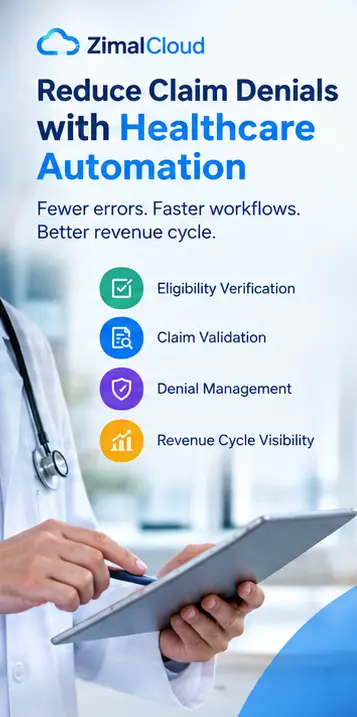
1. Automate Insurance Eligibility Verification
Insurance eligibility problems are a common source of avoidable billing issues.
Automated eligibility verification can help practices check coverage information before services are billed. Staff can receive relevant information about coverage status and potential insurance issues earlier in the workflow.
This allows the practice to address problems before they become claim-processing issues.
2. Identify Missing Information Before Submission
Incomplete claims can lead to unnecessary delays and denials.
Automated claim workflows can check whether required information is present before a claim moves forward. Depending on the system and payer requirements, these checks may include patient information, provider details, diagnosis codes, procedure codes, and other required claim data.
Early validation gives staff an opportunity to correct problems before submission.
3. Support Coding Accuracy
Coding errors can affect whether a claim is accepted and reimbursed.
Healthcare automation can support billing teams by applying predefined rules and identifying potential inconsistencies in coding or claim information.
Automation does not replace qualified coding professionals. Instead, it can provide an additional layer of workflow support that helps teams identify potential problems earlier.
4. Streamline Prior Authorization Workflows
Some services require prior authorization before they can be reimbursed.
If authorization requirements are missed, a claim may be delayed or denied.
An automated workflow can help teams track authorization requirements, document authorization information, and create reminders for outstanding tasks.
This can make it easier for staff to manage authorization-related activities without relying entirely on spreadsheets, emails, or manual reminders.
5. Improve Documentation Workflows
Accurate documentation is an important part of the billing process.
Automation can help connect clinical documentation and billing workflows so that relevant information is easier for authorized staff to access and review.
When documentation gaps are identified before claim submission, practices may have an opportunity to resolve them instead of discovering the problem after a denial.
6. Use Claim Scrubbing Before Submission
Claim scrubbing is a process used to identify potential claim errors before submission.
Automated claim-scrubbing tools can apply predefined validation rules to claims and flag potential issues.
For example, a system may identify:
- Missing information
- Invalid data
- Potential coding inconsistencies
- Duplicate claim information
- Payer-specific requirements
The goal is simple: identify preventable problems before the claim reaches the payer.
7. Automate Denial Management
Automation is not only useful before a claim is submitted. It can also support practices after a denial occurs.
A connected workflow can help organize denied claims, categorize denial reasons, assign follow-up tasks, and track resubmission activities.
Instead of manually searching through different systems, billing teams can have better visibility into outstanding denial-related work.
8. Prioritize High-Impact Denials
Not every denial requires the same level of attention.
Automation can help practices organize denials based on factors such as denial reason, claim value, payer, status, or follow-up requirements.
This can help billing teams focus their attention on actionable items and reduce the amount of time spent manually sorting through denial queues.
9. Create Automated Follow-Up Workflows
Following up on claims can become a time-consuming responsibility for billing teams.
Automated reminders and task workflows can help staff monitor claims that require additional action.
For example, a system may help track:
- Claims requiring follow-up
- Resubmission deadlines
- Pending payer responses
- Documentation requests
- Outstanding staff tasks
A structured workflow can reduce the risk of important follow-up activities being overlooked.
10. Use Analytics to Identify Recurring Problems
Reducing claim denials requires more than fixing individual claims.
Practices should also understand why denials are happening repeatedly.
Healthcare automation can provide reporting and analytics that help practices identify patterns across:
- Payers
- Providers
- Procedures
- Diagnosis codes
- Locations
- Denial reasons
- Billing workflows
For example, if a practice notices repeated denials associated with a particular payer or process, leadership can investigate the underlying workflow and make targeted improvements.
Manual Billing vs. Automated Billing Workflows
| Manual Workflow | Automated Workflow |
|---|---|
| Staff manually verify information | Eligibility checks can be automated |
| Errors may be discovered after submission | Potential issues can be flagged earlier |
| Follow-ups rely heavily on manual reminders | Automated tasks and reminders can support follow-up |
| Denials may require manual sorting | Denials can be categorized and organized |
| Limited visibility into recurring problems | Reporting can reveal denial patterns |
| Staff spend more time on repetitive tasks | Teams can focus more on exceptions and higher-value work |
Automation does not eliminate the need for billing professionals. Instead, it can help healthcare organizations build a more consistent and visible billing workflow.
Benefits of Automating the Claims Workflow
When implemented appropriately, healthcare automation can provide several operational benefits.
Fewer Avoidable Errors
Automated validation can help identify common errors before claims are submitted.
Faster Billing Workflows
Reducing repetitive manual tasks can help staff process claims and follow-ups more efficiently.
Better Revenue-Cycle Visibility
Dashboards and reporting can give practice leaders greater visibility into claim status and denial trends.
More Consistent Follow-Up
Automated tasks and reminders can help teams maintain a structured follow-up process.
Reduced Administrative Burden
By handling repetitive workflow steps, automation can allow staff to spend more time on exceptions, payer issues, and other activities that require human judgment.
What Should Practices Automate First?
Practices do not necessarily need to automate every part of their revenue cycle at once.
A practical approach is to identify areas where repetitive manual work and preventable errors are most common.
Start by reviewing:
- Your most frequent denial reasons
- Eligibility verification workflows
- Authorization tracking
- Claim validation
- Documentation gaps
- Denial follow-up processes
- Payer-specific billing requirements
- Reporting and denial analytics
This can help practices determine where automation could have the greatest operational impact.
Automation Should Connect the Entire Workflow
One of the biggest challenges with healthcare automation is creating isolated tools that do not communicate with each other.
For example, if eligibility information is stored in one system, documentation in another, and denial follow-up in a spreadsheet, staff may still need to move information manually between workflows.
A connected healthcare platform can help bring these processes together.
The goal is not simply to automate individual tasks. The goal is to create a workflow where information moves efficiently from patient registration and eligibility verification through documentation, coding, claim submission, payment, and denial management.
How ZimalCloud Can Support Healthcare Workflows
ZimalCloud helps medical practices use connected technology to streamline healthcare workflows and improve operational visibility.
By connecting clinical, administrative, and revenue-cycle processes, practices can reduce unnecessary manual work and create more consistent workflows.
Healthcare automation can support areas such as:
- Patient and insurance workflows
- Documentation
- Practice management
- Billing operations
- Claim workflows
- Revenue-cycle visibility
- Reporting and analytics
For practices looking to reduce avoidable claim problems, the first step is understanding where workflow gaps occur.
Final Thoughts
Claim denials can have many causes, and automation cannot prevent every denial. However, it can help practices identify potential problems earlier, standardize repetitive processes, improve follow-up, and gain better visibility into denial patterns.
The most effective approach is to combine automation with accurate documentation, appropriate coding, payer-specific knowledge, and trained healthcare staff.
Instead of asking whether a practice should automate everything, a better question is:
Which parts of the claims workflow are repetitive, error-prone, and suitable for automation?
Identifying those areas can help practices build a more efficient revenue-cycle workflow while allowing staff to focus on tasks that require human judgment.
Follow ZimalCloud for practical healthcare workflow, revenue-cycle, and practice-management strategies.