GI Medical Billing: Common Challenges and Solutions
Gastroenterology billing can be complex due to specialized procedures, coding requirements, documentation rules, insurance policies, and claim denials. This guide explores common GI medical billing challenges and practical solutions to improve coding accuracy, reduce rejected claims, accelerate reimbursements, and create a more efficient revenue cycle for gastroenterology practices.
Table of contents
- What Is GI Medical Billing?
- Why Is Gastroenterology Billing So Complex?
- Common GI Medical Billing Challenges and Solutions
- 1. Incorrect CPT Coding
- The Challenge
- The Solution
- 2. ICD-10 Diagnosis Coding Errors
- The Challenge
- The Solution
- 3. Incomplete Procedure Documentation
- The Challenge
- The Solution
- 4. Insurance Eligibility and Verification Problems
- The Challenge
- The Solution
- 5. Prior Authorization Issues
- The Challenge
- The Solution
- 6. Claim Rejections and Denials
- The Challenge
- The Solution
- 7. Modifier and Multiple-Procedure Complexity
- The Challenge
- The Solution
- 8. Medical Necessity Problems
- The Challenge
- The Solution
- 9. Slow Payment Posting and Reconciliation
- The Challenge
- The Solution
- 10. Patient Billing Confusion
- The Challenge
- The Solution
- How Technology Can Improve GI Medical Billing
- Patient Management
- Clinical Workflow
- Coding
- Revenue Cycle
- GI Billing Workflow
- Key Metrics GI Practices Should Monitor
- Best Practices for GI Medical Billing
- 1. Standardize Documentation
- 2. Verify Insurance Early
- 3. Improve Charge Capture
- 4. Strengthen Coding Reviews
- 5. Scrub Claims Before Submission
- 6. Automate ERA Processing
- 7. Track Denial Reasons
- 8. Monitor A/R
- 9. Communicate Clearly With Patients
- 10. Use Integrated Technology
- Conclusion
Gastroenterology practices manage a wide range of diagnostic and therapeutic services, from office consultations and colonoscopies to upper GI endoscopies, biopsies, polypectomies, and other specialized procedures. While these services provide significant value to patients, they also create unique challenges for medical billing teams.
GI medical billing requires accurate CPT coding, ICD-10-CM diagnosis coding, modifier selection, documentation review, insurance verification, claim submission, payment posting, and denial management.
Even a small mistake in any part of this process can result in a rejected claim, delayed reimbursement, or unnecessary administrative work.
The good news is that most common GI billing problems can be reduced through standardized workflows, accurate documentation, eligibility verification, coding controls, and effective revenue cycle management.
What Is GI Medical Billing?
GI medical billing is the process of converting gastroenterology services provided to patients into accurate insurance claims and ultimately collecting payment from payers and patients.
A typical GI billing workflow may include:
Patient Registration → Insurance Verification → Eligibility → Encounter → Procedure → Documentation → Coding → Claim Creation → Claim Submission → Adjudication → ERA/EOB → Payment Posting → Denial Management → Patient Balance
Because gastroenterology involves both evaluation and management services and specialized procedures, billing teams must understand how the clinical documentation supports the services reported on the claim.
Why Is Gastroenterology Billing So Complex?
GI billing can become complicated because a single patient encounter may involve multiple services.
For example, a patient may undergo a colonoscopy during which the physician identifies and removes a polyp and performs a biopsy. The billing team must ensure that the reported services accurately reflect what was performed and documented.
Several factors can affect reimbursement, including:
- Procedure type
- Diagnosis
- Medical necessity
- Documentation
- Modifiers
- Payer policies
- Patient eligibility
- Coverage limitations
- Multiple procedures performed during the same session
- Claim submission requirements
- Payer-specific reimbursement rules
This makes GI billing more specialized than simply submitting a standard office visit claim.
Common GI Medical Billing Challenges and Solutions
1. Incorrect CPT Coding
The Challenge
One of the most common GI billing problems is incorrect procedure coding.
Gastroenterology practices perform numerous procedures, and selecting an incorrect CPT code can lead to claim rejection, underpayment, or compliance concerns.
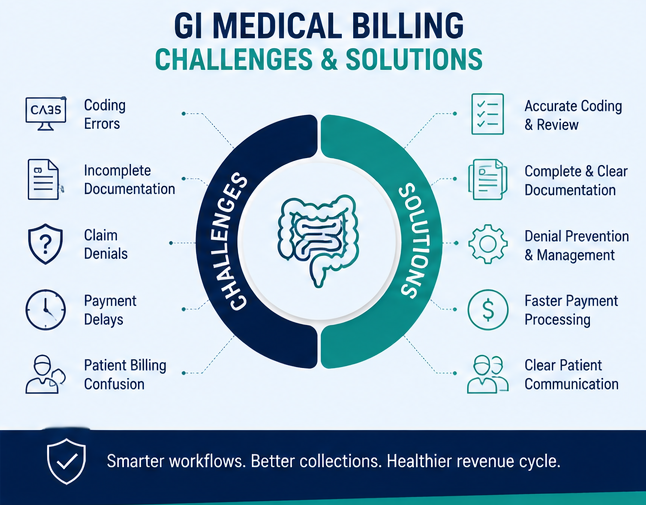
Common situations include:
- Selecting the wrong procedure code
- Reporting a procedure that is not adequately documented
- Missing a separately reportable service
- Incorrectly reporting multiple procedures
- Failing to apply the appropriate modifier when required
The Solution
Implement a structured coding review process.
Billing teams should:
- Review the procedure documentation.
- Identify exactly what was performed.
- Select the appropriate CPT code.
- Verify supporting diagnosis information.
- Review applicable payer rules.
- Perform a pre-submission coding check for high-risk claims.
A coding checklist can significantly reduce preventable errors.
2. ICD-10 Diagnosis Coding Errors
The Challenge
Diagnosis codes help establish the medical reason for a service. Incorrect or insufficient diagnosis coding can create medical-necessity problems.
For example, documentation may describe symptoms such as:
- Abdominal pain
- Rectal bleeding
- Dysphagia
- GERD
- Anemia
- Changes in bowel habits
However, the final diagnosis may be different after the procedure.
The Solution
The diagnosis code should accurately reflect the provider's documented assessment and applicable coding rules.
Billing teams should avoid:
- Guessing diagnoses
- Using outdated codes
- Selecting codes that are not supported by documentation
- Automatically carrying forward diagnoses without verification
Regular ICD-10-CM updates and coder education can help maintain accuracy.
3. Incomplete Procedure Documentation
The Challenge
Poor documentation can make an otherwise valid service difficult to bill.
For GI procedures, documentation may need to clearly establish details such as:
- Indication
- Procedure performed
- Extent of examination
- Findings
- Interventions performed
- Specimens or biopsies
- Complications
- Physician participation
- Relevant clinical details
If important information is missing, the billing team may be unable to confidently report the service.
The Solution
Create standardized GI procedure templates.
Electronic templates can guide providers through required documentation while minimizing manual typing.
For example:
Procedure → Indication → Findings → Intervention → Specimen → Complications → Impression → Recommendations
This approach can improve both clinical consistency and billing accuracy.
4. Insurance Eligibility and Verification Problems
The Challenge
A patient may schedule a procedure believing that their insurance covers the service, but eligibility or benefit limitations can create unexpected billing problems.
Common issues include:
- Inactive insurance
- Incorrect member information
- Incorrect payer
- Coverage limitations
- Prior authorization requirements
- Deductible or coinsurance responsibilities
The Solution
Perform insurance verification before the patient's appointment whenever possible.
A strong workflow should verify:
Patient → Insurance → Eligibility → Benefits → Authorization → Procedure
Automated eligibility integrations can further reduce manual work and help staff identify problems before the procedure occurs.
5. Prior Authorization Issues
The Challenge
Some procedures may require authorization depending on the payer, plan, indication, or clinical circumstances.
If authorization is required but missing, the claim may be denied even when the procedure itself was clinically appropriate.
The Solution
Create an authorization workflow that identifies requirements before the procedure.
The system should track:
- Authorization required
- Authorization number
- Requested procedure
- Approved procedure
- Valid dates
- Number of approved services
- Payer
- Authorization status
A centralized authorization dashboard can help staff prevent missed requirements.
6. Claim Rejections and Denials
The Challenge
Claim rejections and denials directly affect cash flow.
GI claims may be rejected or denied because of:
- Incorrect patient information
- Invalid insurance details
- Coding errors
- Missing modifiers
- Medical necessity issues
- Authorization problems
- Duplicate claims
- Documentation problems
- Payer-specific requirements
The Solution
Don't treat every denial as an isolated event.
Instead, categorize denials by root cause.
For example:
| Denial Category | Possible Root Cause | Recommended Action |
|---|---|---|
| Eligibility | Inactive coverage | Verify insurance before service |
| Coding | Incorrect CPT/ICD | Perform coding review |
| Authorization | Missing authorization | Implement pre-procedure authorization |
| Medical necessity | Diagnosis does not support service | Review documentation and coding |
| Duplicate | Claim previously submitted | Check claim history |
| Documentation | Required information missing | Improve clinical templates |
Tracking denial trends allows practices to address the underlying problem instead of repeatedly fixing the same error.
7. Modifier and Multiple-Procedure Complexity
The Challenge
GI encounters can involve multiple procedures during the same session.
Determining how services should be reported can become complicated, particularly when procedures have relationships that affect billing.
Incorrect modifier usage can result in:
- Claim denials
- Incorrect reimbursement
- Underbilling
- Overbilling
- Compliance concerns
The Solution
Use a systematic coding review process for claims involving multiple procedures.
Coders should verify the applicable coding guidelines and payer-specific requirements rather than applying modifiers automatically.
8. Medical Necessity Problems
The Challenge
Insurance companies may determine that the diagnosis reported on a claim does not sufficiently support the medical necessity of the procedure.
For example, a procedure may be clinically appropriate, but the claim may not communicate that appropriately because the diagnosis coding does not accurately represent the documented indication.
The Solution
Connect clinical documentation, diagnosis coding, and procedure coding.
The billing workflow should effectively answer:
Why was the service performed?
The medical record should support the indication, while the submitted diagnosis codes should accurately represent the provider's documentation.
9. Slow Payment Posting and Reconciliation
The Challenge
Receiving an insurance payment is not the final step.
The payment must be accurately posted against:
- Claims
- CPT services
- Adjustments
- Contractual obligations
- Patient responsibility
- Outstanding balances
Manual payment posting can become time-consuming and prone to errors.
The Solution
Use ERA/EOB-based payment workflows wherever possible.
An effective system should support:
Claim → ERA/EOB → Payment → Adjustment → Patient Responsibility → Reconciliation
Automated reconciliation can reduce manual entry and help billing teams identify unpaid or underpaid claims.
10. Patient Billing Confusion
The Challenge
Patients may receive bills after insurance processing and may not understand:
- Deductibles
- Copayments
- Coinsurance
- Insurance adjustments
- Remaining balances
- Procedure charges
This can lead to delayed payments and increased calls to the billing department.
The Solution
Provide clear patient statements that separate:
Total Charges → Insurance Payment → Insurance Adjustment → Patient Responsibility → Amount Due
Online patient payment options and electronic statements can also make collections easier.
How Technology Can Improve GI Medical Billing
Modern gastroenterology practice-management software can connect clinical, billing, and financial workflows in one system.
A well-designed platform can provide:
Patient Management
- Demographics
- Insurance
- Eligibility
- Registration
- Patient communication
Clinical Workflow
- Encounters
- GI procedures
- Procedure documentation
- Diagnosis
- Clinical notes
Coding
- CPT
- ICD-10-CM
- Modifiers
- Coding validation
Revenue Cycle
- Charge capture
- Claim creation
- Claim submission
- Claim status
- ERA/EOB
- Payment posting
- Denial management
- Patient billing
This reduces duplicate data entry and provides better visibility across the revenue cycle.
GI Billing Workflow
A streamlined GI billing workflow can look like this:
1. Patient Registration
↓
2. Insurance Verification
↓
3. Eligibility & Benefits
↓
4. Prior Authorization
↓
5. GI Encounter / Procedure
↓
6. Clinical Documentation
↓
7. CPT & ICD-10 Coding
↓
8. Claim Scrubbing
↓
9. Electronic Claim Submission
↓
10. Payer Adjudication
↓
11. ERA/EOB Processing
↓
12. Payment Posting
↓
13. Denial Management
↓
14. Patient Billing & Collections
The objective is to identify errors before the claim reaches the payer, rather than discovering them after a denial.
Key Metrics GI Practices Should Monitor
GI practices should regularly monitor revenue-cycle KPIs such as:
- Clean claim rate
- Claim rejection rate
- Denial rate
- Days in accounts receivable
- First-pass acceptance rate
- Net collection rate
- Payment turnaround time
- Outstanding A/R
- Patient balance
- Underpayment rate
- Authorization-related denials
These metrics help practices identify where revenue is being lost.
Best Practices for GI Medical Billing
To create a more efficient GI billing operation, practices should:
1. Standardize Documentation
Use structured procedure and encounter templates.
2. Verify Insurance Early
Check eligibility and benefits before scheduled procedures.
3. Improve Charge Capture
Ensure performed services are accurately captured.
4. Strengthen Coding Reviews
Validate CPT, ICD-10-CM, and applicable modifiers.
5. Scrub Claims Before Submission
Identify common errors before claims reach the payer.
6. Automate ERA Processing
Reduce manual payment posting and reconciliation.
7. Track Denial Reasons
Use denial analytics to identify recurring problems.
8. Monitor A/R
Follow unpaid claims and outstanding balances systematically.
9. Communicate Clearly With Patients
Make statements and payment responsibilities easy to understand.
10. Use Integrated Technology
Connect clinical documentation, coding, billing, claims, payments, and reporting.
Conclusion
GI medical billing involves much more than submitting claims. Specialized procedures, coding requirements, documentation, insurance rules, authorizations, denials, and payment reconciliation all contribute to the complexity of the gastroenterology revenue cycle.
The most effective approach is to build a connected, standardized, and technology-supported billing workflow.
By improving documentation, verifying eligibility, strengthening coding accuracy, preventing avoidable denials, automating payment workflows, and monitoring revenue-cycle KPIs, gastroenterology practices can reduce administrative burden and improve financial performance.
Ultimately, better GI medical billing means fewer errors, faster reimbursement, clearer patient billing, and a healthier revenue cycle.