835 ERA Integration: How Automated Payment Posting Works
835 ERA integration can automate the healthcare payment posting process from payer remittance to claim reconciliation. Learn how electronic remittance advice helps billing systems match payments, post adjustments, update patient responsibility, identify exceptions, and improve revenue-cycle efficiency while reducing repetitive manual data entry.
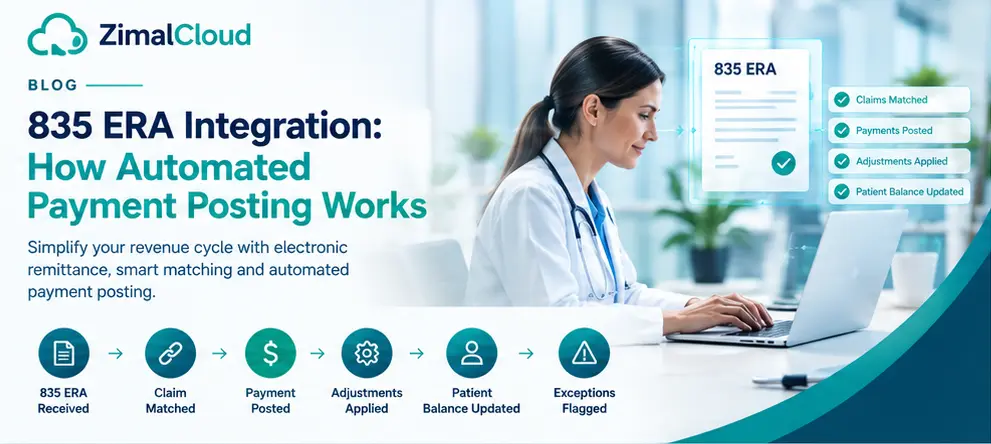
Table of contents
- Introduction
- What Is an 835 ERA?
- What Is Automated Payment Posting?
- How 835 ERA Integration Works
- 1. The Claim Is Submitted
- 2. The Payer Adjudicates the Claim
- 3. The Payer Generates an 835 ERA
- 4. The 835 ERA Is Imported Into the Billing System
- 5. The System Matches the ERA to the Claim
- 6. Payments Are Automatically Posted
- 7. Adjustments Are Recorded
- 8. Patient Responsibility Is Updated
- 9. Exceptions Are Sent for Review
- 835 ERA Integration vs. Manual Payment Posting
- Manual workflow
- Automated workflow
- Benefits of Automated 835 Payment Posting
- 1. Less Manual Data Entry
- 2. Faster Payment Reconciliation
- 3. Fewer Data-Entry Errors
- 4. Better Visibility Into Claim Payments
- 5. More Efficient Billing Staff
- Example of an Automated 835 Payment Posting Workflow
- Why Claim Matching Matters
- What Are CARC and RARC Codes?
- CARC
- RARC
- 835 ERA Integration and Denial Management
- 835 ERA and EFT: What's the Difference?
- EFT
- ERA
- What Should an 835 ERA Integration Include?
- ERA Import
- Claim Matching
- Payment Posting
- Adjustment Posting
- Patient Responsibility
- Exception Management
- Duplicate Detection
- Audit Trail
- Reporting
- Common Challenges With 835 ERA Integration
- How Automated Payment Posting Improves the Revenue Cycle
- Best Practices for 835 ERA Automation
- 1. Validate ERA Data
- 2. Maintain Accurate Payer Mapping
- 3. Use Exception Work Queues
- 4. Monitor Posting Accuracy
- 5. Maintain Auditability
- 6. Review Denial and Adjustment Trends
- 7. Integrate With the Broader RCM Workflow
- The Future of Automated Payment Posting
- Conclusion
Introduction
Medical practices process a large volume of insurance payments every day. Once a claim is submitted and an insurance payer processes it, the practice still needs to determine exactly how much was paid, what was adjusted, what the patient owes, and whether the payment matches the original claim.
Traditionally, payment posting can require staff to manually open payer documents, review remittance details, locate the corresponding claim, and enter payment information into the practice management or billing system. This process takes time and can create opportunities for data-entry errors.
835 ERA integration helps automate this workflow.
An Electronic Remittance Advice (ERA), commonly known as an 835 file, contains detailed information about how an insurance payer adjudicated a healthcare claim. When an 835 ERA is integrated with medical billing software, the system can automatically read payment information, match it to the appropriate claim, post payments and adjustments, and identify items that require staff attention.
The result is a faster and more consistent automated payment posting workflow.
What Is an 835 ERA?
An 835 ERA is an electronic transaction used by healthcare payers to communicate claim payment and remittance information to providers.
Instead of receiving payment information only through paper remittance documents or manually reviewing payer portals, providers can receive structured electronic information containing details such as:
- Claim payment amounts
- Allowed amounts
- Contractual adjustments
- Patient responsibility
- Deductibles
- Coinsurance
- Copayments
- Denials and remark information
- Claim-level adjustments
- Service-line payment information
- Check or electronic payment details
The 835 transaction is designed to provide the financial details necessary for a healthcare organization to reconcile payer payments with submitted claims.
What Is Automated Payment Posting?
Automated payment posting is the process of importing electronic remittance information into a medical billing or practice management system and using that information to update patient and claim financial records.
Instead of a billing employee manually entering every payment and adjustment, software can process the ERA and automatically apply appropriate information to the corresponding claim.
A typical workflow looks like this:
Payer processes claim → 835 ERA generated → ERA received → Payment information interpreted → Claim matched → Payment posted → Adjustments recorded → Patient responsibility updated → Exceptions reviewed
This reduces repetitive data entry and allows billing staff to focus on exceptions, denials, unresolved balances, and other higher-value tasks.
How 835 ERA Integration Works
1. The Claim Is Submitted
The process begins when a healthcare provider submits a claim to an insurance payer.
The claim contains information such as:
- Patient information
- Provider information
- Dates of service
- Diagnosis codes
- Procedure codes
- Charges
- Insurance information
The payer receives and processes the claim according to its adjudication rules and the patient's benefits.
2. The Payer Adjudicates the Claim
The insurance payer evaluates the claim and determines how it should be processed.
The payer may:
- Pay the claim in full or partially
- Apply contractual adjustments
- Assign patient responsibility
- Deny certain services
- Request additional information
- Apply deductible or coinsurance amounts
Once adjudication is complete, the payer generates payment and remittance information.
3. The Payer Generates an 835 ERA
The payer sends an 835 Electronic Remittance Advice containing the financial details associated with the claim.
The ERA can communicate information such as:
Billed amount → Allowed amount → Paid amount → Adjustments → Patient responsibility
For example:
| Claim Amount | Amount |
|---|---|
| Provider charge | $200 |
| Allowed amount | $150 |
| Insurance payment | $120 |
| Contractual adjustment | $30 |
| Patient responsibility | $50 |
The 835 provides structured information that software can use to update the billing record.
4. The 835 ERA Is Imported Into the Billing System
With an integrated billing platform, the ERA can be electronically imported into the system.
The software reads the structured transaction instead of requiring staff to manually enter every financial value.
Depending on the implementation, the system may identify:
- Payer
- Payment reference
- Claim number
- Patient
- Service lines
- Payment amount
- Adjustment codes
- Reason codes
- Patient responsibility
- Check or EFT information
This creates the foundation for automated payment posting.
5. The System Matches the ERA to the Claim
One of the most important steps is claim matching.
The system compares information in the 835 ERA with claims already stored in the billing system.
Matching may use information such as:
- Patient identifiers
- Claim control numbers
- Payer information
- Provider information
- Dates of service
- Service-line details
- Payment references
When the system finds a reliable match, the payment can be associated with the correct claim.
This helps reduce manual searching by billing staff.
6. Payments Are Automatically Posted
After a successful match, the system can post the payer payment to the corresponding claim.
For example:
Original charge: $200
Insurance payment: $120
Contractual adjustment: $30
Remaining patient responsibility: $50
The billing system can update the claim's financial balance based on the ERA information.
Instead of entering these values manually, the software can process them as part of the automated posting workflow.
7. Adjustments Are Recorded
Payment posting isn't only about recording the insurance payment.
The system also needs to account for adjustments associated with the claim.
Common adjustment categories can include:
- Contractual adjustments
- Deductibles
- Coinsurance
- Copayments
- Non-covered amounts
- Other payer adjustments
Correctly recording these adjustments is important because they affect the remaining balance and the practice's financial reporting.
8. Patient Responsibility Is Updated
After insurance payment and applicable adjustments are posted, the remaining amount may become the patient's responsibility.
For example:
Charge: $200
Insurance payment: $120
Contractual adjustment: $30
Patient responsibility: $50
The billing system can use the ERA information to update the patient's outstanding balance.
This helps create a clearer path from:
Insurance adjudication → payment posting → patient balance → patient billing
9. Exceptions Are Sent for Review
Automation does not mean every ERA should be posted blindly.
Some transactions may require human review.
Examples include:
- Claim cannot be matched
- Unexpected payment amount
- Duplicate payment
- Unknown adjustment
- Missing claim
- Partial payment requiring investigation
- Denial requiring follow-up
- Conflicting financial information
A well-designed system should separate automatically processed transactions from exceptions requiring staff attention.
This creates a more efficient workflow because billing employees can focus on the transactions that actually need investigation.
835 ERA Integration vs. Manual Payment Posting
Traditional payment posting can involve several repetitive steps.
Manual workflow
Open remittance → Find claim → Review payment → Enter payment → Enter adjustment → Update balance → Save → Repeat
For practices processing hundreds or thousands of claims, this can consume substantial staff time.
Automated workflow
Receive 835 → Parse ERA → Match claim → Post payment → Apply adjustments → Update balance → Flag exceptions
The automated approach reduces repetitive data entry and can make payment posting more consistent.
Benefits of Automated 835 Payment Posting
1. Less Manual Data Entry
Billing staff do not need to manually enter every payment and adjustment when the system can process the information electronically.
This can significantly reduce repetitive work.
2. Faster Payment Reconciliation
Electronic payment information can move directly into the billing workflow, helping practices reconcile payments more efficiently.
3. Fewer Data-Entry Errors
Manual entry creates opportunities for incorrect amounts, missed adjustments, and incorrect claim selection.
Automating structured ERA data can reduce these types of errors.
4. Better Visibility Into Claim Payments
An integrated system can provide a clearer view of:
- Paid claims
- Partially paid claims
- Denied claims
- Adjustments
- Patient responsibility
- Unmatched payments
This can help billing teams identify problems faster.
5. More Efficient Billing Staff
Instead of spending most of their time entering routine payments, staff can concentrate on:
- Denial management
- Underpayment investigation
- Unmatched transactions
- Accounts receivable
- Claim follow-up
- Patient balance issues
Automation shifts staff effort from repetitive data entry toward exception management.
Example of an Automated 835 Payment Posting Workflow
Imagine a medical practice submits a claim for $500.
The payer adjudicates the claim and determines:
- Allowed amount: $400
- Insurance payment: $320
- Contractual adjustment: $80
- Patient responsibility: $100
The payer sends an 835 ERA containing the payment and adjustment information.
An integrated billing system can then:
- Receive the 835 transaction.
- Identify the payer.
- Locate the matching claim.
- Apply the $320 insurance payment.
- Record the $80 contractual adjustment.
- Update the patient responsibility to $100.
- Update the claim balance.
- Record the payment reference.
- Flag the transaction if something does not match.
The billing team can then review exceptions instead of manually entering every routine transaction.
Why Claim Matching Matters
Automated payment posting depends heavily on accurate claim matching.
If the system cannot confidently determine which claim belongs to a payment, automatically posting the transaction could create incorrect financial records.
That is why effective ERA workflows should include:
- Reliable claim identifiers
- Payer mapping
- Payment validation
- Duplicate detection
- Exception handling
- Posting rules
- Audit trails
Automation should improve accuracy, not simply increase processing speed.
What Are CARC and RARC Codes?
835 ERA transactions can include standardized adjustment and remark information.
CARC
Claim Adjustment Reason Codes (CARCs) communicate why a claim or service-line amount was adjusted.
Examples may relate to:
- Deductibles
- Contractual obligations
- Non-covered services
- Other payment adjustments
RARC
Remittance Advice Remark Codes (RARCs) provide additional explanation about a payment or adjustment.
Together, these codes can help billing teams understand why the payer did not pay the amount originally billed.
This information can be especially valuable for denial management and underpayment analysis.
835 ERA Integration and Denial Management
ERA integration can also support the revenue cycle beyond basic payment posting.
When a claim is denied or adjusted, the remittance information can help identify the reason.
For example:
Claim submitted → Payer adjudication → Denial/adjustment → ERA received → Reason identified → Work queue created → Staff follow-up
Instead of manually discovering the reason for every unpaid claim, billing teams can use structured remittance information to prioritize follow-up.
835 ERA and EFT: What's the Difference?
ERA and EFT are related but different.
EFT
Electronic Funds Transfer (EFT) electronically moves money from the payer to the provider's bank account.
ERA
Electronic Remittance Advice (ERA) explains how the payer processed the claim and how the payment was calculated.
In simple terms:
EFT = money movement
ERA = payment explanation
When EFT and ERA information are properly coordinated, practices can more efficiently reconcile the money received with the claims that were paid.
What Should an 835 ERA Integration Include?
A robust automated payment posting solution should ideally provide:
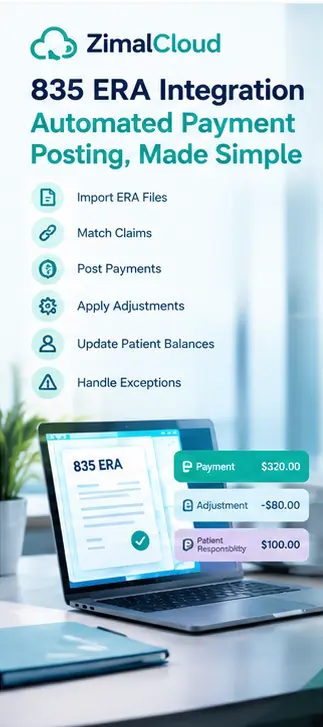
ERA Import
Receive and process electronic remittance transactions.
Claim Matching
Automatically identify the corresponding claim.
Payment Posting
Apply insurance payments to the appropriate claim.
Adjustment Posting
Record contractual and other applicable adjustments.
Patient Responsibility
Update the amount owed by the patient.
Exception Management
Route unmatched or unusual transactions for review.
Duplicate Detection
Help prevent the same payment from being posted multiple times.
Audit Trail
Maintain visibility into what was posted and when.
Reporting
Provide financial and payment-posting visibility for billing teams and practice managers.
Common Challenges With 835 ERA Integration
Although automation can simplify payment posting, implementation still requires careful configuration.
Common challenges include:
- Different payer formats and behaviors
- Incorrect payer mapping
- Claim matching failures
- Unexpected adjustment combinations
- Duplicate transactions
- Missing remittance information
- Incorrect posting rules
- Integration problems between systems
A strong implementation should therefore include validation, exception handling, testing, and monitoring.
How Automated Payment Posting Improves the Revenue Cycle
Payment posting is an important part of the healthcare revenue cycle because it connects payer adjudication with the practice's financial records.
A streamlined workflow can help practices move more quickly from:
Claim submission → Payer adjudication → 835 ERA → Automated payment posting → Adjustment reconciliation → Patient responsibility → Accounts receivable follow-up
This gives billing teams better visibility into what has been paid, what remains outstanding, and which claims need attention.
Best Practices for 835 ERA Automation
To get the most value from automated payment posting, medical practices should consider the following best practices:
1. Validate ERA Data
Do not automatically post transactions without appropriate validation rules.
2. Maintain Accurate Payer Mapping
Correct payer configuration is essential for reliable ERA processing.
3. Use Exception Work Queues
Unmatched and unusual transactions should be routed to staff instead of being forced through automation.
4. Monitor Posting Accuracy
Regularly compare posted transactions against payer and financial records.
5. Maintain Auditability
Keep a clear record of automated and manually adjusted transactions.
6. Review Denial and Adjustment Trends
ERA data can provide useful information for identifying recurring payment and denial patterns.
7. Integrate With the Broader RCM Workflow
ERA processing should not operate as an isolated function. It should connect with claims, billing, patient balances, accounts receivable, and reporting.
The Future of Automated Payment Posting
Healthcare revenue cycle management is increasingly moving toward automation.
Instead of treating payment posting as a standalone data-entry task, modern systems can connect:
Claims + ERA + EFT + Billing + Patient Accounts + Denial Management + Reporting
This creates a more connected revenue-cycle workflow.
Automation can handle repetitive transactions while billing professionals focus on exceptions, complex claims, payer issues, and revenue opportunities.
The goal isn't simply to post payments faster.
The goal is to create a more accurate, connected, and efficient revenue cycle.
Conclusion
835 ERA integration is an important component of automated healthcare payment posting.
By electronically processing remittance information, matching payments to claims, recording adjustments, updating patient responsibility, and routing exceptions for review, healthcare organizations can reduce repetitive manual work and improve financial visibility.
For medical practices and billing organizations, the combination of ERA automation, accurate claim matching, exception management, and integrated revenue-cycle workflows can create a more efficient path from payer adjudication to final account reconciliation.
Automated payment posting turns remittance data into actionable financial information—helping billing teams spend less time entering payments and more time managing the revenue cycle.
FAQ
Frequently asked questions
What is an 835 ERA?
An 835 ERA, or Electronic Remittance Advice, is a standardized electronic healthcare transaction that provides detailed information about how an insurance payer processed a claim, including payments, adjustments, patient responsibility, and other remittance details.
What is automated payment posting?
Automated payment posting is the process of electronically importing remittance information into a medical billing or practice management system and automatically applying payments, adjustments, and patient responsibility to the appropriate claims.
How does 835 ERA integration work?
835 ERA integration receives the electronic remittance from a payer, interprets the transaction, matches the remittance information to the appropriate claim, posts payments and adjustments, updates patient responsibility, and routes unmatched or unusual transactions for staff review.
What information is included in an 835 ERA?
An 835 ERA can include claim payment amounts, allowed amounts, contractual adjustments, patient responsibility, deductibles, coinsurance, copayments, denial information, adjustment codes, remark codes, service-line payment details, and payment references.
What are the benefits of automated 835 payment posting?
Automated 835 payment posting can reduce manual data entry, improve payment reconciliation, reduce data-entry errors, provide better claim payment visibility, and allow billing staff to focus on exceptions, denials, accounts receivable, and other revenue-cycle activities.
What is the difference between ERA and EFT?
EFT, or Electronic Funds Transfer, electronically moves payment funds from a payer to a provider's bank account. ERA, or Electronic Remittance Advice, explains how the payer processed the claim and how the payment and adjustments were calculated.
What are CARC and RARC codes in an 835 ERA?
CARC codes, or Claim Adjustment Reason Codes, explain why a claim or service-line amount was adjusted. RARC codes, or Remittance Advice Remark Codes, provide additional information about a payment or adjustment.
Can 835 ERA integration help with denial management?
Yes. ERA information can provide structured payment, adjustment, denial, and remark information that helps billing teams identify why claims were not paid as expected and prioritize appropriate follow-up.
Why is claim matching important for automated payment posting?
Accurate claim matching ensures that payments and adjustments are applied to the correct claim and patient account. Reliable matching helps reduce incorrect postings, duplicate transactions, and reconciliation problems.
What should a healthcare 835 ERA integration include?
A robust 835 ERA integration should support ERA import, claim matching, automated payment posting, adjustment posting, patient responsibility updates, duplicate detection, exception management, audit trails, and payment reporting.